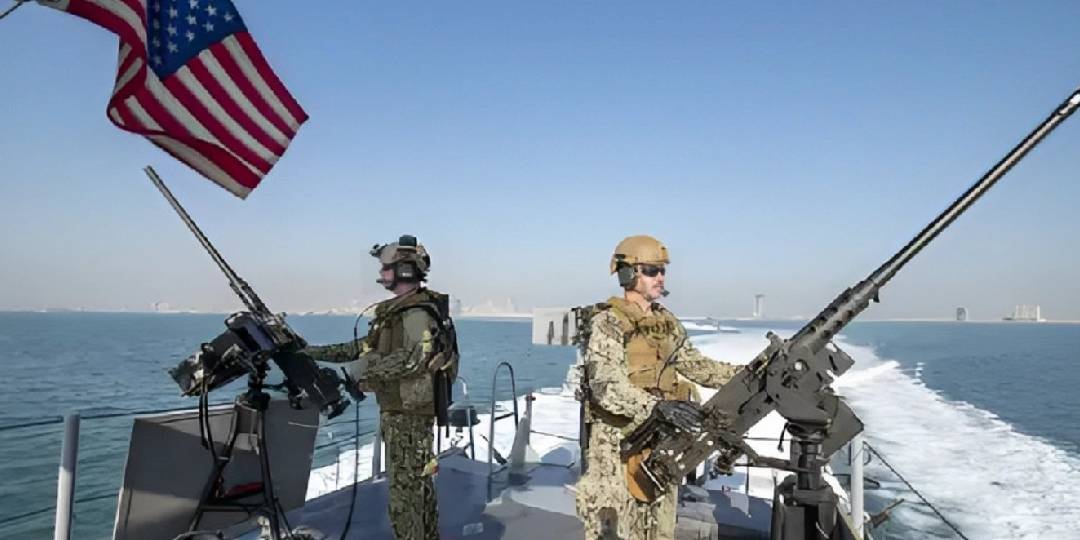

President Donald Trump confirmed today that the US military buildup in the region continues, warning Iran that attacks on American vessels executing Operation Inherent Resolve would result in Iran being “wiped off the face of the earth.” In a sharp retaliation, Iran’s military declared that Strait of Hormuz security is a “red line” and vowed to prevent American warships from entering the strategic waterway.
The dramatic escalation reflects a dangerous intensification of US-Iran tensions with direct implications for Arabian Gulf security and one of the world’s most critical shipping routes.
Trump confirms ongoing US military reinforcements in region
President Trump declared in statements to Fox News: “The US military buildup in the region is ongoing,” emphasizing that America possesses “weapons and ammunition far greater and far more advanced than anything we had before.”
Trump issued a stark warning to Iran: “Iran will be wiped off the face of the earth if they attack American ships executing Operation Inherent Resolve,” indicating that the US military buildup aims to protect navigation and American interests.
Trump also suggested Iranian flexibility in peace negotiations, stating “Either Iranians negotiate in good faith or we resume military operations,” underscoring Washington’s firm stance on deterrence.
Trump’s position on negotiations and deterrence
Trump outlined America’s approach:
“US military buildup in the region is ongoing”
“Iran has become more flexible in peace negotiations”
“Either Iranians negotiate in good faith or we resume military operations”
Emphasis on advanced weapons and superior military capability
US Central Command secures Hormuz passage and sustains blockade
Admiral Brad Cooper, commander of US Central Command, confirmed today: “We have opened a corridor in the Strait of Hormuz to secure navigation and continue enforcing blockade on Iranian ports.”
Cooper explained that “the Revolutionary Guard fired missiles and drones at commercial vessels and we provided protection,” noting that “Operation Inherent Resolve is a defensive operation and we have deployed destroyers equipped with ballistic missile defense systems.”
The commander stated that “no US Navy vessels have been struck” to date, asserting American operational success.
Details of US defensive operations
The Central Command reported:
Opening secure corridor in Strait of Hormuz for free navigation
Deployment of ballistic missile defense equipped destroyers
Protection of commercial shipping from Iranian attacks
Enforcement of naval blockade on Iranian ports
Iran’s military declares Hormuz security as non-negotiable red line
Major General Amir Hatami, commander of Iran’s military, declared emphatically: “Strait of Hormuz security is a red line for us,” signaling Iran will not tolerate American presence in the strategic waterway.
Hatami revealed a military encounter: “American destroyers attempted to approach the Strait of Hormuz with radar disabled, and our response came with missiles,” indicating direct armed confrontation between forces.
Hatami elaborated that “American destroyers attempted approach using radar deception tactics, but our response was with fire,” disclosing Iranian firing on US military vessels.
Iran’s military escalation in Hormuz
Iran announced:
Prevention of American warships from entering the strait after stern warning
Firing on American military naval vessels
Readiness for all scenarios in the waterway
Islamic Revolutionary Guard commitment to blocking US military passage
Conflicting narratives over clashes and incidents
Major discrepancies exist between American and Iranian accounts of Hormuz confrontations:
The US Central Command stated no American vessels sustained strikes, while Iranian media reported Iranian forces firing on American military vessels.
Iranian news agency Tasnim affirmed that “armed forces fired on American military naval vessels” and that “our forces will not permit American military passage as occurred during previous conflicts.”
The Islamic Revolutionary Guard emphasized that “there is no change in managing Strait of Hormuz” and vowed to “forcibly stop violating vessels.”
Iranian Revolutionary Guard’s position
The Guard stressed:
No change in Strait of Hormuz administration
Forcible interdiction of violating vessels
Complete readiness for all contingencies
Commitment to upholding red lines in the waterway
Strategic importance of Strait of Hormuz
The Strait of Hormuz represents one of the world’s most critical strategic waterways, with approximately one-third of seaborne traded oil passing through its waters.
The struggle for control of the strait occurs within broader US-Iran competition for regional influence and dominance over energy resources affecting global economies.
Potential risks to global shipping and commerce
The US-Iran escalation in Strait of Hormuz poses direct threats to:
Global commercial shipping and maritime trade
Global oil and energy prices
International economic stability
Regional security and neighboring states’ interests
Conclusion:
The current escalation between the United States and Iran over the Strait of Hormuz reflects dangerous levels of tension with potential consequences for regional and global stability. The sharp rhetoric from both sides underscores risk of further crisis escalation absent international diplomatic intervention to de-escalate tensions.