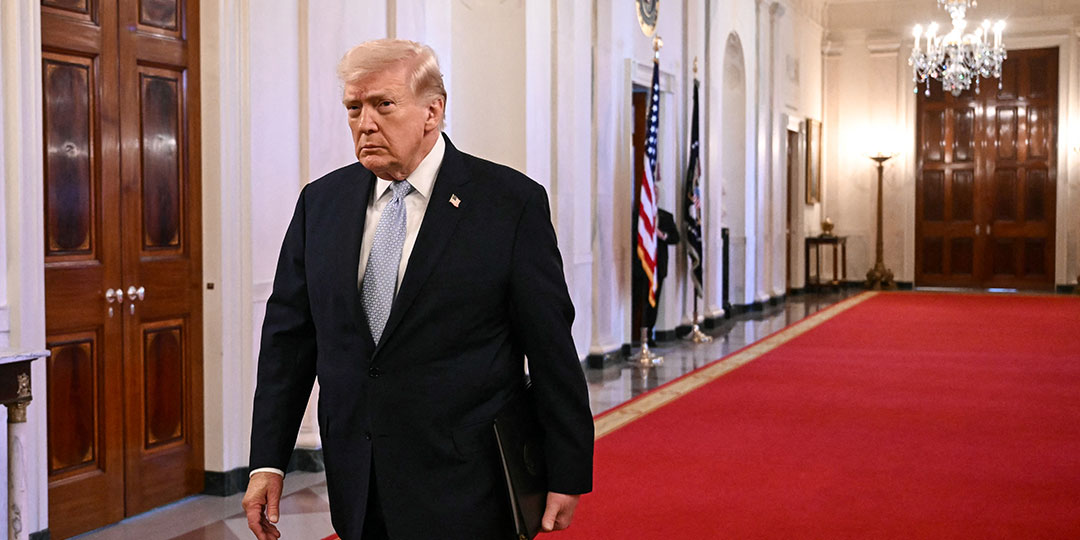

US President Donald Trump delivered a harsh and blunt attack on NATO members Friday, March 20, describing them as “cowards” for refusing to provide military assistance to secure the strategic Strait of Hormuz amid the ongoing war with Iran. The severe criticism came via Trump’s Truth Social platform, where the 79-year-old president declared that NATO without the United States is “a piece of paper tiger,” reflecting decades-long skepticism about the Western military alliance’s value and cohesion.
Simultaneously, NATO announced the complete withdrawal of all personnel from its Iraq mission, with the last non-combat contingent departing the country Friday evening. The withdrawal reflects deteriorating security conditions in Iraq resulting from the war, which erupted on February 28, 2026, when the United States and Israel launched operations against Iran. This coordinated attack on NATO by its own leader and the alliance’s rapid withdrawal from Iraq reveal a deeper crisis: the Middle Eastern conflict is splintering rather than unifying the Western alliance, exposing fundamental disagreements about who should bear the costs and risks of regional military engagements.
Trump’s Harsh Rhetoric: “Piece of Paper” and “Cowards”
The Provocative Truth Social Post
Trump used his Truth Social platform to launch pointed criticism directly at NATO. He wrote: “NATO without the United States is a piece of paper tiger.” The message was unmistakable: NATO members are weak without American protection and incapable of independent or effective action.
Trump continued: “Our allies don’t want to help open the Strait of Hormuz, which is a simple military maneuver and is the main reason for oil price increases. It’s easy for them to do it, with minimal risk.” He then concluded harshly: “Cowards, and we won’t forget!”
Contradictions in Trump’s Hormuz Strategy
Trump’s statements reveal a fundamental contradiction in his recent positions on the Strait of Hormuz. Previously, Trump declared that the United States does not need help securing the strategic waterway and is fully capable of doing so alone. Now he criticizes Western allies for not helping in this “simple military maneuver.”
This contradiction reflects a deeper truth: Trump wants allies to shoulder the burdens of war without consulting them first or considering their strategic preferences. He demands military contributions from NATO members without having sought their input on the broader strategy or whether they should be involved in this conflict.
Context: Trump’s Long-Standing NATO Skepticism
This attack is not Trump’s first assault on NATO. The American president has harbored doubts about the Western alliance for years. During his first term (2017-2021), he frequently accused NATO members of not paying their “fair share” in defense spending and accused them of relying too heavily on American security guarantees.
These statements reflect Trump’s broader philosophy: every alliance must pay for itself, and if the benefits don’t outweigh the costs, the United States might consider withdrawing. This raises serious questions about America’s long-term commitment to defending Europe, potentially undermining the entire post-World War II security architecture.
NATO’s Cautious Response: Conditional Commitment
Six Major Powers Announce “Willingness to Contribute”
In a rapid response to Trump’s rhetoric, six major powers announced Thursday, March 19 (hours before Trump’s harsh criticism), that they were “willing to contribute” to efforts to secure maritime navigation in the Strait of Hormuz. These countries included:
Britain: Europe’s closest ally to the United States
France: Europe’s most powerful military force and most independent in foreign policy
Germany: Europe’s leading economic power but historically reluctant in military matters
Japan: A key Asian ally of the United States
Two other unnamed countries
Cautious Wording: “Willingness” Rather Than “Commitment”
Notably, the response language was extremely cautious. The countries said they were “willing to contribute,” but with unspecified conditions:
When would this assistance be provided?
What exactly would such assistance entail?
What financial and military costs would be involved?
Would there be prior consultation before escalating operations?
This caution reveals that NATO members want to avoid direct involvement in a war that the United States initiated unilaterally without consulting them.
The Critical Point: Lack of Prior Consultation
Crucially, Trump did not consult any NATO members before launching the US-Israeli military operation against Iran. This reflects a persistent pattern in Trump’s foreign policy: making unilateral military decisions and then demanding that allies bear the consequences.
It stands to reason that NATO members would be hesitant to respond to requests for assistance when they were not included in the original decision. They were not invited to the table when the war began, yet they are now being asked to commit resources and risk their personnel and domestic political support.
The Strait of Hormuz: Vital Strategic Passage and Economic Chokepoint
Critical Importance for Global Energy
The Strait of Hormuz—the narrow passage between Iran and Oman connecting the Persian Gulf to the Gulf of Oman and Indian Ocean—handles approximately one-fifth (20%) of global crude oil and liquefied natural gas. This makes it arguably the world’s most critical maritime passage, directly affecting global energy prices and the global economy.
In times of peace, thousands of tankers pass through the strait annually. Since the war began February 28, Iran has effectively blockaded commercial shipping through:
Direct military threats through naval and air forces
Attacks on tankers and vessels
Mine-laying operations
Military positioning and shows of force
War’s Impact on Global Oil Prices
Crude oil prices have surged sharply since the war began. This surge reflects market fears of supply disruptions and inability to transport oil and natural gas through the Strait of Hormuz.
European economies, which depend heavily on energy imports, are directly affected. Rising energy prices drive up prices for all other commodities, causing inflation and placing pressure on governments as cost-of-living crises spread throughout their populations.
This reflects a bitter reality: a war in the Middle East affects all global economies, even those geographically distant from the conflict zone.
American Arguments: “Simple Military Maneuver”
Trump insists that securing the Strait of Hormuz is a “simple military maneuver” achievable with “minimal risk.” However, this assessment differs radically from evaluations by military analysts and strategic experts:
Geopolitical complexity: Iran is a nation-state with genuine military capabilities, not a weak non-state group
Military dangers: Any attempt to secure the passage could result in direct clashes with Iranian naval forces
Economic costs: Prolonged military operations require vast resources
Impact on allies: NATO members may reasonably conclude that the risk is not “minimal” to their national decisions
NATO Withdrawal from Iraq: Collapse of Diplomatic Pretense
Official Announcement: Safe Transfer but Real Withdrawal
NATO formally announced the withdrawal of all personnel from its Iraq mission. The statement employed careful language: “The mission adjusted its posture and relocated all its personnel safely from the Middle East to Europe.” The last NATO personnel departed Friday, March 20, 2026.
This careful wording attempts to minimize the withdrawal’s significance, but the reality is stark: NATO is leaving Iraq without direct advisory support for Iraqi forces amid an escalating regional war.
NATO’s Iraq Mission: Advisory and Training Role
NATO’s Iraq mission performed an advisory and training role, not direct combat operations. Established in 2018, it included “several hundred” personnel from NATO member states and partners (Australia and Austria). Its headquarters was located at an Iraqi military base in central Baghdad, near the American embassy.
This proximity to the US embassy was a strategic vulnerability. The embassy has faced multiple attacks by rockets and unmanned aircraft since the war began, and military camps housing forces aligned with various sides have exchanged attacks with increasing frequency.
Security Context: Israeli Airstrikes and Iranian Retaliation
Iraqi security officials described the withdrawal as “temporary,” but the term masks a broader reality. Since February 28, Iraq has become a secondary conflict zone where:
Airstrikes on Iran-aligned militias: American and Israeli forces have conducted strikes against Iranian-aligned armed group positions
Attacks on US interests: These militias have fired rockets and unmanned aircraft at American installations
Iranian strikes on Kurdish groups: Iranian forces have targeted Kurdish opposition groups in northern Iraq
This chaotic environment made Iraq dangerous for NATO’s non-combat personnel.
What the Withdrawal Means for Iraq
NATO’s departure means Iraq loses critical advisory support that was helping build the capacity of Iraqi armed forces and security institutions. This occurs precisely when Iraq needs such support most.
Iraqi forces now face mounting pressure from:
American and Israeli forces operating on Iraqi territory
Iran-aligned armed militia groups
Tensions between federal authorities and the Kurdish regional government
Atlantic Divisions: Is NATO Collapsing?
History of Internal Disagreements: Then and Now
NATO has faced internal challenges for years, with disputes over:
Military spending distribution: Trump frequently criticized NATO members for insufficient defense spending
Russia strategy: Some European countries prefer more pragmatic dialogue with Moscow
Military deployments in Eastern Europe: Divisions between threatened nations and distant members
The current Iran crisis exacerbates these existing tensions dramatically.
The Credibility Crisis
Trump’s repeated attacks on NATO allies create a credibility crisis. If the American president describes NATO members as “cowards” and the alliance as worthless without America, how can those allies trust American commitments in other security matters?
This is particularly damaging because NATO was built on mutual trust and shared commitment to collective defense. When the US president publicly disparages the alliance and its members, that trust erodes dangerously.
Implications for American Credibility
Historically, the United States committed to defending Europe through NATO. Trump’s rhetoric suggests those commitments may be conditional and revocable. This uncertainty may push European nations toward developing independent defense capabilities, which could fundamentally weaken NATO’s integrated command structure.
Broader Implications for Global Stability
Weakness of Western Alliances
The Middle Eastern war and Trump’s actions expose fundamental weakness in Western alliances. Rather than unifying around common challenges, Western nations appear:
Uncoordinated: No unified strategy exists among allies
Uncertain about American commitment: Trump’s rhetoric creates doubt about lasting US obligations
Divided on interests: Each nation pursues its own economic interests
Opportunities for Competitors: China and Russia
As Western nations fracture, China and Russia gain opportunities to expand influence. China builds economic partnerships throughout Asia and the Middle East, while Russia strengthens regional positioning.
American Responsibility
Trump bears direct responsibility for this situation. His decision to launch war against Iran without consulting allies, combined with subsequent attacks on those allies for failing to assist as he demands, reflects an approach that divides rather than builds coalitions.
The Oil Price Factor: Economic Leverage
Global Oil Markets Under Pressure
Oil prices have become a central factor in the dispute. Trump blames NATO for not helping secure the Strait of Hormuz, claiming this is the “main reason” for rising oil prices. While oil transport disruptions certainly contribute to price increases, the reality is more complex.
Rising oil prices result from market uncertainty about continued supply flows. Securing the strait would help, but it cannot solve the fundamental problem: a major war in the world’s most strategically important energy region creates inherent supply uncertainty regardless of military measures.
European Economic Impact
European economies face severe pressure from rising energy costs. This creates domestic political pressure on European governments to find solutions, but those solutions cannot be purely military. Europeans seek diplomatic resolutions alongside security measures—an approach Trump seems unwilling to pursue.
Conclusion:
Trump’s harsh attacks on NATO and the alliance’s simultaneous withdrawal from Iraq reveal a fundamental crisis in Western cohesion. The president’s criticism of allies for not helping in a war he started unilaterally, without consultation, exemplifies an approach that fragments rather than unifies.
The NATO alliance faces an existential question: Can it survive a US president who publicly calls it worthless and describes its members as cowards? Can European allies trust American security guarantees when the American president openly questions the alliance’s value?
History suggests that when great alliances fracture, the costs extend far beyond military calculations. The post-World War II international order, built on Western unity and American security guarantees, may be entering a new, more uncertain phase. Whether NATO survives this challenge—and in what form—will largely depend on whether cooler heads can prevail over the inflammatory rhetoric now dominating American foreign policy.