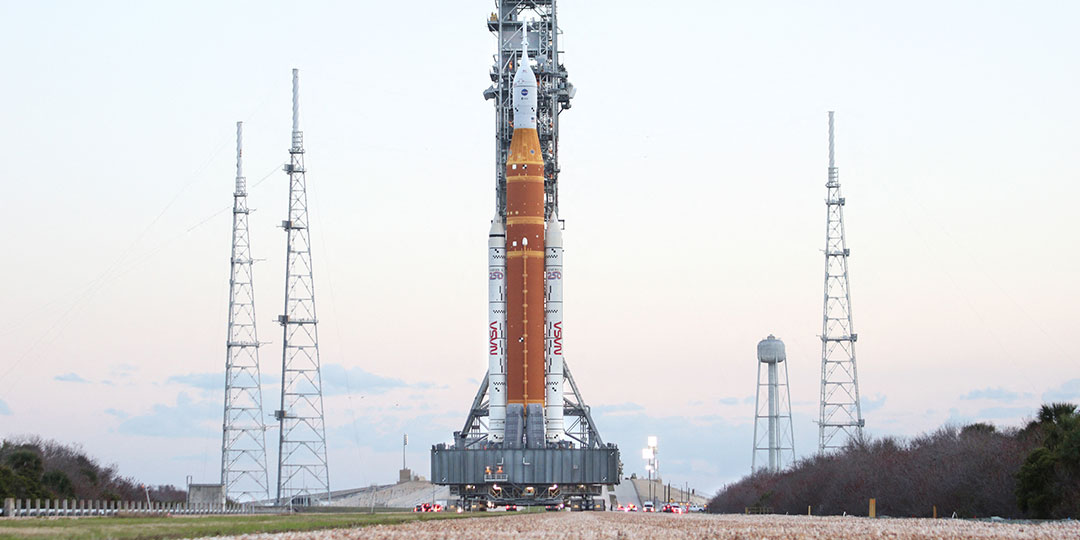

The National Aeronautics and Space Administration (NASA) began Thursday, March 20, moving the towering Space Launch System (SLS) rocket and Orion spacecraft to Launch Pad 39B at Kennedy Space Center in Florida. This critical logistical operation marks a significant milestone toward humanity’s return to the Moon, following successful completion of necessary repairs and systems testing.
The relocation paves the way for a potential launch on April 1, 2026, in what will be a historic moment for space exploration. Artemis 2 will carry a diverse crew of four astronauts—three Americans and one Canadian—on a 10-day journey into lunar orbit. This mission carries particular historical significance: it will include the first woman to travel beyond Earth orbit toward the Moon, the first astronaut of African or Asian descent to reach lunar distance, and Canada’s first astronaut to orbit the Moon. These milestones reflect how space exploration has evolved from the narrow parameters of earlier decades to embrace humanity’s full diversity.
The Technical Operation: Moving a Colossus
Twelve Hours of Precision Engineering
NASA engineers began the delicate operation at 8:00 PM Thursday evening, with the entire repositioning and preparation process expected to consume approximately 12 hours before final pre-launch procedures commence. This extended timeline reflects the extraordinary complexity of moving one of humanity’s most powerful and sophisticated machines.
The Space Launch System stands approximately 111 meters (364 feet) tall and weighs approximately 2.6 million kilograms (5.7 million pounds). Moving such a massive structure across the Kennedy Space Center requires specialized crawler-transporters, extensive preparation, and teams of specialized engineers who have trained for years to execute this precise operation. Every alignment must be perfect, every connection must be secure, every system must function flawlessly.
April 1, 2026: Target Date (Not Necessarily Final)
NASA has announced April 1, 2026, as the target launch date for Artemis 2. However, those familiar with the agency’s history understand that target dates should be treated with cautious optimism. The space program has a long track record of launch delays caused by technical challenges, weather, or additional testing requirements that emerge during final preparations.
Nevertheless, the movement to the launch pad represents a genuine commitment by NASA leadership to achieve the April launch window. The logistics, engineering, and personnel required to execute this relocation underscore the serious intent to fly this mission within the stated timeframe. Early spring represents an optimal launch window from both meteorological and orbital mechanics perspectives.
Artemis 2: The Diverse Crew and Mission Profile
A Crew Representing Global Humanity
The astronaut roster for Artemis 2 reflects intentional diversity and international cooperation:
Three NASA Astronauts: American space explorers representing decades of NASA training and experience in human spaceflight operations.
One Canadian Astronaut: Marking Canada’s first crewed participation in lunar-orbit operations, reinforcing the international character of modern space exploration.
The significance extends beyond mere representation:
First Woman: Will journey beyond Earth orbit, breaking a barrier that has existed since the Apollo era
First Astronaut of Color: Will participate in humanity’s return to lunar space, reflecting contemporary demographics of space-capable nations
First Canadian in Lunar Orbit: Expands the geographic scope of lunar exploration beyond traditional spacefaring powers
This diversity represents a deliberate shift in how space agencies conceptualize human spaceflight—no longer the exclusive domain of a narrow demographic, but genuinely inclusive of humanity’s full potential.
Ten Days Circling the Moon: Science and Preparation
The 10-day mission profile focuses on lunar-orbit operations rather than landing. During this extended period, the Orion spacecraft will circle the Moon multiple times, enabling:
Extensive Systems Testing: Verify that all life support, power, propulsion, and communication systems function correctly with human operators aboard in the actual lunar environment.
Radiation Data Collection: Measure radiation exposure in the space between Earth and Moon, crucial data for protecting future lunar surface missions and eventual Mars expeditions.
Landing Site Assessment: Photography and sensor data collection of proposed landing sites for Artemis 3, including the lunar south polar region where ice deposits may exist.
Psychological Evaluation: First-hand assessment of how human crews respond psychologically and physiologically to extended spaceflight and lunar proximity.
The Artemis Program: Three-Phase Return to the Moon
Phase One (Artemis 1): Uncrewed Test Flight
NASA announced the Artemis program in 2019 with an explicit three-phase approach:
Artemis 1 (Completed): An uncrewed test flight that demonstrated the SLS rocket and Orion spacecraft could successfully journey to the Moon and return to Earth. This proved critical technologies functioned as designed, validating the fundamental engineering approaches.
Phase Two (Artemis 2): Crewed Lunar Orbit Mission
Artemis 2 (Current): The crewed mission to lunar orbit represents the essential bridge between technological validation and the ultimate goal. This flight tests human-rated systems with actual astronauts aboard, providing invaluable data about real-world performance under conditions no ground simulation can perfectly replicate.
Artemis 2 answers critical questions: Can the spacecraft sustain human life during the three-day journey to the Moon? How do systems perform in actual space radiation environments? What unexpected challenges emerge when humans interact with spacecraft in real lunar space rather than simulators?
Phase Three (Artemis 3): Lunar Landing and Beyond
Artemis 3: The ultimate goal—landing astronauts on the Moon’s surface, particularly the south polar region where water ice deposits have been detected. This mission seeks to:
Establish surface operations infrastructure
Extract and analyze lunar water ice
Conduct detailed geological surveys
Prepare for permanent lunar presence
Beyond the Moon lies Mars. The entire Artemis architecture functions as a stepping-stone toward eventual human Mars exploration, utilizing lunar operations as testing ground for technologies and procedures necessary for deep-space missions.
A History of Delays: NASA’s Long Struggle
The Artemis 2 Postponement Timeline
NASA has repeatedly postponed Artemis 2 over the past several years, citing various technical challenges:
Hardware Issues: Problems with thermal protection systems, avionics, and structural components required extensive redesign and retesting.
Supply Chain Disruptions: Global manufacturing challenges affected component availability and integration schedules.
Quality Assurance Requirements: Each discovered issue triggered additional testing protocols to ensure mission safety.
Budget Constraints: Developing entirely new launch systems costs tens of billions of dollars, creating competing demands on NASA’s annual appropriations.
Realistic Assessment of the April Target
While NASA has committed to April 2026, experienced space observers acknowledge that this represents an optimistic timeline. Launch delays of months or even a year would not represent failure—the Apollo program experienced numerous schedule adjustments before humans reached the Moon. What matters most is ensuring that when Artemis 2 launches, it carries a crew safely to lunar orbit and back home.
Technical Considerations and Remaining Challenges
Final Testing Requirements
Before launch, NASA must complete several critical validation tests:
Integrated Systems Testing: Verification that all rocket stages, spacecraft systems, and ground infrastructure function together without conflicts or failures.
Abort System Validation: Ensuring that emergency procedures can safely return astronauts to Earth if problems develop during launch or ascent.
Environmental Monitoring: Confirming that the spacecraft meets thermal, acoustic, and vibration specifications within acceptable margins.
Crew Procedures Validation: Final rehearsals by the astronaut crew of all normal and emergency procedures they may encounter.
SpaceX Competition and Alternative Architectures
Recent reports from Bloomberg indicate NASA is evaluating alternative launch architectures that could employ SpaceX’s Falcon Heavy rocket to launch Orion, with on-orbit rendezvous with Starship acting as a higher-stage vehicle. This proposed modification could reduce costs and accelerate launch timelines.
However, such changes face congressional opposition from lawmakers representing districts where SLS manufacturing occurs. NASA Administrator Jared Isaacman is scheduled to meet with stakeholder companies on Tuesday, March 26, to discuss potential modifications to the Artemis architecture.
Political Context: Trump’s Space Ambitions
Returning to the Moon as Presidential Priority
President Donald Trump has made returning Americans to the Moon a cornerstone of his administration’s space policy. This represents both scientific aspiration and geopolitical competition. China and Russia pursue their own lunar programs; Trump views American lunar dominance as essential to maintaining technological leadership.
Beyond the Moon: Mars as the Horizon
The genuine objective transcends ceremonial lunar landings. Trump administration officials and NASA leadership envision:
Permanent Lunar Base: Sustained human presence supporting scientific research and resource extraction
In-Situ Resource Utilization: Using lunar water and minerals to support future exploration
Mars Gateway: Establishing the Moon as a staging point for human Mars expeditions
These ambitions require testing every technology and procedure on the Moon before risking human lives on the multi-year Mars journey.
Geopolitical Dimensions
Space exploration has always carried strategic implications. American leadership in space symbolizes broader technological and economic dominance. Trump’s emphasis on lunar return aims to reinforce American preeminence in spacefaring capabilities.
Economic and Scientific Implications
Massive Investment, Substantial Returns
The complete Artemis program carries an estimated cost of tens of billions of dollars. Supporters argue that returns—measured in technological advancement, scientific knowledge, and strategic positioning—justify the investment.
NASA spinoff technologies have historically yielded significant returns:
GPS and Communications: Derived from space program technologies
Materials Science: Advanced composites, polymers, and alloys
Medical Devices: Diagnostic equipment and monitoring systems
Energy Technology: Photovoltaic panels and power systems
The investment in Artemis similarly promises technological breakthroughs with applications across multiple industries.
International Competition in Space
China, Russia, India, Japan, and private companies all pursue lunar exploration programs. The new space race appears more competitive and multipolar than the Cold War-era competition. American success in Artemis reinforces broader assertions of technological leadership.
Human Dimensions: What Artemis Means
Breaking Historical Barriers
For the women, people of color, and Canadians selected for Artemis crews, participation carries profound personal significance. These astronauts represent millions of people historically excluded from space exploration. Their journey toward the Moon symbolizes expanded possibilities for future generations.
Inspiration and Scientific Curiosity
Throughout history, great exploration missions have inspired scientific interest among youth. The Apollo program generated decades of increased STEM education participation. Artemis, with its diverse crew and inspiring mission profile, similarly promises to inspire the next generation of scientists, engineers, and explorers.
The Path Forward: Challenges Ahead
Engineering Complexity Never Decreases
Despite extensive preparation, surprises inevitably emerge during actual spaceflight. No amount of ground testing perfectly replicates the actual space environment. Artemis 2 will encounter unexpected challenges that the crew must solve in real time using training and ingenuity.
The Ultimate Question
Will Artemis succeed in returning humans to the lunar neighborhood safely? The technical systems appear sound. The engineering appears robust. The preparations appear thorough. But spaceflight inherently carries risk. That’s precisely what makes achievement so meaningful.
Conclusion:
The movement of the Space Launch System rocket and Orion spacecraft to Launch Pad 39B represents a pivotal moment in America’s return to the Moon. After years of technical challenges, budget debates, and postponements, NASA and its contractors approach the threshold of a historic mission that will expand human presence beyond Earth orbit for the first time in fifty years.
Artemis 2 in April 2026 will not merely represent a technological achievement, though it certainly represents that. It will symbolize humanity’s continuing aspiration to explore, to reach beyond current boundaries, to embrace our full diversity in pursuing common goals. Whether the April launch date proves realistic matters less than the genuine commitment to achieving this mission safely and successfully.
The Moon awaits. This time, humanity returns not just to visit, but to stay.