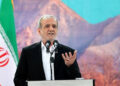

Iranian President Masoud Pezeshkian said on Monday that the supreme leader is in full health, adding that he had met him for several hours to discuss key domestic issues, including living conditions, employment and housing.
Pezeshkian said the meeting lasted about seven hours and that the supreme leader listened comfortably to the concerns and problems raised during the discussion.
Talks with the supreme leader
The president said the meeting covered a wide range of current issues in Iran, with particular focus on people’s living conditions, job creation and housing shortages.
He also said the discussions dealt in detail with the impact of sanctions, and with how the government and the public can endure them while maintaining unity and cohesion.
Emphasis on unity and cohesion
Pezeshkian said one of the main recommendations made by the supreme leader during the meeting was the importance of preserving unity and cohesion.
He said what he described as the enemy’s plans were focused on creating division and discord, and urged Iranians to avoid any speech or action that could undermine national unity.
New military appointments
In a separate development, Iran’s supreme leader issued orders appointing a number of senior military commanders, according to the Iranian news agency.
Brigadier General Ali Abdollahi was named chief of staff of the armed forces, while Brigadier General Kioumars Heidari was appointed deputy chief of staff.
Changes in the Revolutionary Guard and Basij
Brigadier General Ahmad Vahidi was appointed commander of the Islamic Revolutionary Guard Corps after being promoted to major general, while Major General Mostafa Izadi became deputy commander-in-chief of the Revolutionary Guard.
The agency said Admiral Ali Azmayi was appointed commander of the Revolutionary Guard Navy, and Hossein Taeb was named head of the Basij, Iran’s paramilitary volunteer force.
Strengthening deterrence
The supreme leader, according to the agency, said the continuous and comprehensive development of military capabilities is intended to strengthen deterrence and readiness for offensive operations against the enemy.
He stressed the need to further develop the defensive and security capabilities of the armed forces and Basij so they can respond effectively to military, hybrid and cognitive threats.
Completing military integration plans
The supreme leader also said the process of integrating the General Staff and Khatam al-Anbiya Headquarters should be completed in line with the directives of the late leader.
Conclusion:
The president’s remarks on the supreme leader’s health, together with the new military appointments, highlight Iran’s continued focus on internal cohesion and military preparedness. The messages from Tehran suggest that deterrence, unity and institutional readiness remain central priorities.