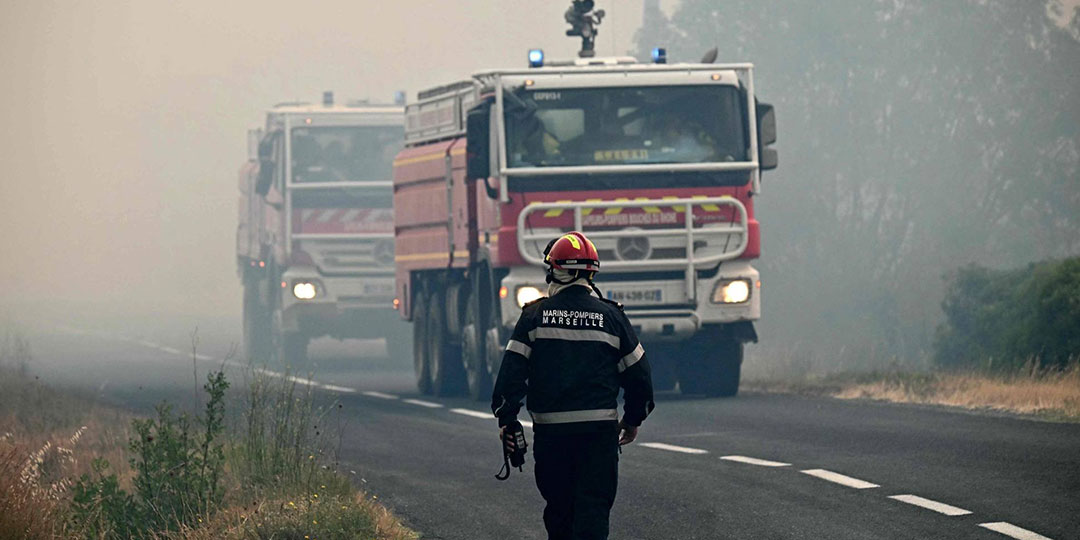

Massive wildfires are continuing to spread across Andalusia in southern Spain after a major blaze broke out in Huelva province on Thursday, with firefighters racing to contain the flames and prevent them from reaching more residential areas.
Local authorities said the fire has burned through an estimated 20,000 hectares, or about 200 square kilometres, although the full extent of the damage is still being assessed as the blaze remains active.
Hundreds evacuated as authorities prioritise safety
Andalusia’s interior minister, Antonio Sanz, said the fire is currently “beyond the capacity” of the fire services to extinguish, adding that this is not due to a lack of resources but to the “extreme and unexpected force of the flames.”
He said the main priority is now to protect people, adding that 479 residents were evacuated as a precaution.
Large-scale firefighting operation
Around 600 firefighters are continuing to battle the flames near the small town of Niebla, about 60 kilometres west of Seville.
More than 20 aircraft and helicopters have also been deployed to support the firefighting effort in the forested and mountainous area, where access remains difficult in some places.
Wildfires also hit southern France
In a separate incident, a fast-moving forest fire in southern France prompted the deployment of more than 200 firefighters and the evacuation of residents.
The fire began around 12:45 p.m. local time in the Lozère region, about 140 kilometres northwest of Montpellier, and officials said it may have started after a vehicle caught fire on a local road.
Fire contained in parts of France
The blaze spread across roughly 153 hectares, with 270 firefighters from Lozère and nearby areas backed by four Canadair water-bombing aircraft and one Dash aircraft.
A fire service spokesperson in Lozère said the combined response helped contain the fire and save two homes that had been directly threatened. Work is now focused on the fire’s front, where access remains difficult.
Precautionary evacuations and warnings
As a precaution, two small villages in the commune of Latiol were evacuated. Local authorities also urged residents not to call emergency services just to report the fire, warning that doing so could put extra pressure on crews already fighting the blaze.
Officials said the area is heavily forested and extremely dry, with conditions they have not seen for a long time.
Heatwave and climate change raise the risk
Europe is experiencing a searing summer heatwave that is increasing the risk of wildfires, while scientists say human-caused greenhouse gas emissions are making extreme weather events more intense and more frequent.
This has made wildfires an increasingly recurring threat across southern Europe, especially in areas where drought and high temperatures allow flames to spread rapidly.
Conclusion:
The massive wildfires in Andalusia show the scale of the challenge facing Spanish authorities amid drought and extreme heat, with evacuations continuing and firefighting reinforcements working around the clock. Similar fires in southern France underline the wider environmental risks facing Europe this summer.