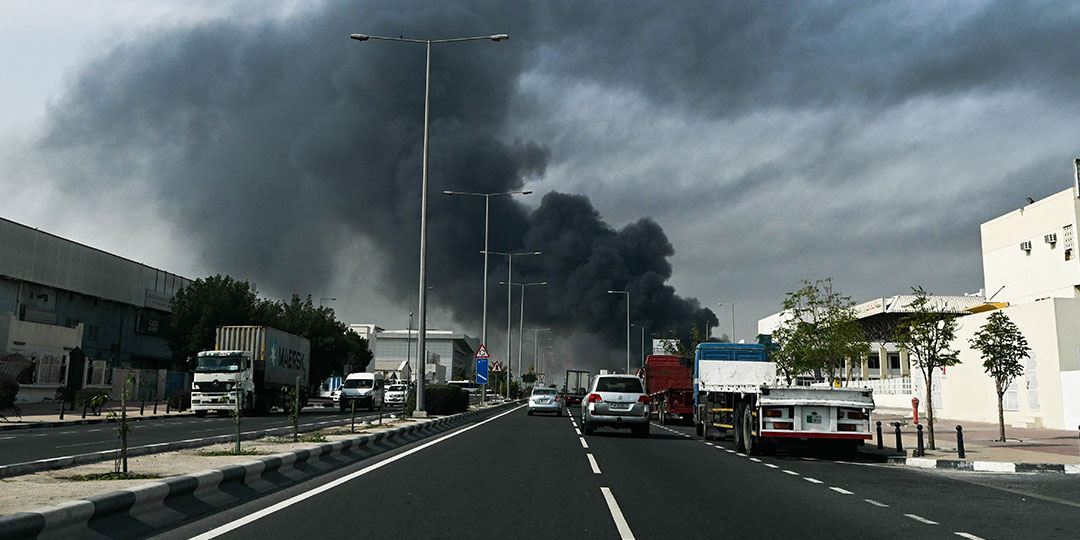

Dense clouds of black smoke billowed into the sky over Qatar’s capital Thursday as the country’s air defense systems intercepted a new Iranian missile strike, according to Agence France-Presse correspondents on the ground. Qatar announced that its air defenses were actively countering the missile attack on the sixth consecutive day of Iranian bombardment targeting Gulf states in retaliation for American-Israeli military strikes on Iranian territory.
Qatar’s Defense Ministry issued an official statement confirming that “the State of Qatar came under a missile attack” and that “air defense systems are countering the missile strike.” The ministry did not specify in its initial statement the number of missiles intercepted or potential casualties.
Qatari authorities imposed immediate precautionary measures including the evacuation of residents living near the US Embassy in Doha, reflecting a sharp escalation in the security threat facing the capital and the broader Gulf region.
Air Defense Systems Engage as Multiple Explosions Rock Doha
An AFP correspondent positioned in Doha reported witnessing at least one column of black smoke rising over multiple areas of the capital Thursday following the Iranian missile attack. Journalists heard sounds of multiple consecutive explosions across different parts of the city, indicating active engagement by Qatar’s air defense system.
The correspondent noted that the explosions were powerful and audible across wide areas of the capital, with visible pressure waves detected from several observation points. The sounds indicated that Qatar’s air defenses were intercepting incoming missiles before they reached civilian targets.
Qatar Defense Ministry Confirms Missile Interception Operations
Qatar’s Defense Ministry issued an official statement Thursday confirming that “the State of Qatar came under a missile attack” and that “air defense systems are countering the missile strike.” The immediate statement indicated an organized and rapid activation of Qatar’s complete air defense network.
The statement came as Iran continued on the sixth day of its attack campaign on Gulf states using both ballistic missiles and unmanned aerial vehicles, targeting military installations, government facilities, and strategic infrastructure across the region.
Direct Strike on Al-Udeid American Military Base
Earlier Thursday, an Iranian ballistic missile struck the Al-Udeid American military base located 40 kilometers southwest of Doha with a direct hit. Qatar’s Defense Ministry formally announced the direct strike on the military installation in a separate statement.
The Al-Udeid base serves as a major hub for American military operations in the Middle East and has been among the primary targets in Iran’s missile campaign across the Gulf. The strike demonstrated Iran’s capability to target major military installations with high precision.
Qatar Successfully Thwarts Attacks on Civilian Infrastructure
Qatar announced the successful thwarting of attacks on civilian installations, particularly Hamad International Airport, the country’s main civilian aviation hub. The successful defense of airport infrastructure prevented potential disruption to air traffic operations and civilian activities.
Qatar’s Defense Ministry’s ability to intercept incoming missiles before they struck civilian targets demonstrated significant success for Qatar’s air defense capabilities under sustained Iranian bombardment.
Immediate Evacuation Orders Near US Embassy
In response to escalating missile strikes, Qatari authorities announced the immediate evacuation of residents living near the US Embassy in Doha. Qatar’s Interior Ministry issued an official statement on the X platform announcing that “competent authorities are evacuating residents living near the American Embassy as a temporary precautionary measure.”
The ministry committed to “providing alternative accommodation” for evacuated residents, while urging all citizens and residents to remain indoors and in buildings and avoid unnecessary travel except when absolutely required.
Government Safety Directives and Precautionary Measures
Qatar’s Interior Ministry previously issued directives instructing all residents to remain in homes and buildings and avoid venturing outside except when absolutely necessary. The directives reflected the ongoing security threat posed by continued Iranian attacks on the capital.
The government’s activation of emergency protocols and evacuation procedures indicated official recognition of the serious and immediate danger posed by the Iranian missile campaign to civilian populations in Doha.
Sixth Consecutive Day of Iranian Attack Campaign on Gulf Region
Thursday’s Doha explosions marked the sixth consecutive day of Iranian strikes on Gulf states. The sustained campaign demonstrated Iran’s commitment to a prolonged retaliation against American-Israeli military action on Iranian soil that began last Saturday.
Iranian forces have launched successive waves of ballistic missiles and unmanned aircraft at targets across Qatar, Bahrain, the United Arab Emirates, and Kuwait. The broad geographic scope and sustained intensity of the campaign indicate a coordinated strategy targeting multiple countries simultaneously.
Regional Escalation and Continued Threat of Further Attacks
Gulf states remain on maximum alert as Iran signals its intention to continue retaliatory strikes in response to American-Israeli military actions. Iranian officials have announced plans for additional waves of attacks if American-Israeli military operations continue.
The situation represents an unprecedented level of direct Iranian military action against Arab Gulf states, with expectations among regional analysts and governments of sustained escalation in coming weeks.
Conclusion
Thursday’s Doha explosions and Qatar’s active defense against Iranian missile strikes highlight the escalating military threat facing the Gulf region. The successful interception of missiles by Qatar’s air defense systems prevented what could have been more catastrophic outcomes, yet the continued bombardment forced authorities to evacuate residents near critical diplomatic facilities. As Iran signals its intention to sustain its retaliation campaign, Gulf states face a period of prolonged security challenges and potential for further military escalation in the coming weeks.