
US President Donald Trump intensified threats against Iran on Sunday, specifically targeting Tuesday for comprehensive strikes on the nation’s bridges and power stations if Tehran does not immediately reopen the strategic Strait of Hormuz. The ultimatum came hours after the military announced the rescue of a second American pilot missing since Friday when his F-15E fighter jet crashed over southwestern Iran, though the rescued airman sustained “severe injuries” according to updated military statements. In response, Iran launched a wave of drone and missile attacks against Gulf energy facilities, signaling its firm rejection of American demands.
The parallel developments mark a critical juncture in the sixth week of conflict, with escalating military operations on multiple fronts replacing any possibility of rapid diplomatic resolution. Both sides appear committed to escalatory trajectories, suggesting the coming hours will prove decisive in determining whether the regional conflict expands into even more destructive phases.
Trump’s Specific Tuesday Deadline and Infrastructure Threats
Trump posted a direct threat on his Truth Social platform stating: “Tuesday will be the day for power plants, the day for bridges, all together in one package, in Iran. There will be nothing like it!!!”
In starkly harsher language, the President added: “Open the damn strait, you crazy bastards, or you will live in hell.”
The Tuesday-specific threat represents significant escalation beyond the earlier 48-hour ultimatum issued Saturday. Rather than providing negotiation time, Trump now names a precise date for comprehensive infrastructure bombing, targeting utilities critical to Iranian civilian populations and economic function.
The Second Pilot Rescue and Severity Reassessment
Trump announced the rescue of the second pilot from the F-15E crew in dramatic terms, stating: “In recent hours, the American military conducted one of the boldest search and rescue operations in United States history, to help one of our remarkable personnel, a highly respected colonel.”
He emphasized: “This is the first time American pilots have been rescued in two separate operations in the heart of hostile territory.”
However, military assessments shifted significantly when Trump later acknowledged the rescued pilot suffered “severe injuries,” contradicting his initial statement that the airman was “safe and well.” Trump announced a press conference with military officials at the White House on Monday at 1 PM GMT to provide operational details.
The F-15E fighter jet crashed in southwestern Iran on Friday after both pilots ejected. Iran claimed its air defenses shot down the aircraft. The second pilot’s rescue involved an abandoned airfield in southern Isfahan Province and required extensive special operations involvement.
Iran’s Military Rejection and Retaliatory Strikes
Rather than yielding to American pressure, Iran responded with wide-scale military operations targeting Gulf energy infrastructure. Kuwait announced that multiple facilities of the National Petroleum Company and petrochemical manufacturing plants came under drone attack, resulting in “severe material losses.”
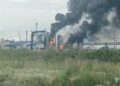
These strikes followed earlier attacks on two Kuwaiti power generation and water desalination plants. The United Arab Emirates announced its air defenses “engaged incoming rocket attacks and drones from Iran,” while fires broke out at the Brouj petrochemical facility in Abu Dhabi.
In Bahrain, a government energy company reported a fuel tank fire from an Iranian drone strike that was “completely extinguished.” Bahrain’s National Communication Center announced defensive systems “intercepted and destroyed 13 drones targeting Bahrain over the past 24 hours.”
In an official statement, Iranian forces claimed targeting aluminum manufacturing plants in the UAE and American military positions in Kuwait. Air raid sirens sounded across Israel as the military reported intercepting Iranian rocket attacks.
Iran’s Explicit Rejection and Counter-Threats
Iran’s Central Armed Forces Command categorically rejected Trump’s Saturday ultimatum, describing it as “an action of desperation, tension, imbalance, and stupidity.”
The commander of Khatam al-Anbiya Central Headquarters, Major General Ali Abdullah Ali Abadi, responded directly to the American President: “The gates of hell will open upon you.”
Sultanate of Oman announced it was hosting discussions between Tehran and foreign interlocutors to “explore possible options regarding ensuring smooth passage through the Strait of Hormuz during these circumstances affecting the region,” suggesting limited diplomatic channels remain active despite escalating rhetoric.
Israeli Defense Minister Pledges Continued Assassinations and Targeting
Israeli Defense Minister Yisrael Katz committed to sustained operations against Iranian leadership, stating: “As long as rockets continue to be fired and Israeli civilians remain targeted, Iran will pay an exorbitant price that will lead to… paralysis of national infrastructure and operational capabilities.”
Katz added: “Simultaneously, we will continue pursuing and neutralizing terrorist leadership, striking security targets and strategic resources throughout Iran.”
Prime Minister Benjamin Netanyahu congratulated Trump on the rescue operation, declaring: “Congratulations, President Trump! All Israelis rejoice at the remarkable rescue of a brave American pilot by America’s brave warriors. This operation reinforces a sacred principle: no one is left behind.”
Iranian Leadership Assassinations and Escalating Targeting Strategy
US-Israeli strikes since February 28 have resulted in deaths of numerous high-ranking Iranian political and military leaders, including Supreme Leader Ayatollah Ali Khamenei. Strikes have targeted industrial facilities, critical bridges, and civilian infrastructure across Iran.
Iran’s military claimed the pilot rescue operation “failed” and asserted it shot down four American military aircraft. Local media reported that strikes accompanying the rescue effort resulted in five deaths. In northwestern Iran, US-Israeli strikes killed five Revolutionary Guard members according to official Iranian news agency IRNA. Additional strikes targeted an airfield in Ahvaz city in southwestern Iran.
Regional Expansion into Lebanon and Diplomatic Breakdown
The conflict has expanded significantly into Lebanon where Lebanese President Joseph Aoun called for negotiations with Israel to prevent “southern Lebanon from becoming like Gaza,” amid ongoing Israeli airstrikes on southern villages. Aoun reported casualty counts exceeding 1,400 dead and 4,000 wounded.
Israel conducted fresh airstrikes on southern Beirut suburbs on Sunday, with the military stating it was striking Hezbollah targets. The Lebanese Health Ministry announced at least four dead and 39 wounded from a strike on the Janah area near Rafik Hariri University Hospital, Lebanon’s largest government medical facility.
In southern Lebanon, seven people including six family members died in a single Israeli airstrike. Israel threatened Sunday evening to attack the Masnaa crossing, the main Lebanese-Syrian border crossing, claiming Hezbollah uses it for weapons smuggling.
The Syrian border crossing appeared nearly abandoned Monday morning with minimal guard presence, according to Reuters correspondents.
Humanitarian Crisis and Internet Blackout Deepens
Iran entered its 37th consecutive day of internet outage that began over a month ago. NetBlocks internet monitoring organization announced this represents “the longest internet blackout ever recorded in any country,” exceeding all prior similar incidents with 864 hours of sustained disconnection.
Within Iran, authorities executed two individuals Sunday convicted of working for Israel and the United States during recent 2026 protests. The executions signal intensified internal security measures amid ongoing external military pressure.
Global Economic Implications and Oil Market Volatility
As global oil prices rise due to the conflict, principal OPEC+ members discussed production quotas for coming months on Sunday amid market disruption caused by Middle Eastern warfare. Iran’s effective blockade of the Strait of Hormuz represents a genuine global economic crisis affecting international energy security.
The 48-Hour Window Approaching Expiration
Trump’s initial 48-hour ultimatum issued Saturday approaches expiration with no Iranian capitulation or substantive movement toward reopening the strait. The President has now specified Tuesday as the bombing date rather than offering extended negotiation windows, suggesting American military planning has already commenced for comprehensive infrastructure strikes.
Since the conflict began February 28, no American servicemen have been killed or captured in Iran, though 13 US military personnel have died in Kuwait, Saudi Arabia, and Iraq.
Conclusion:
The escalation pattern reflects complete breakdown of diplomatic channels between American and Iranian leadership. With Tuesday’s deadline approaching, the Middle Eastern region faces imminent large-scale strikes targeting critical infrastructure. Iran’s firm rejection of ultimatums and continued retaliation against Gulf energy facilities suggests neither side contemplates near-term compromise. The rescue of two American pilots, while tactically significant, has not moderated Trump’s military threats or altered the conflict trajectory. As the sixth week progresses, global economic consequences from Strait of Hormuz disruption compound alongside expanding military operations in Lebanon and elsewhere. The coming 48 hours will likely prove decisive in whether this conflict enters an even more destructive phase affecting regional and global stability.