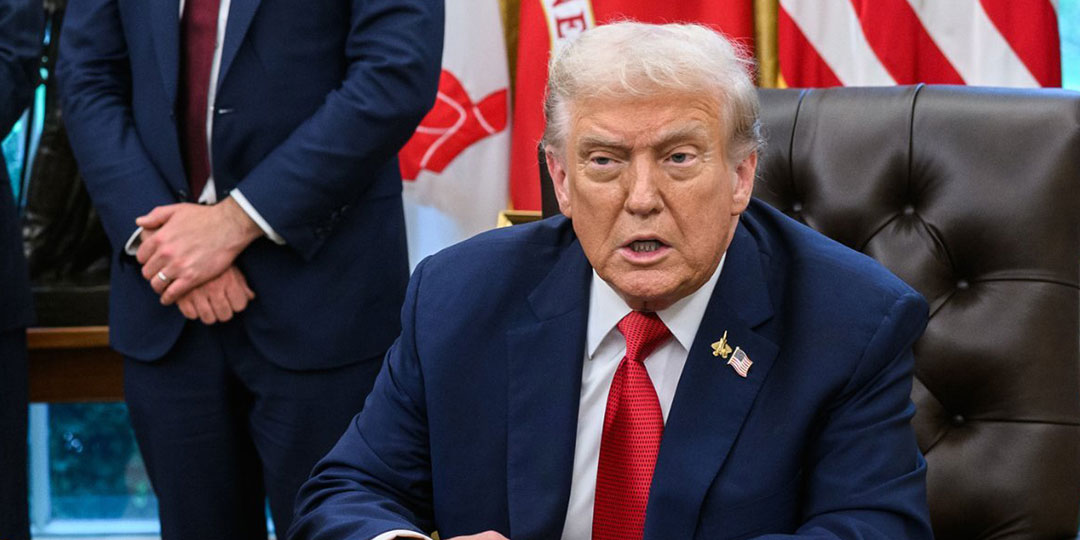

US President Donald Trump said on Wednesday that no funds have been released from Iranian assets, amid ongoing diplomatic developments related to the Strait of Hormuz and US-Iran agreements.
His remarks come as Washington reiterates its opposition to any transit fees in the strategic waterway, while regional actors continue discussions on maritime arrangements.
Trump: No Funds Released to Iran
Speaking to reporters, Trump stated that “no money has been given to Iran or released from their assets in the United States.”
He added that Iran had informed Washington that “no fees are required for passage through the Strait of Hormuz,” and said any Iranian funds would be used “only for American products.”
The comments appear to address speculation surrounding financial aspects of recent US-Iran understandings.
Direct Communication Channel Confirmed
In a related development, Pakistan’s Foreign Ministry spokesperson Tahir Andrabi confirmed that the agreement between Washington and Tehran includes a direct communication line.
He said the arrangement aims to “prevent misunderstandings,” adding that Pakistan is maintaining contact with both sides to ensure effective implementation of the memorandum of understanding.
US Rejects Transit Fees in Strait of Hormuz
US Secretary of State Marco Rubio reaffirmed Washington’s position rejecting any attempt to impose transit fees in the Strait of Hormuz.
Speaking to journalists during a visit to Abu Dhabi, Rubio said:
“The Strait of Hormuz is an international waterway. No country is allowed to impose fees or charges on an international passage.”
He emphasized that this principle is consistent with international law and applies to all maritime routes worldwide.
Regional Discussions on Future Navigation
Rubio’s remarks followed a joint announcement by Oman and Iran that they will work toward an agreement on the future management of navigation in the Strait of Hormuz, including services and related costs.
The statement noted that both countries agreed to continue dialogue through a joint working group to establish a framework aligned with international standards.
Gradual Return of Maritime Traffic
Following recent disruptions caused by the conflict, maritime traffic in the Strait of Hormuz has begun to recover gradually.
According to shipping data platform Kpler, at least 36 vessels transited the Strait on Monday, marking the highest level of activity since the start of the crisis. This figure represents roughly one-third of normal peacetime traffic, which averages about 120 vessels per day.
Meanwhile, the International Maritime Organization announced plans to evacuate more than 11,000 stranded seafarers in the Gulf due to earlier disruptions.
Strategic Importance of the Strait
The Strait of Hormuz remains one of the world’s most critical maritime chokepoints, with a significant share of global oil and gas shipments passing through it.
Stability in the Strait directly impacts:
– Global energy markets
– Supply chains
– Regional security
– International trade flows
Key Points
– Trump denies any release of Iranian assets
– US rejects transit fees in the Strait of Hormuz
– Pakistan confirms direct US-Iran communication channel
– Oman and Iran discuss future navigation management
– Maritime traffic shows signs of recovery
– Over 11,000 seafarers to be evacuated
Conclusion
Trump’s statements and US policy positions highlight ongoing efforts to manage tensions in the Strait of Hormuz while maintaining freedom of navigation. As diplomatic engagements continue and maritime activity resumes, the Strait remains central to both regional stability and global energy security.