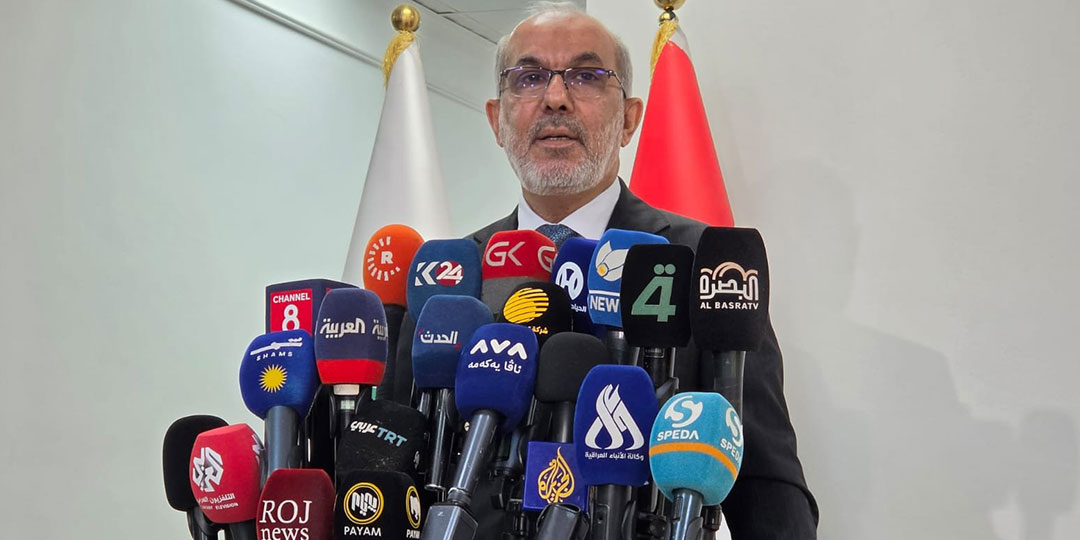

Iraq’s Oil Minister Basem Mohammed Khudair said on Saturday that the ministry is moving ahead with the government programme until Iraq takes a leading role in energy production, adding that the government has a clear plan to end gas flaring and make better use of associated gas.
Speaking at a press conference in Baghdad, Khudair said the ministry had managed to secure petroleum products for citizens despite challenges linked to shipping routes and the wider regional environment. He said the ministry is working around the clock under the prime minister’s instructions.
Plans to raise production and expand infrastructure
The minister said the ministry is working to develop the oil industry, increase production and exports, and build the infrastructure needed to support the sector.
He added that Iraq needs modern infrastructure after decades of war and instability, and said the government is determined to place the country in a leading position that would improve economic and living conditions.
Exploration work to rebuild reserves
Khudair said exploration teams are conducting surveys in several provinces to help replace depleted reserves as part of a broader plan to strengthen the country’s oil and gas resources.
He also said the ministry is working on two parallel tracks in the gas sector: ending gas flaring and investing in gas fields. Iraq, he said, spends large sums on gas and therefore seeks to capture and use it more efficiently.
14 contracts sent to global companies
The minister said 14 contracts had been referred to international companies for gas investment, and added that the ministry is also working to upgrade export infrastructure.
He described his recent visit to the United States as a new chapter of cooperation with global companies, saying the presence of US firms in Iraq reflects the attractiveness of the country’s investment environment.
New memorandums and agreements
Khudair said the ministry signed memorandums of understanding and contracts covering seven items, including two contracts to develop oil and associated gas assets, an addendum to the agreement on the West Qurna-2 field, the Nasiriyah project and four blocks.
He also said three memorandums of understanding were signed with US companies, adding that they would provide significant investment capacity and support a project to export oil through Aqaba.
Diversifying export routes
The minister said Iraq used to export about 3.4 million barrels per day through the Strait of Hormuz before the war, but volumes through that route have fallen since the conflict began.
He said Iraq needs future solutions to diversify export outlets, adding that the Basra-Fishkhabur pipeline project will be built under a build-operate-transfer model, with a company responsible for construction and operation under an investment framework.
He said current oil exports cannot reach previous levels, but could return to them after the war ends, noting that all oil fields are ready to restore earlier export rates.
Kurdistan file and talks with Turkey
On Iraq’s oil agreement with Turkey, the minister said the deal had been renewed and included specific terms, while Turkey had suggested limiting it to oil transport and participation in certain projects.
He said the planned amount of 700,000 barrels per day could not be supplied through Kirkuk alone, and stressed that the Kurdistan file requires extensive dialogue. He added that the ministry does not distinguish between citizens in Kurdistan and those in any other province.
Storage plans abroad
Khudair said one of the ministry’s goals is to establish storage facilities in some countries, and that discussions on the matter are ongoing as Iraq looks for more flexible export and storage options.
Kirkuk project aims for 420,000 barrels per day
In a separate statement, the Oil Ministry said the Kirkuk field development and rehabilitation project, which entered into force in September 2025, aims to raise crude output to a peak of 420,000 barrels per day and increase gas production for optimal use.
Spokesman Salem Al-Rikabi said current oil output stands at 320,000 barrels per day, while the project seeks to increase it to 420,000 barrels per day at peak capacity.
Gas output and reduced flaring
Al-Rikabi said current gas output stands at 255 million standard cubic feet per day, and the project aims to utilise associated gas to reach peak production of 400 million standard cubic feet per day.
He said BP’s planned work includes rehabilitating and developing Kirkuk fields, expanding North Gas Company facilities, building a 400-megawatt power plant, upgrading infrastructure, absorbing local labour, and carrying out social benefit projects.
He added that the projects will help stop the continuous burning of produced gas by putting it to better use as fuel for power plants, while also meeting domestic market needs and increasing oil exports.
Conclusion:
The ministry’s statements show Iraq is pressing ahead with strategic plans to end gas flaring, develop Kirkuk fields and diversify export routes as part of a wider effort to raise output and attract investment. Officials say the projects could improve energy supply, boost exports and strengthen the country’s economic position.