
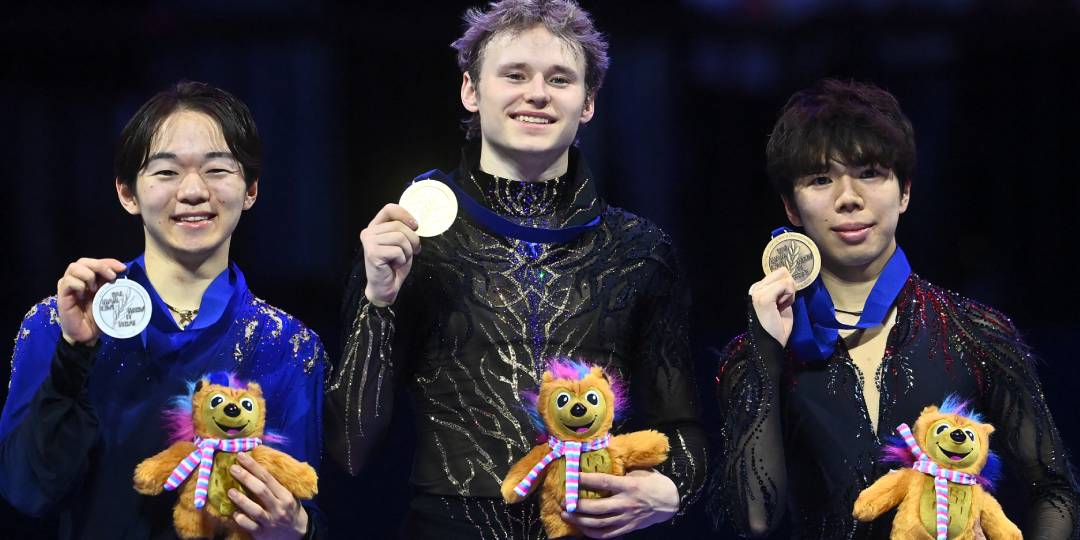

American figure skating sensation Ilia Malinin reclaimed the world championship crown on Saturday in Prague, capturing his third consecutive global title just one month after an stunning collapse at the Winter Olympics that left him reeling. The 21-year-old skater, who had remained undefeated for over two years entering the Games, rebounded with a commanding performance, defeating Japan’s Yuma Kagiyama by a decisive 22.73-point margin. Malinin’s redemption in the Czech capital represents one of sport’s most remarkable psychological comebacks, transforming Olympic disappointment into world championship glory and reasserting his dominance in men’s figure skating. His victory places him alongside American legend Nathan Chen as only the second male skater to capture three world titles in the modern era.
From Olympic Favorite to Eighth Place: The Winter Games Collapse
Malinin arrived at the Milan-Cortina Olympics last month as an overwhelming favorite. The American had compiled an extraordinary record of more than two years without a competitive loss and entered the Games as the clear frontrunner for gold. His performance in the short program confirmed expectations, as Malinin advanced with a commanding lead heading into the free skate final.
However, under the intense pressure of Olympic competition, Malinin’s performance unraveled dramatically. In the free skate, the American skater collapsed under pressure, ultimately finishing in a shocking eighth place. The disappointment was staggering for Malinin and his supporters, who had watched the world’s most consistent and dominant men’s skater buckle when it mattered most.
Kazakhstan’s Mikhail Shaidorov claimed Olympic gold, edging Kagiyama and Shun Sato, leaving Malinin to contemplate one of sport’s most painful collapses on the sport’s biggest stage.
Psychological Pressure and the Weight of Expectations
Malinin’s Olympic failure highlighted the immense psychological demands of elite figure skating. Despite his technical mastery and consistent championship performances, the psychological weight of overwhelming expectations and the one-time nature of Olympic competition proved overwhelming. His collapse became a stark reminder that even the most talented athletes can falter when facing peak pressure moments.
The question lingering after the Olympics was whether Malinin could recover psychologically and return to competitive skating with confidence intact, or whether Olympic disappointment would undermine his confidence and dominance.
Prague Triumph: Malinin’s Redemptive Return
Making his first competitive appearance since the Olympics, Malinin entered the world championship final with a commanding 9.44-point lead after the short program held Thursday. The 21-year-old skater carried the weight of Olympic disappointment into the free skate competition, but this time, he performed with poise and technical precision.
Malinin’s free skate routine featured five quadruple jumps—a technical showcase of his exceptional athleticism and consistency. Earning 218.11 points in the free skate and a combined total of 329.40 points, Malinin delivered a near-flawless performance that left no doubt about his superiority in the men’s field. His decisive 22.73-point victory over Japan’s Yuma Kagiyama underscored his return to form and psychological resilience.
A Program Without Errors
Speaking emotionally after his Prague performance, Malinin reflected on the psychological journey from Olympic collapse to world championship victory: “It’s over. This is it,” he said with visible emotion. “My goal was to complete my free skate program with no errors, and that definitely happened. It was amazing. I enjoyed every part of it, and I’m very happy to be here.”
His comments emphasized the importance of clean execution and mental fortitude—qualities that had been questioned after his Olympic failure but were decisively reestablished in Prague.
The Role of Support and Mental Resilience
Malinin’s victory speech revealed the psychological dimension of his comeback, emphasizing the critical role of fan support and community encouragement in overcoming Olympic trauma. “I felt the love. Thank you so much. The competition was incredibly difficult, but with your help I managed to overcome it. So much happens in this sport, and of course nothing would have been possible without you—without your support for all the skaters, your encouragement, your love, and your care. We need so much to get to where we are today,” he said.
His words underscored that athletic success at the highest levels depends not only on technical skill and physical conditioning but also on psychological support networks and the emotional resilience to rebound from devastating setbacks. Malinin’s acknowledgment of fan support as a crucial factor in his redemption highlighted the interconnected nature of modern elite sport, where athletes draw strength from global audiences and community encouragement.
Joining Elite Company: Nathan Chen’s Legacy
Malinin’s third world title positions him in rarefied historical company. He becomes only the second American male figure skater to capture three world championships, joining fellow American legend Nathan Chen, who won world titles in 2018, 2019, and 2021. This connection links Malinin to one of the sport’s greatest recent champions and suggests the American program’s continued global dominance in men’s figure skating.
The achievement also reflects the demanding nature of sustaining championship-level performance across multiple seasons. Three world titles require not only technical consistency but also the mental toughness to handle repeated high-pressure situations—a quality Malinin demonstrated convincingly in Prague despite the Olympic setback.
Kagiyama and Sato Complete the Podium
Japan’s Yuma Kagiyama claimed the silver medal with 306.67 points, ascending from sixth place after the short program to earn his fifth world medal. His performance demonstrated the competitive depth of the men’s field and Kagiyama’s consistent ability to deliver strong free skate performances when it matters.
Shun Sato, Kagiyama’s Japanese teammate, captured bronze, advancing from fourth place after the short program to reach the world championship podium for the first time in his career. Sato’s bronze medal represents a breakthrough performance at the world championships level and signals emerging talent within Japan’s competitive men’s figure skating program.
The strong Japanese showing reflected the depth of talent in the men’s competition and the increasingly competitive international landscape for elite male figure skaters globally.
Women’s Figure Skating: Sakamoto’s Emotional Farewell
As Malinin claimed redemption in the men’s competition, retiring Japanese star Kaori Sakamoto delivered her own emotional farewell to competitive figure skating, capturing her fourth world championship gold on Friday with a career-best performance in Prague.
The 25-year-old Olympic silver medalist marked her retirement with an elegant, charismatic free skate routine set to Edith Piaf’s “Je ne regrette rien” (I Have No Regrets), earning personal bests of 158.97 in the free skate and a combined total of 238.28 points. Her performance was flawless, featuring seven triple jumps and earning a packed arena’s roaring approval.
Sakamoto’s Emotional Goodbye
Visibly moved by the overwhelming reception from the Prague crowd, Sakamoto reflected on her career conclusion: “There are no regrets at all. I can say goodbye with this performance. I gave it all I have. There were a few tricky moments, but I think I gave my best.”
She explained the emotional weight of the moment: “After that, I had a feeling I’ve done everything I could, and this is a really good way to end a career. Today I tried not to cry—I was really trying hard not to cry—but I heard so many people cheering for me and applauding me, and when I saw that scene, I couldn’t help it.”
Sakamoto punched the air in delight after completing her routine, her tears of joy replacing the tears of disappointment that had accompanied her Olympic silver medal at Milan-Cortina just weeks earlier.
Historic Achievement and Legacy
With four world titles, Sakamoto ranks fifth all-time among women’s figure skaters—an extraordinary achievement that positions her among the sport’s all-time greats. She is tied with legendary skaters Lily Kronberger and Katarina Witt, though far behind Norwegian Sonja Henie’s unattainable record of 10 titles between 1927 and 1936.
Sakamoto’s farewell world championship victory demonstrated that she could transform Olympic disappointment into world championship triumph, much like Malinin’s parallel redemption in the men’s competition.
Ice Dance Dominance: France Leads Toward Gold
In ice dance competition, Olympic champions Guillaume Cizeron and Laurence Fournier Beaudry dominated the rhythm dance segment, breaking their season record with 92.74 points and establishing a commanding lead heading into Saturday’s free dance final.
The French pair, skating to a Madonna-inspired routine featuring “Vogue,” displayed the confidence and technical mastery expected of defending Olympic champions. They hold a comfortable lead of more than six points over Canadian bronze medalists Piper Gilles and Paul Poirier (86.45 points).
Cizeron’s Path to Historic Sixth World Title
If Cizeron and Fournier Beaudry triumph in the free dance, Cizeron will clinch his sixth world title—his first with Fournier Beaudry after five consecutive world championship victories with former partner Gabriella Papadakis between 2015 and 2022. For Canadian-born Fournier Beaudry, a world title would represent a first world medal and a major career milestone.
Cizeron, 31, and Fournier Beaudry, 33, are bidding for their first world title together after a turbulent first competitive season that unexpectedly culminated in Olympic gold last month. Their dominant rhythm dance performance suggests they are well-positioned to add world championship gold to their growing list of achievements.
Britain’s Lilah Fear and Lewis Gibson performed third with 85.89 points, entertaining the crowd with a Spice Girls routine and positioning themselves competitively for Saturday’s free dance.
Conclusion:
The 2026 World Figure Skating Championships in Prague have delivered compelling narratives of redemption, farewell, and continuity. Ilia Malinin’s third world title represents a dramatic psychological recovery from Olympic collapse, demonstrating the resilience required to compete at elite levels in modern figure skating. Kaori Sakamoto’s emotional farewell with a fourth world championship captures the bittersweet nature of athletic retirement. Meanwhile, ice dance competition showcases the continued evolution of the sport’s artistic dimensions. These performances from Prague underscore figure skating’s enduring capacity to produce moments of human drama, athletic excellence, and emotional authenticity that transcend the sport itself.