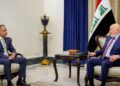
Iraq’s leading Sunni political figures announced on Sunday the formation of a unified bloc, the “National Political Council,” aimed at coordinating positions and unifying decision-making following the parliamentary elections in which they ran on separate lists.
A meeting was held in Baghdad bringing together leaders of five major Sunni parties, led by former Parliament Speaker Mohammed al-Halbousi, head of the Taqaddum movement—which secured the largest share of Sunni seats (27 seats)—and businessman Khamis al-Khanjar, leader of the Sovereignty Alliance, who is under U.S. sanctions.
According to a statement published by the Iraqi News Agency, the attendees agreed to establish the National Political Council as an inclusive umbrella “to coordinate positions and unify visions and decisions regarding major national issues.”
They emphasized that the council “will remain open to all national partners and committed to the foundational principles that preserve Iraq’s unity and stability and safeguard the rights of all its components without exception.”
Since Iraq’s first multi-party elections in 2005—two years after the U.S.-led invasion that toppled Saddam Hussein—the country’s political system has been based on power-sharing: the Speaker of Parliament is Sunni, the Prime Minister (head of the executive authority) is Shia, and the President is Kurdish.
Since the fall of Saddam Hussein, Iraq’s Shia majority has held predominant political influence.
Last week, the Coordination Framework—a coalition of Shia parties aligned with Iran—announced the formation of the largest parliamentary bloc and the beginning of the process to select a new Prime Minister.
The following day, caretaker Prime Minister Mohammed Shia al-Sudani announced that his coalition, which topped the November 11 election results with 46 out of 329 seats, had joined the largest parliamentary bloc.
This bloc now holds more than 175 seats, securing a majority in the Council of Representatives.