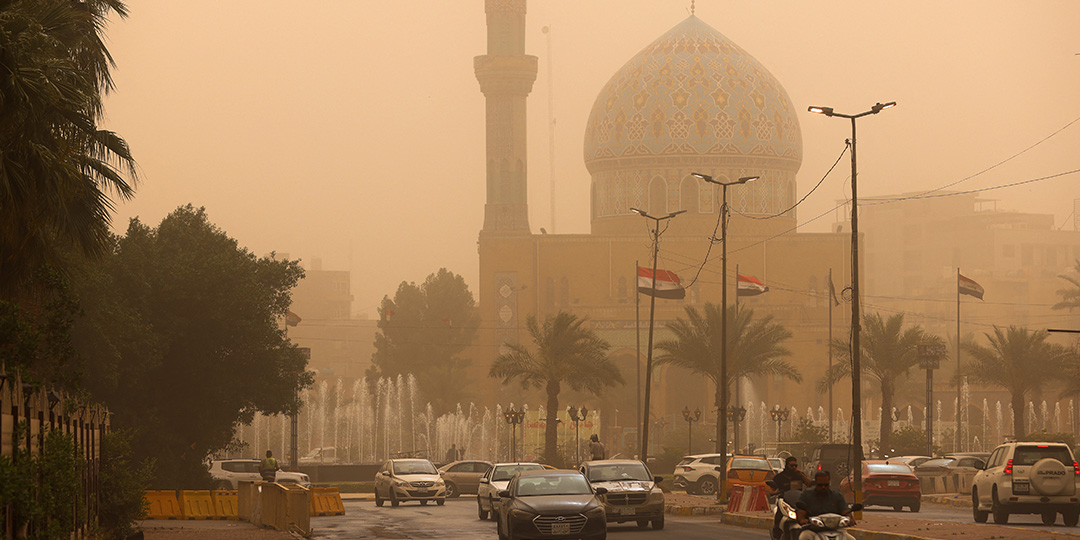

Iraq’s Ministry of Environment issued a clarification on Tuesday regarding the unusual weather conditions witnessed in Baghdad, confirming that the phenomenon observed is a natural and temporary type of smog known as “photochemical smog” or “smog haze.”
Ministry spokesperson Loay Al-Mukhtar told the Iraqi News Agency (INA) that the rise in pollution levels across the capital is linked to emissions and smoke trapped near the ground due to current weather patterns and a temperature inversion, which prevents pollutants from dispersing into higher atmospheric layers.
Al-Mukhtar explained that this phenomenon occurs annually during similar weather conditions, depending on temperature fluctuations. He noted that Baghdad’s dense population—hosting nearly a quarter of Iraq’s residents—combined with the large number of cars, generators, and ongoing daily activities, contributes to a noticeable increase in emissions under such circumstances.
He added that the Ministry of Environment continues to monitor environmental violations through field teams tasked with identifying and taking action against offenders. The odors reported by residents, he said, result from a reaction between various emissions and airborne dust particles, producing a distinct smell and forming what is generally known as smog haze. This phenomenon typically diminishes as the day approaches midday.
Al-Mukhtar urged the public to follow World Health Organization (WHO) recommendations by minimizing exposure to the polluted air: staying indoors as much as possible and keeping windows closed to reduce direct contact with outdoor air.