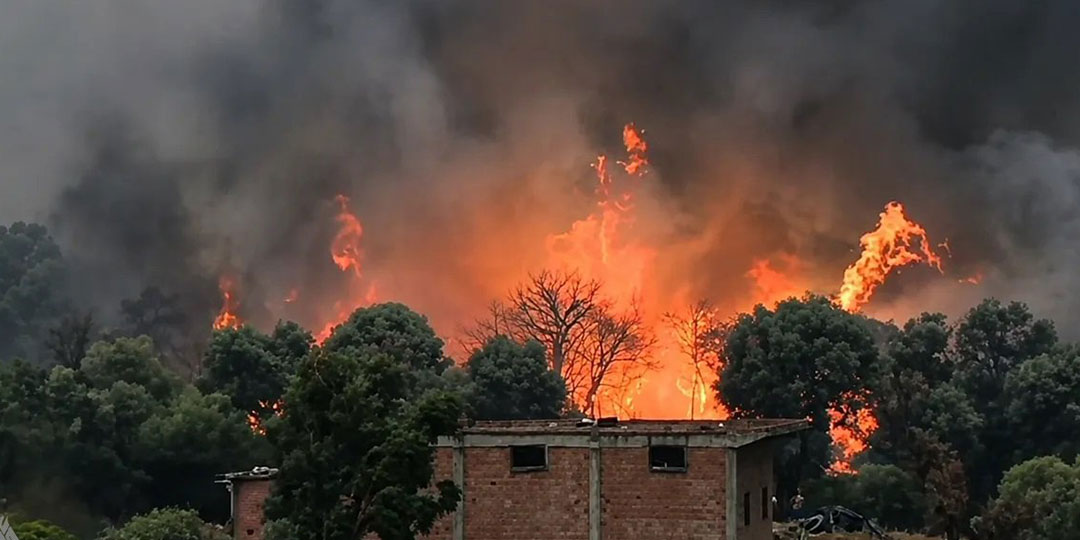

Algerian civil protection teams are continuing to battle dozens of wildfires that broke out across northern and eastern parts of the country, as the latest official casualty toll rose to 12 dead and 54 people suffering burn injuries. The fires have spread across vegetation and farmland, while authorities work to contain the blazes and prevent them from reaching new areas.
According to the latest operational update, Algeria recorded 153 vegetation and crop fires by 8 p.m. Thursday. Fire crews had put out 85 of them, while 67 fires remained active across 16 provinces.
Jijel, El Tarf, and Skikda Among the Hardest-Hit Areas
Jijel Tops the List
Jijel remains the province with the largest number of active fires, with 17 blazes still burning. It is followed by El Tarf and Skikda, with 10 fires in each province. Tizi Ouzou and Guelma each had five active fires, while Annaba and Béjaïa each had four.
Firefighters are also battling two fires each in Souk Ahras, Sétif, and M’sila, as well as one fire each in Boumerdès, Mila, Constantine, Tébessa, Médéa, and Bouira. Ground teams are working to surround the fires amid difficult weather conditions that have helped them spread quickly.
Operations Across Multiple Communes
In Jijel, firefighting efforts have focused on the communes of Texenna, Ziama Mansouriah, El Milia, Sidi Marouf, Oulad Yahia Khadrouche, and Chekfa. In El Tarf, fires have spread across Lake of Birds, Chaffia, Bou Thletha, and Hammam Beni Salah.
In Skikda, civil protection teams have continued their response in Filfila, Bekouche Lakhdar, Zerdazra, Azzaba, and Oum Toub, alongside scattered fire pockets in several other communes across the affected provinces.
Heavy Human Toll and Serious Injuries
12 Dead, 54 Injured
Interior Minister Saïd Sayoud said 12 people have died in the fires, including five in Jijel, four in Béjaïa, and three in Tizi Ouzou. Authorities also counted 54 burn victims, including six people in critical condition who are receiving intensive care.
Medical teams continue treating the injured in hospitals across the affected regions, while officials warn that the toll could rise if the fires continue to spread or if more victims are found.
Families Evacuated
In addition to the human toll, authorities evacuated dozens of families from affected areas to prevent further harm from the flames or smoke inhalation. Temporary shelters and field medical support are being used to assist residents who were forced to leave their homes.
National Mourning and Investigation
Official Mourning Period Announced
The presidency объявed three days of national mourning starting Thursday, with flags lowered and national celebrations and sports events canceled after the deaths caused by the fires in several central and eastern provinces.
The decision reflects the scale of the disaster, especially in areas where both human and material losses have been severe.
Investigations Underway
The interior minister said in-depth investigations have been opened to determine the cause of the fires, but no preliminary findings have been announced and there is no official confirmation yet on whether they were accidental or deliberate.
At the same time, the Algerian Red Crescent has activated its field response mechanism and deployed its human and logistical resources to support relief efforts and accompany affected families in the burned areas.
110 Fires Extinguished, 64 Still Being Contained
Updated 24-Hour Figures
In a later update, Algeria’s Civil Protection services said they had extinguished 110 fires out of 174 recorded across several provinces over the past 24 hours, while efforts continued to bring the remaining 64 fires under control.
The General Directorate of Civil Protection said the active fires are spread across 10 provinces: Jijel, Skikda, El Tarf, Guelma, Annaba, Béjaïa, Bouira, Tébessa, Constantine, and Mila. Crews are still working to extinguish the remaining hotspots.
Background of Repeated Wildfires in Algeria
Algeria has seen major wildfires in recent years, causing dozens of deaths and damaging large areas of forests, farmland, and property. That has pushed authorities to strengthen prevention measures, increase monitoring, and raise the readiness of firefighting units and equipment.
The current wave of fires once again highlights the challenges of protecting vegetation cover and responding to heat, drought, and wind conditions that can rapidly accelerate the spread of flames.
Conclusion:
Algeria continues to face one of its most severe wildfire outbreaks in years, with 67 fires still active across 16 provinces and a death toll of 12, along with 54 burn injuries. Civil protection teams are working to contain the remaining fires, while authorities investigate the causes and provide support to evacuated families. The crisis has also prompted national mourning and renewed attention to wildfire preparedness across the country.