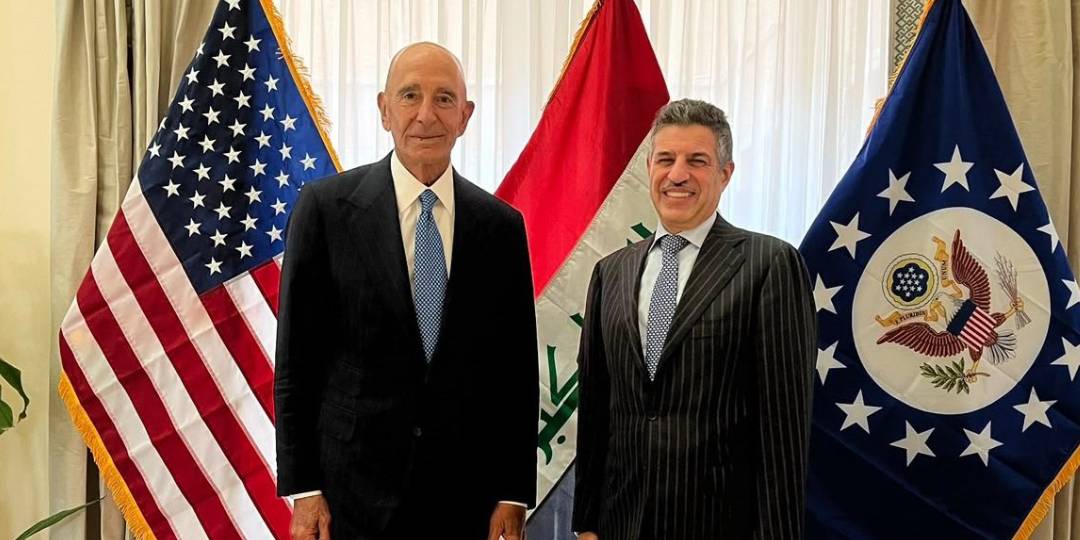

United States Presidential Envoy to Iraq Tom Barrack affirmed on Monday that bilateral ties between Washington and Baghdad have reached a defining turning point. He underscored that the strategic partnership is undergoing a comprehensive realignment, transitioning Iraq-US relations from security to economy while establishing long-term cooperation anchored in shared commercial interests and regional stability.
The statements were delivered during Barrack’s official diplomatic mission to Baghdad, where he met with US Chargé d’Affaires Steve Fagin to review strategic administrative priorities.
The envoy also held high-level discussions with the President of the Supreme Judicial Council, Judge Faiq Zidan, to explore avenues for expanding bilateral cooperation in the legal and judicial fields while safeguarding institutional independence.
The visit marks an evolving diplomatic dynamic following the conclusion of multinational military missions, creating opportunities to attract foreign direct investment and foster a transparent legal framework that supports sustainable reconstruction across Iraqi governorates.
“`
+————————————————————-+
| Bilateral Partnership Transition |
+————————————————————-+
| Strategic Pivot | Transitioning from defense to commerce |
| Diplomatic Focus | Private investment, banking & energy |
| Judicial Channel | Enhancing legal frameworks & rule of law |
| Key Meetings | SJC President Faiq Zidan & Steve Fagin |
+————————————————————-+
“`
The Strategic Realignment of Iraq-US Relations from Security to Economy
Writing on social media platform X, Ambassador Tom Barrack highlighted that the bilateral relationship has entered a mature institutional phase. He explained that a partnership centered for years on counter-terrorism and military coordination is broadening into commercial trade, infrastructure modernization, and energy development.
Barrack noted that the extensive diplomatic experience of Chargé d’Affaires Steve Fagin in Iraq and the wider region makes him well-suited to advance Washington’s core objectives. He stressed that the United States remains committed to supporting Iraqi economic reform, enabling the country to leverage its resources for national prosperity.
Strategic Priorities in the Economic Partnership
– Encouraging American corporations to participate in major Iraqi energy, industrial, and technology tenders.
– Supporting regulatory and banking compliance reforms implemented by the Central Bank of Iraq to ensure international transparency.
– Shifting bilateral assistance toward technical capacity building, institutional governance, and digital modernization.
– Activating joint economic committees under the Strategic Framework Agreement to expand trade exchange.
Judicial Discussions and Strengthening the Rule of Law
On the institutional front, Supreme Judicial Council President Judge Faiq Zidan welcomed Ambassador Barrack at the council’s headquarters in Baghdad. The meeting focused on exchanging perspectives regarding the development of bilateral relations in legal and judicial matters, as well as enhancing professional expertise between the two judicial systems.
Barrack described his dialogue with Judge Zidan as productive and constructive. He commended the leadership of the Supreme Judicial Council in administering the judiciary and safeguarding its constitutional autonomy, emphasizing that an independent judiciary serves as an indispensable pillar of national sovereignty.
Focus Areas in Bilateral Legal Collaboration
– Exchanging technical expertise to combat cross-border financial crime, money laundering, and illicit transactions.
– Strengthening bilateral legal mechanisms for asset recovery and the extradition of wanted fugitives.
– Modernizing court management systems through digital archiving and electronic case processing technologies.
– Reinforcing statutory protections for foreign investors to cultivate a secure and transparent business climate.
An Independent Judiciary as a Prerequisite for Investment
Diplomatic observers point out that Washington’s engagement with Iraq’s judicial leadership reflects an understanding that major economic partnerships depend on an impartial legal system capable of resolving commercial disputes and enforcing contractual rights.
Iraqi officials consistently maintain that national sovereignty relies on the supremacy of statutory law and the exclusive authority of constitutional courts. Establishing a predictable legal environment allows Iraq to convert its natural and human capital into sustainable infrastructure, generating employment and reinforcing social stability nationwide.
Conclusion:
The official visit of US Presidential Envoy Tom Barrack signals an active effort to transition Iraq-US relations from security to economy. By combining expanded commercial initiatives with sustained support for judicial independence and the rule of law, both nations are laying the groundwork for a balanced partnership focused on institutional development, private investment, and regional peace.