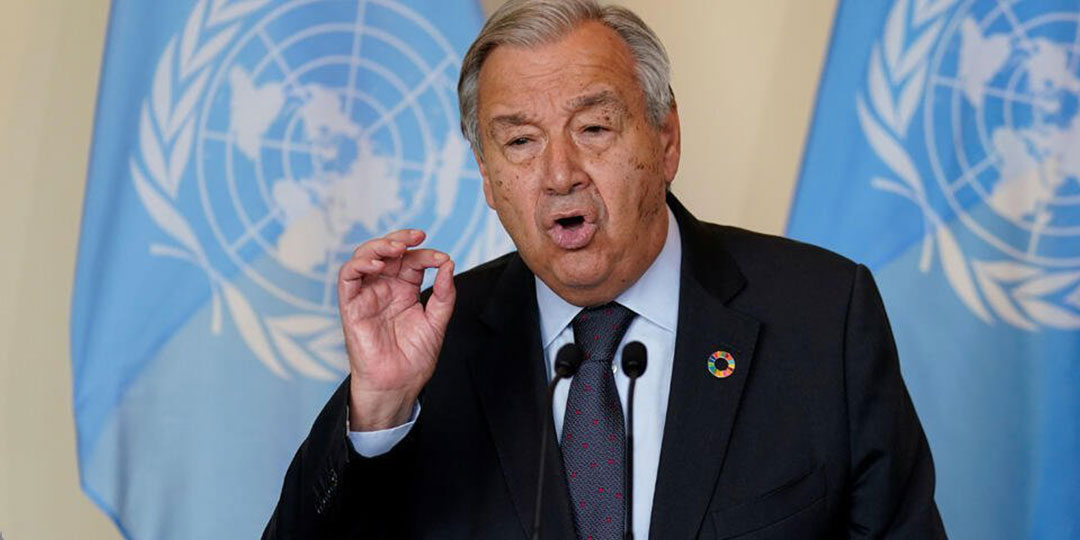

The United Nations Secretary-General Antonio Guterres has warned of the risk of regional escalation following recent military developments, expressing concern that tensions could lead to a broader conflict in the Middle East.
His remarks came as Iran announced it is reviewing the status of ongoing negotiations after a U.S. strike on southern Iranian territory, while U.S. President Donald Trump accused Tehran of wasting time in talks.
Guterres Expresses Deep Concern
Guterres said the people of the region are paying a heavy price due to continued escalation, with repercussions extending beyond the Middle East.
He voiced deep concern that recent developments could trigger a comprehensive renewal of conflict across the region.
Regarding Lebanon, the UN chief urged all parties to work toward a diplomatic settlement that respects the country’s sovereignty and territorial integrity.
On Gaza, he called for the immediate and full implementation of efforts to secure a ceasefire and remove obstacles hindering the delivery of humanitarian aid, stressing that Gaza is an integral part of the Palestinian state.
He also cited troubling reports from the West Bank, including rising settler violence, home demolitions, land confiscations, and expansion of settlements.
Iran Reviews Negotiations After U.S. Strike
Iran’s Foreign Ministry announced that Tehran is reassessing its approach to negotiations following the U.S. strike.
Spokesperson Esmail Baghaei said Iran had responded forcefully on the battlefield and demonstrated its capabilities, adding that the country is prepared to confront any further hostile actions.
He emphasized that foreign policy and military strength complement one another, stating that diplomacy and the battlefield are interconnected tools for protecting Iran’s national interests.
Baghaei also said that diplomatic efforts require a minimum level of conducive conditions, accusing Washington of undermining negotiations by repeatedly changing its positions.
The U.S. strike was described by Washington as a response to the reported downing of an AH-64 Apache helicopter over the Strait of Hormuz. In turn, Iran’s Khatam al-Anbiya headquarters said Iranian forces targeted U.S. bases in the region in retaliation for attacks on southern Iran.
Trump Criticizes Iran’s Negotiation Approach
President Donald Trump said Iran had wasted significant time negotiating an agreement that, in his view, would have delivered substantial benefits.
He stated that Tehran would now “have to pay the price,” adding that Iran speaks without taking action.
Trump also claimed that the Iranian military is experiencing disorder and dysfunction, suggesting that parts of its naval and air forces are no longer operational.
Diplomacy Under Pressure
The latest developments highlight mounting pressure on diplomatic channels amid heightened tensions.
Key elements of the situation include:
– UN warnings of potential regional escalation.
– Iran’s review of negotiations after a U.S. strike.
– Continued U.S.–Iran military exchanges.
– Calls for ceasefires in Lebanon and Gaza.
The trajectory of events will depend largely on whether diplomatic efforts can regain momentum and prevent further confrontation.
Conclusion:
As the UN warns of regional escalation, the exchange of military and political statements between Washington and Tehran underscores the fragile state of diplomacy. With negotiations under review and tensions elevated, the coming days will be critical in determining whether the situation moves toward de-escalation or broader conflict.