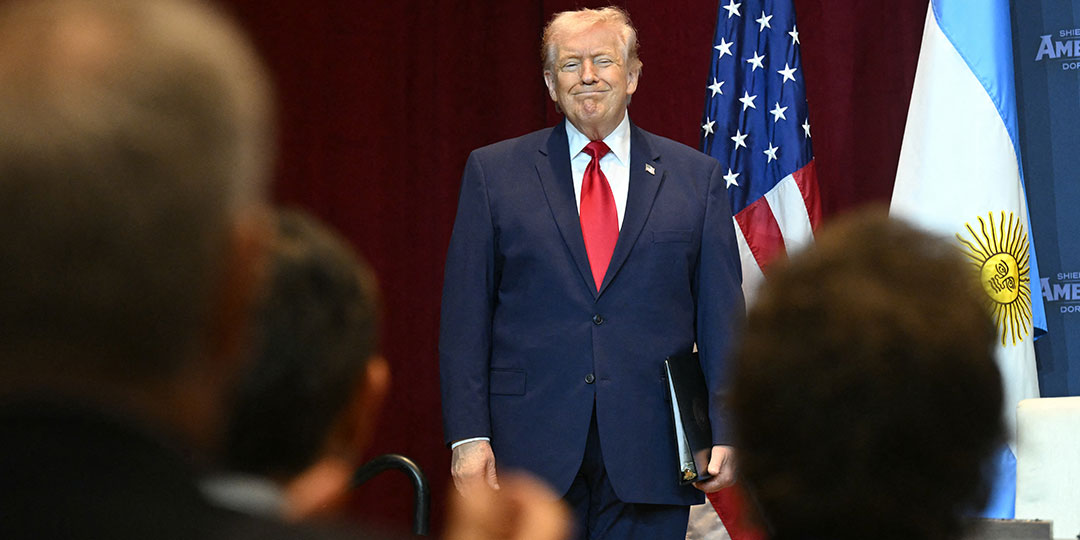

President Donald Trump hosted the “Shield of the Americas” summit at his Miami-area golf resort on Saturday, bringing together leaders of 12 Latin American nations to coordinate military action against drug trafficking cartels and transnational criminal organizations. The gathering included heads of state from Argentina, Bolivia, Chile, Costa Rica, the Dominican Republic, Ecuador, El Salvador, Guyana, Honduras, Panama, Paraguay, and Trinidad and Tobago.
Trump framed the summit as a demonstration of renewed US commitment to regional dominance and a bulwark against what he characterized as decades of Chinese economic encroachment in America’s hemisphere. The summit represents a significant pivot toward militarized responses to organized crime, with Trump explicitly calling for regional militaries to “unleash” force against cartels comparable to the US-led coalition against ISIS in the Middle East.
The gathering emerged from the ashes of a failed Summit of the Americas scheduled for the Dominican Republic, which was scrapped after the White House pressured the host nation to exclude Cuba, Nicaragua, and Venezuela, prompting protests from leftist-led Colombia and Mexico.
Trump’s Call for Military Action Against Cartels
Escalation of Military Doctrine
Trump explicitly encouraged regional leaders to deploy military force against drug trafficking organizations and transnational gangs, describing them as an “unacceptable threat” to hemispheric security. “The only way to defeat these enemies is by unleashing the power of our militaries,” Trump stated during the summit. “We have to use our military. You have to use your military.”
Drawing a parallel to international counterterrorism operations, Trump invoked the US-led coalition that confronted ISIS in the Middle East. “We must now do the same thing to eradicate the cartels at home,” he declared, signaling a significant shift toward military-first solutions in addressing drug trafficking and organized crime in the region.
The rhetoric underscored the administration’s conviction that traditional law enforcement and development-focused interventions have failed to contain cartel violence, necessitating increased military intervention.
US-Ecuador Military Operations
Demonstrating commitment to the militarized approach, the United States and Ecuador conducted joint military operations this week against organized crime groups operating within Ecuadorian territory. Neither government disclosed operational details regarding location or scope. However, General Francis Donovan, who oversees US Southern Command, hailed the operation as a “strategic success” on Friday, signaling Pentagon confidence in the campaign’s initial results.
The operation marked one of the first tangible demonstrations of the Trump administration’s shift toward direct military involvement in combating narcotics-related violence in the region, moving beyond the advisory and support roles that characterized previous US interventions.
Significant Absences and Regional Divisions
The Absent Powers
Notably absent from the summit were representatives from Brazil and Mexico, the hemisphere’s two dominant economic and political powers, as well as Colombia, which has historically served as the linchpin of US counter-narcotics strategy in South America. The conspicuous absences underscored deep divisions within Latin America regarding Washington’s regional approach.
Mexico’s absence proved particularly significant given Trump’s explicit focus on cartels operating from Mexican territory. Colombia’s non-attendance reflected disagreement over US pressure to exclude leftist governments from regional dialogue, while Brazil’s absence signaled concerns about being marginalized from discussions affecting regional security and policy.
Trump’s Criticism of Mexico
Trump directly criticized Mexico’s response to cartel violence, describing the nation as the “epicenter of cartel violence” where drug kingpins orchestrate “much of the bloodshed and chaos in this hemisphere.” His rhetoric intensified pressure on Mexico’s government while simultaneously suggesting that unilateral US military action could follow if regional compliance proved inadequate.
“The cartels are running Mexico,” Trump stated bluntly to assembled leaders. “We can’t have that. Too close to us. Too close to you.”
The comments reflected the administration’s implicit threat that refusal to comply with US-demanded military escalation could trigger direct American intervention within Mexican territory, escalating tensions with a key regional partner.
The Chinese Challenge and Economic Competition
The Trump Corollary to Monroe Doctrine
While Trump made no direct public mention of countering Chinese influence during the summit proceedings, his administration’s national security strategy explicitly identifies limiting Beijing’s hemispheric presence as a top priority for his second term. The strategy promotes what officials call the “Trump Corollary” to the 19th-century Monroe Doctrine, which historically sought to prohibit European intervention in the Americas.
This contemporary version targets Chinese infrastructure projects, military cooperation, and investment in the region’s resource industries. The approach represents a significant escalation from previous US policy, employing explicit economic coercion and military posturing to roll back Chinese gains accumulated over two decades of trade-focused engagement.
Panama and the Belt and Road Initiative
The administration has already demonstrated its willingness to employ coercive tactics. Trump strong-armed Panama into withdrawing from China’s Belt and Road Initiative and reviewing long-term port contracts held by Hong Kong-based operators amid explicit US threats to retake control of the Panama Canal. The ultimatum highlighted Washington’s readiness to weaponize historical grievances and strategic infrastructure concerns to counter Chinese influence.
Venezuela and Energy Disruption
More significantly, the US capture of former Venezuelan President Nicolás Maduro and Trump’s pledge to “run” Venezuela threatens to disrupt critical oil shipments to China, which was the largest buyer of Venezuelan crude before the military raid. The operation represents an attempt to bring Venezuela into Washington’s sphere of influence, thereby denying Beijing one of its closest regional allies and eliminating a significant source of energy revenue for Beijing.
Trump is scheduled to travel to Beijing later this month to meet with Chinese President Xi Jinping, potentially using these developments as leverage in broader US-China negotiations regarding hemispheric influence.
Reluctance Among US-Aligned Leaders
Despite Trump’s efforts to rally regional support against Chinese economic presence, even leaders closely aligned with the US administration have shown reluctance to sever ties with Beijing. According to Evan Ellis, a scholar of Chinese engagement at the Center for Strategic and International Studies, most Latin American nations view China’s trade-focused diplomacy as essential to meeting critical financial needs.
For many regional economies, Chinese investment fills crucial gaps in financing that Western institutions and the Trump administration have failed to address. Development challenges ranging from poverty reduction to infrastructure modernization require sustained capital flows that only China currently provides at scale.
The Economic Comparison
The economic disparity between American and Chinese offers creates strategic leverage for Beijing. “The U.S. is offering the region tariffs, deportations and militarization whereas China is offering trade and investment,” said Kevin Gallagher, director of Boston University’s Global Development Policy Center and author of extensive research on Chinese economic diplomacy in the Americas.
Gallagher advised regional leaders to “remain neutral and hedge, such that they can leverage increased U.S.-China rivalry to their own benefit.” This counsel reflects the reality that many Latin American nations view the emerging superpower competition as an opportunity to extract concessions from both powers rather than committing exclusively to either bloc.
The Failed Summit of the Americas and Geopolitical Tensions
Origins in Dominican Republic Controversy
The Shield of the Americas summit emerged directly from the collapse of the planned 10th Summit of the Americas, which was scheduled for the Dominican Republic but ultimately abandoned due to irreconcilable diplomatic disagreements. The White House pressured Dominican President Luis Abenader to exclude Cuba, Nicaragua, and Venezuela from the regional gathering, seeking to isolate leftist governments within the hemisphere.
However, this exclusionary approach triggered fierce backlash from leftist-led nations. Colombia and Mexico threatened to boycott the gathering entirely, with leaders rejecting what they characterized as US efforts to divide the hemisphere along ideological lines. With no firm commitment from Trump to attend the original summit, Abenader made a last-minute decision to postpone indefinitely, citing “deep differences” within the region.
The cancellation exposed the limits of US coercive diplomacy and highlighted Washington’s diminishing ability to command hemispheric compliance on its preferred regional architecture.
Global Crises and Competing Priorities
The Competing Demands of Multiple Conflicts
Trump’s time devoted to the Latin American leaders was severely constrained by simultaneous global crises demanding presidential attention. Immediately following the summit, Trump departed for Dover Air Force Base in Delaware to oversee the dignified transfer ceremony for six US military personnel killed in a drone strike on a command center in Kuwait. The deaths occurred just one day after the US and Israel launched their military campaign against Iran.
Trump described the American deaths as a “very sad situation” and praised the fallen troops as “great heroes,” underscoring the emotional and strategic weight of the Middle Eastern conflict competing for his attention.
Reassertion of Western Hemisphere Primacy
Despite these competing global crises, Trump sought to use the summit to refocus international attention on the Western Hemisphere and demonstrate continued American commitment to regional dominance. His invocation of military solutions for cartel violence, combined with explicit warnings regarding Chinese economic influence, represented an attempt to reassert traditional US preeminence in what Washington has historically regarded as its sphere of influence.
The summit messaging emphasized that despite involvement in Middle Eastern conflicts and broader global competition with China, the Trump administration maintains strategic focus on hemispheric security and maintaining American primacy in the Americas.
Cuba and Post-Iran War Calculations
Signaling Renewed Confrontation
Trump signaled that following conclusion of the conflict with Iran, the US will turn its attention toward Cuba with renewed vigor. He suggested his administration would pursue a negotiated agreement with Havana, though simultaneously indicating a hardline stance toward the Cuban government’s communist leadership. “Great change will soon be coming to Cuba,” Trump declared, adding that “they’re very much at the end of the line.”
The comments suggested the administration views Cuba as a secondary priority temporarily deferred due to higher-profile Middle Eastern commitments, but one targeted for renewed pressure once Iranian hostilities conclude.
Havana’s Cautious Response
Cuban officials have indicated on multiple occasions that they remain open to dialogue with the United States, provided such engagement respects Cuban sovereignty and operates within frameworks of mutual respect. However, Cuban authorities have never confirmed that actual negotiations are underway, maintaining official ambiguity regarding the prospect of restored diplomatic relations or negotiated settlements.
The discrepancy between Trump’s aggressive rhetoric and Cuba’s more measured diplomatic posture suggests significant obstacles to achieving any negotiated agreement, particularly given the Trump administration’s demonstrated preference for regime change and military solutions over traditional diplomacy.
Conclusion:
The Shield of the Americas summit reflects Trump’s attempt to reorder hemispheric relationships around an explicitly anti-China agenda and militarized approach to organized crime. The absence of major regional powers including Brazil, Mexico, and Colombia underscores persistent divisions regarding American regional policy. The tension between calls for military escalation and simultaneous reduction of economic aid reveals the contradictions within Trump’s hemispheric strategy, rewarding compliant allies while threatening non-cooperation. The fundamental challenge confronting the Trump administration remains convincing Latin American nations to prioritize alignment with Washington over maintaining economically essential relationships with China, a difficult proposition given limited American economic incentives and the appeal of Beijing’s trade and investment offerings.