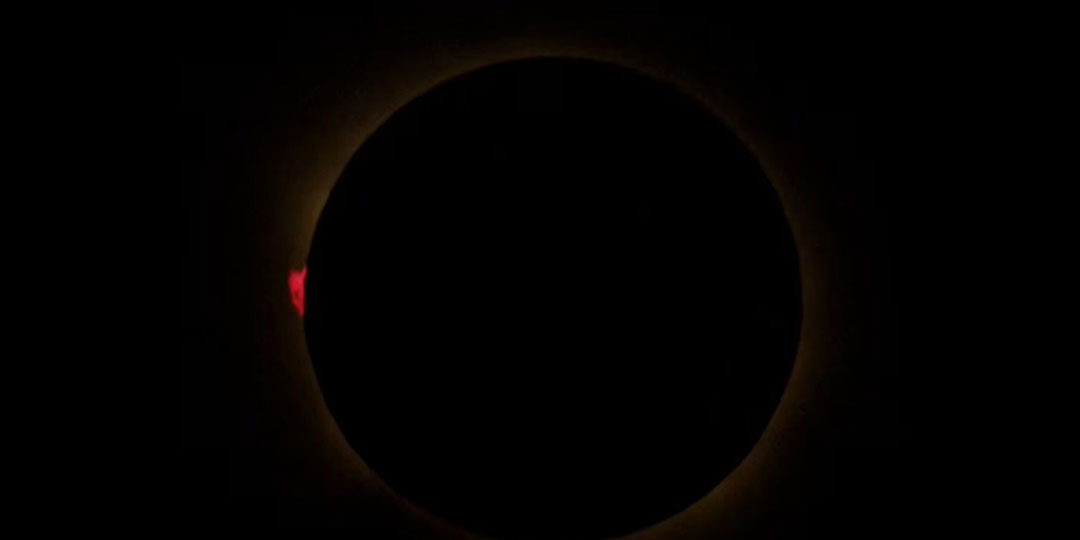

Russia’s space agency Roscosmos said a total solar eclipse began near the Russian Arctic, with the rare astronomical event set to darken a small part of Europe briefly during the day.
The eclipse began around 17:00 GMT in the far northern regions of mainland Russia and is expected to cross the northern hemisphere, including the Atlantic Ocean, with much of Europe due to see a partial eclipse before sunset.
Partial eclipse across Europe
Large parts of Europe are expected to experience a partial eclipse at varying levels, covering most northern, western and central countries.
Only people in the far northern areas along the path of totality will be able to witness the full darkness of the total solar eclipse for a brief moment.
Spain awaits first total eclipse in more than a century
In Madrid, Spain was set to experience its first total eclipse in more than 100 years, as the phenomenon moved across many parts of Europe before sunset.
Experts said the sight could appear like twilight or complete dimness in some areas, giving the event a striking visual effect.
Clouds may block the view
Weather forecasters in Spain warned that cloud cover could obscure the eclipse in some regions, despite expectations that the event would be total in large parts of the country.
The visibility of the eclipse will depend heavily on local weather conditions, meaning the best view may only be available in places with clear skies.
A rare astronomical spectacle
A total solar eclipse is one of the most widely followed astronomical events because of its rarity and the different phases of total and partial coverage depending on the observer’s location on Earth.
As the eclipse track crosses Russia, Europe and the Atlantic Ocean, it is expected to draw wide attention from scientific observatories and skywatchers alike.
Conclusion:
The total solar eclipse that began near the Russian Arctic is a major astronomical event extending across Europe, with partial eclipse conditions expected in many countries. In Spain, people are anticipating the first total eclipse in more than a century, although clouds may limit visibility in some areas.