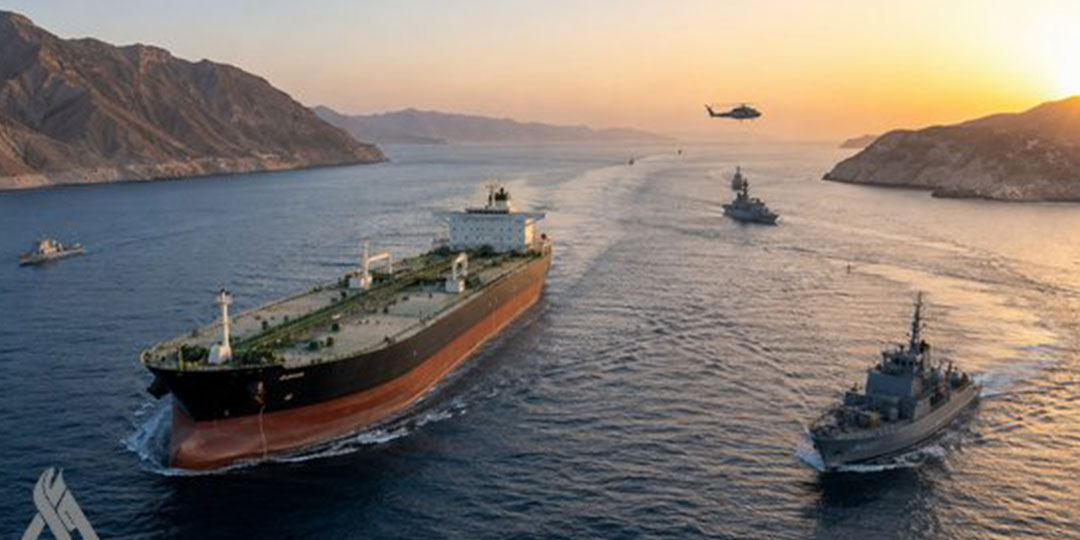

Oman and Iran confirmed on Tuesday their commitment to maintaining the Strait of Hormuz as a safe and secure waterway for international navigation, amid ongoing regional tensions and heightened global focus on energy routes.
The announcement followed high-level talks in Muscat, where both sides emphasized the importance of maritime security and adherence to international law.
Commitment to Maritime Safety
According to Oman News Agency, both countries stressed that “all arrangements related to the Strait of Hormuz must fully respect the sovereignty of the two states.”
The joint statement reaffirmed their commitment to ensuring that the Strait remains “a safe and open waterway for international navigation,” highlighting its critical role in global trade and energy supply.
Joint Mechanism for Future Management
The two sides agreed to continue dialogue through a joint working group between their foreign ministries to address:
– Future management of navigation in the Strait
– Services provided to maritime traffic
– Associated costs in line with international standards
They also agreed to expand consultations with other littoral states and relevant stakeholders.
Regional Cooperation and Stability
Both Oman and Iran emphasized the importance of cooperation to enhance maritime safety, freedom of navigation, and regional stability.
They reiterated that all arrangements must respect their sovereign rights over the Strait of Hormuz, a key strategic passage linking the Persian Gulf with global markets.
Support for US-Iran Understanding
Oman expressed support for the “Islamabad Memorandum of Understanding” between the United States and Iran, stressing the importance of continued dialogue and coordination to ensure its successful implementation.
This reflects Oman’s ongoing diplomatic role as a mediator in regional and international negotiations.
Pakistan Expresses Optimism on Long-Term Agreement
In a related development, Pakistan’s Prime Minister Shehbaz Sharif expressed confidence that the memorandum between Iran and the United States could lead to a long-term agreement within 60 days of technical negotiations.
He said Pakistan has played a significant role in facilitating dialogue between the two sides and will continue to support the process.
Technical Negotiation Tracks
Pakistan’s Foreign Minister Ishaq Dar noted that the diplomatic process includes three technical working groups focusing on:
– Iran’s nuclear program
– Sanctions and frozen assets
– The situation in Lebanon
Progress in US-Iran Talks
The first round of high-level talks between Tehran and Washington recently concluded in Bürgenstock, Switzerland, resulting in a roadmap aimed at reaching a final agreement within 60 days.
US Vice President JD Vance said the talks established “a solid foundation for a successful final agreement,” while Iranian Foreign Minister Abbas Araghchi welcomed the progress but noted that the real test would be the functioning of the new dispute resolution mechanism.
Strategic Importance of the Strait
The Strait of Hormuz is one of the world’s most critical maritime chokepoints, with a significant portion of global oil and gas shipments passing through it.
Ensuring its stability directly impacts:
– Global energy markets
– International trade routes
– Regional security in the Gulf
– Relations among major powers
Key Points
– Oman and Iran reaffirm safe navigation in Strait of Hormuz
– Agreement on joint working group for future management
– Emphasis on sovereignty and international law
– Support for US-Iran memorandum
– Pakistan optimistic about long-term agreement
– Ongoing US-Iran negotiations linked to regional stability
Conclusion
The joint position by Oman and Iran underscores a shared interest in preserving stability in the Strait of Hormuz, a vital global energy route. As diplomatic efforts between the United States and Iran continue, maritime security remains a central element in broader regional negotiations.