
The Middle East war has unleashed a wave of economic disruption across the globe, forcing international financial institutions to slash growth forecasts and mobilize emergency assistance. Despite a temporary ceasefire between the United States and Iran announced this week, the conflict’s damage to supply chains, energy markets, and trade routes continues to ripple through economies worldwide, with developing nations and energy-dependent regions facing the most severe consequences.
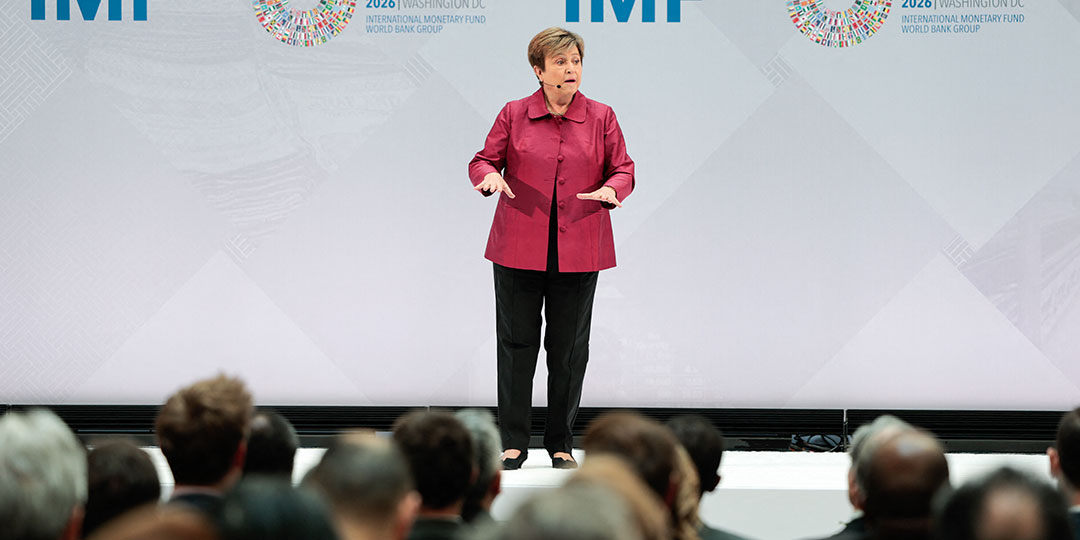
The International Monetary Fund warned Thursday that the war’s economic “scarring effects” will persist even if the conflict ends immediately. IMF Managing Director Kristalina Georgieva told reporters: “Even in a best case, there will be no neat and clean return to the status quo ante.” The IMF expects to provide between $20 billion and $50 billion in immediate financial assistance to affected member states, with particular vulnerability among countries in Asia, sub-Saharan Africa, and small island nations.
Global Growth Forecasts Downgraded
International financial institutions have revised their economic outlooks downward across multiple regions. The Asian Development Bank warned Friday that growth across Asia will slow to 5.1 percent this year and next, down from earlier projections. Under a “more prolonged conflict” scenario, growth could fall as low as 4.7 percent in 2026 and 4.8 percent in 2027 if the war extends into the third quarter.
The World Bank reported that economic growth in the Middle East region, excluding Iran, is expected to slow to just 1.8 percent in 2026, a downgrade of 2.4 percentage points from pre-war estimates. China’s growth is projected to decelerate to 4.6 percent this year and 4.5 percent next, weighed down by continued weakness in its property market and slower export growth.
Energy Dependency Amplifies Vulnerability
Asia’s status as a net energy importer leaves the region particularly vulnerable to the war’s fallout. ADB Chief Economist Albert Park explained the mechanism: “Higher energy prices can generate significant income losses. Even after energy prices normalise, supply-chain disruptions, higher producer prices, and tighter financial conditions would prolong stagflationary pressures.”
Inflation across Asia could spike by as much as 5.6 percent should the conflict continue, the ADB warned, compared to earlier projections of 3.6 percent in 2026 under an “early stabilisation scenario.”
Oil Markets Remain Volatile Despite Ceasefire
Oil prices have extended gains as the Strait of Hormuz, the world’s most critical petroleum shipping chokepoint through which one-fifth of global oil and gas passes, remains functionally closed despite the ceasefire agreement. Brent crude rose 0.6 percent to approximately $96.51 a barrel, while West Texas Intermediate gained 0.8 percent to $98.67 a barrel, hovering near the $100-a-barrel threshold.
Stock markets rallied Friday on optimism about the temporary two-week ceasefire and planned peace talks, with Tokyo, Hong Kong, Seoul, Shanghai, and Taipei all rising at least one percent. However, analysts cautioned that the ceasefire remains fragile and the Strait of Hormuz will take weeks or months to fully reopen after shipping backlogs clear.
Hormuz Strait Remains Largely Closed
Since the ceasefire took effect Wednesday, only 10 vessels have passed through the Strait of Hormuz, with just one being a non-Iranian tanker. The MSG, a Gabon-flagged oil tanker carrying approximately 7,000 tonnes of Emirati fuel oil, became the first non-Iranian vessel to transit the waterway since the truce announcement, heading to India.
Disputes Over Hormuz Tolls and Reopening Terms
Tensions persist between the United States and Iran over the conditions for reopening the strategic waterway. Iran has suggested imposing tolls on shipping transiting the Strait, prompting sharp rebukes from Western powers. US President Donald Trump warned Iran on social media: “There are reports that Iran is charging fees to tankers going through the Hormuz Strait. They better not be and, if they are, they better stop now!”
The European Union issued a formal statement asserting that “freedom of navigation in the Strait of Hormuz must be ensured with no payment or toll whatsoever,” citing international law. European Commission spokesman Anouar El Anouni stated: “International law provides for the freedom of navigation, which means basically no payment or toll whatsoever.”
British Prime Minister Keir Starmer and Trump discussed coordinating efforts to restore shipping, with Downing Street reporting they “agreed that now there is a ceasefire in place and agreement to open the Strait, we are at the next stage of finding a resolution.”
Food Security Crisis Deepens
The war’s disruption of fertilizer and diesel supplies threatens agricultural production across the developing world. The IMF projects that food insecurity will affect at least 45 million people, with higher fertilizer and diesel costs raising agricultural production expenses and potentially reducing yields later this year.
ADB economist Park warned: “Although rice prices still remain relatively low, high fertiliser and diesel prices raise agricultural costs, which could lead to less input use and lower yields later in the year, and that could contribute to food insecurity.”
In Manila, long lines formed outside rice distribution centers where residents sought government-subsidized rice at 20 pesos per kilogram as inflation pressures mount.
Major Economies Mobilize Emergency Support
Japan announced plans to release a further 20 days’ worth of oil reserves beginning in early May to help stabilize crude prices. Prime Minister Sanae Takaichi stated: “To ensure the stable supply of crude oil, we will release starting in early May the equivalent of roughly 20 days’ worth from the national reserves.”
The European Bank for Reconstruction and Development unlocked five billion euros ($5.9 billion) to support economies affected by the war. The EU also accelerated gas reserve buildup ahead of the winter heating season, with the European network transmission operator ENTSOG calling it “critical” to begin gas injections in April and continue through November.
The World Bank said it could deploy as much as $25 billion “very quickly” to developing countries, with up to $60 billion available over the longer term if needed.
Fiscal Discipline Urged Despite Economic Pain
IMF Managing Director Georgieva emphasized that governments must exercise disciplined fiscal responses rather than resorting to broad price controls or subsidies. “There is no way around” the economic pain, she told reporters, but governments must adopt “restrictive, targeted, temporary actions” to protect the most vulnerable without forcing central banks into restrictive monetary policies that would worsen the crisis.
“In a world of more shocks, of exogenous forces they have no control over, what they have control over is getting the economy in good shape,” Georgieva said.
Corporate and Market Movements
Stock markets showed signs of recovery on optimism about diplomatic progress. Japanese retail giant Fast Retailing soared 10 percent to a record high after raising its full-year operating profit outlook, boosted by strong demand for its Uniqlo brand in the United States and Europe.
Equity analyst Fabien Yip warned that while near-term recovery is possible for shares hit hardest during the conflict, “the ceasefire is temporary and the details remain sparse.” She cautioned that “even the reopening of the Strait of Hormuz will take weeks, if not months, before shipping backlogs are cleared and supply chains normalise.”
Air Travel Disruptions Continue
Air France extended suspension of flights to key Middle East destinations through May 3, citing ongoing security risks from the conflict. The decision was made before Tuesday’s ceasefire announcement, reflecting continued uncertainty about regional stability.
Emergency Financing Requests Already Arriving
The IMF has already received two emergency financing requests from affected nations, with several others signaling intent to apply. Georgieva disclosed that the IMF is engaged in intensive country-by-country discussions, with talks ongoing with Sri Lanka, Bangladesh, Egypt, Jordan, and Pakistan on adjusting existing loan programs or providing additional emergency support.
Conclusion:
The Middle East war has exposed the fragility of global supply chains and the economic vulnerability of developing nations dependent on energy imports. While a temporary ceasefire has sparked stock market rallies and limited oil price declines, the underlying damage to trade routes, fertilizer supplies, and economic confidence will persist for months or years. International financial institutions have mobilized unprecedented emergency assistance, yet the conflict’s long-term “scarring effects” remain unavoidable. The success of planned diplomatic talks in coming days will determine whether this fragile ceasefire can stabilize into a lasting peace, or whether further escalation will deepen the global economic crisis.