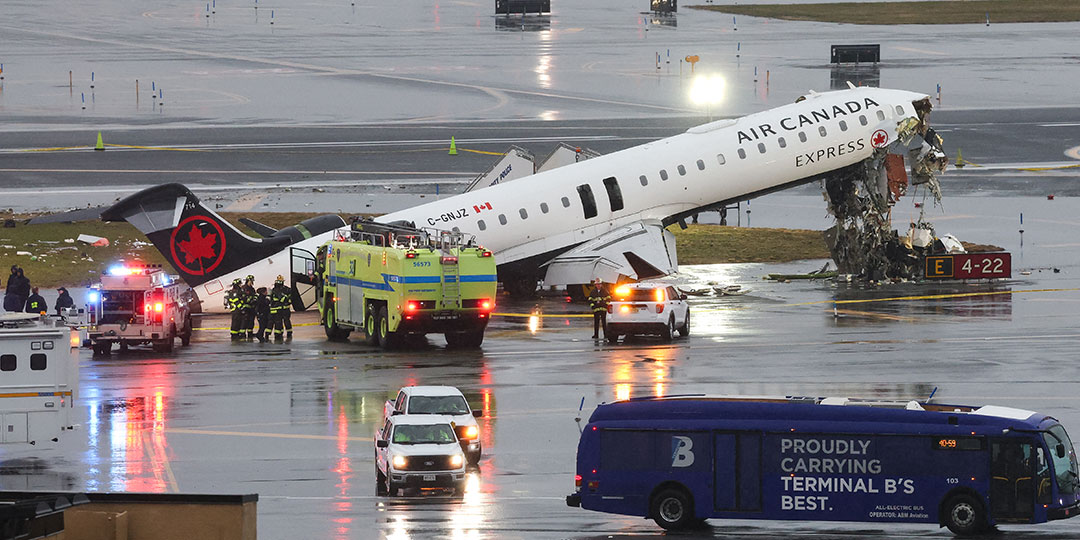

A passenger aircraft carrying dozens of people collided with a fire truck on a runway at LaGuardia Airport in New York on Sunday night, resulting in the deaths of the pilot and co-pilot, according to authorities announced Monday. The collision injured at least 41 people, some suffering “critical injuries,” prompting authorities to suspend all air traffic at the airport and launch a comprehensive investigation.
The accident involving Air Canada Express Flight AC8646 has become the most serious aviation incident at one of New York’s three major airports in recent years, raising new questions about ground operations and runway safety procedures at one of America’s busiest aviation hubs.
Deaths and Injuries in the Collision
The pilot and co-pilot of the aircraft were killed in the impact, according to Katherine Garcia, executive director of the Port Authority of New York and New Jersey. The deaths represent a significant loss among the aircraft’s 76 occupants, including four crew members.
A total of 41 people were transported to hospitals following the collision. Garcia reported that 32 injured individuals had been discharged from hospitals as of Monday. Two aviation rescue and firefighting personnel remain hospitalized with injuries that “do not represent a threat to their lives,” according to Garcia, who confirmed that both were conscious and able to speak to family members.
Extent of Aircraft Damage
Photographs from AFP show severe damage to the front of the Air Canada Express aircraft, with the cockpit suffering “serious damage.” The Bombardier CRJ-900 aircraft, operated by Jazz Aviation (a regional partner of Air Canada), was surrounded by emergency vehicles on the runway following the collision.
Details of the Collision
The collision occurred on runway 4 at approximately 11:40 p.m. Sunday (3:40 a.m. GMT Monday) when the aircraft struck a fire truck that was responding to a separate incident on the runway, according to the Port Authority of New York and New Jersey.
The aircraft had arrived at LaGuardia from Montreal, Canada, as part of scheduled service. Flight tracking platform Flightradar24 reported that the aircraft “was moving on the runway when it collided” with the fire truck that was passing through the area.
The collision triggered immediate activation of emergency response protocols, with emergency vehicles quickly surrounding the damaged aircraft.
Airport Closure and Flight Suspensions
American aviation authorities suspended all flights at LaGuardia Airport in response to the incident. The airport remained closed until at least 2:00 p.m. (6:00 p.m. GMT), according to Port Authority officials, “to allow for a comprehensive investigation.”
The suspension created significant disruptions to air traffic at one of New York’s three major airports, affecting hundreds of passengers scheduled to depart or arrive at LaGuardia.
Emergency Response and Evacuation
New York emergency management reported that passengers and crew could expect “flight cancellations, road closures, traffic delays, and heavy presence of emergency personnel” near the airport in the Queens area. Authorities urged travelers to “use alternative routes.”
The National Transportation Safety Board announced that it had dispatched a team to the accident site to investigate the cause and circumstances of the collision.
Pre-existing Operational Challenges
LaGuardia Airport was already experiencing disruptions before Sunday’s collision. The airport had been dealing with “disruptions in air traffic resulting from poor weather conditions,” according to reports posted by the airport on the social media platform X (formerly Twitter) on Sunday.
Additionally, passengers were facing longer wait times at security checkpoints due to staffing impacts from the federal funding crisis, according to announcements made the previous week. These pre-existing challenges compounded the operational difficulties created by the runway collision.
About LaGuardia Airport
LaGuardia Airport, located in Queens, ranks as the third busiest airport in New York, with approximately 33.5 million passengers passing through in 2024, according to Port Authority data.
The airport recently completed a comprehensive $8 billion modernization project in 2024, which updated its aging infrastructure through construction of new buildings and operational improvements. Despite these recent capital investments, the airport continues to face operational challenges and safety concerns.
Recent Aviation Incident History
The collision at LaGuardia comes amid a troubling pattern of aviation incidents in the United States in recent years. Most notably, a collision between a passenger aircraft and a military helicopter near Washington in January 2025 resulted in 67 deaths, representing one of the deadliest aviation accidents in recent American history.
Other incidents have occurred, or nearly occurred, while aircraft were on the ground. These continuing incidents have raised concerns about ground operations, runway safety, and overall aviation security in American airports.
Aircraft Details and Flight Information
The aircraft involved in Sunday’s collision was a Bombardier CRJ-900, operated by Jazz Aviation, the regional partner of Air Canada. The flight, designated AC8646, was arriving from Montreal, Canada, when the collision occurred.
An initial passenger manifest indicated 76 people on board, including four crew members. The aircraft is a regional jet commonly used for medium-distance routes and represents standard equipment for regional air service across North America.
Investigation Procedures
The National Transportation Safety Board (NTSB) has assumed responsibility for investigating the collision. Investigators will examine multiple factors including:
Ground control procedures and communication protocols
Visibility conditions and weather at the time of collision
Fire truck response coordination with air traffic control
Runway safety procedures and lighting
Aircraft approach and landing procedures
Human factors and decision-making by all parties
Broader Implications for Airport Operations
The collision raises critical questions about ground operations at major American airports. Incidents involving aircraft and ground vehicles are rare but potentially catastrophic. The investigation will likely examine whether existing protocols for coordinating aircraft movements with emergency vehicle responses on runways are adequate.
Questions About Runway Safety
Key questions emerging from the incident include:
How can airports better coordinate ground emergency response with ongoing aircraft operations?
Are current visibility and lighting standards sufficient for safe runway operations?
What communication protocols were in place between air traffic control and emergency vehicles?
Were proper procedures followed in positioning the fire truck on an active runway?
Impact on Air Travel and Regional Economy
The temporary closure of LaGuardia Airport, combined with the suspension of flights, creates significant economic impacts for the region. Hundreds of passengers face flight cancellations and delays, while airlines incur costs from operational disruptions. The incident may also affect confidence in airport operations during peak travel periods.
Staffing and Operational Pressures
The incident occurs at a time when airports nationwide are facing staffing challenges due to federal funding uncertainties. The combination of weather disruptions, security checkpoint delays, and now a major runway accident creates a perfect storm of operational stress for airport personnel and passengers.
Conclusion:
The collision between an Air Canada Express aircraft and a fire truck at LaGuardia Airport represents a serious aviation safety incident resulting in the deaths of two experienced pilots and injuries to 41 others. While the immediate cause of the collision remains under investigation by the National Transportation Safety Board, the incident raises troubling questions about ground operations coordination, runway safety procedures, and the adequacy of existing protocols at one of America’s busiest airports. The comprehensive investigation now underway will be crucial in determining what systemic failures, if any, contributed to the collision and what measures should be implemented to prevent similar incidents in the future. For the aviation industry and the traveling public, the accident at LaGuardia serves as a stark reminder of the complex safety challenges that modern airports must continuously address to maintain safe operations.