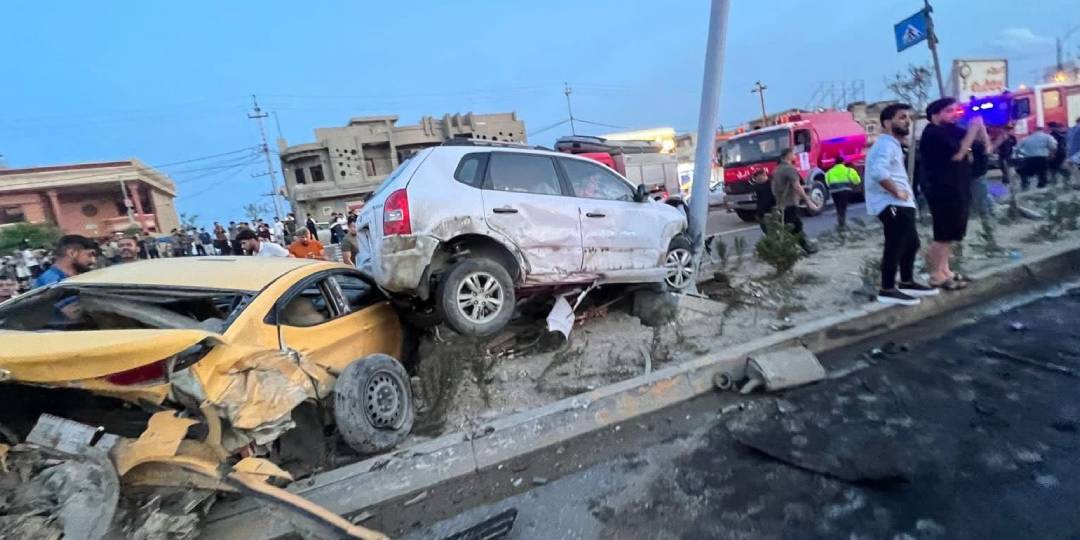

A catastrophic traffic accident occurred in the Dauraza district north of Kirkuk city, resulting in 33 total casualties comprising 6 deaths and 27 injured. The incident occurred when a driver of a “Silo Cement” truck lost control of his vehicle due to excessive speeding on the crowded Dauraza street near the cultural center, causing the truck to collide with a series of other vehicles and causing severe property damage. Eyewitness accounts transmitted by the Iraqi News Agency (WAE) confirmed the massive scale of the disaster involving multiple vehicle collisions.
Kirkuk province announced official mourning for Monday and imposed restrictions on heavy vehicle traffic entering the city from 7:00 AM until 12:00 midnight. Provincial Governor Muhammad Sumi’an confirmed readiness to transfer the most critical patients to Turkish hospitals for advanced medical care in coordination with Kirkuk Health Directorate officials. The governor ordered urgent and thorough investigation into the accident’s circumstances with strict legal procedures.
Details of the Catastrophic Traffic Accident
The accident occurred in a vital area of Kirkuk city. Eyewitness accounts transmitted by the Iraqi News Agency stated: “A large cement transport truck was traveling at high speed on the crowded Dauraza street near the cultural center.”
The witnesses added: “This caused the driver to lose control and the truck collided with a series of vehicles, causing severe property damage and panic among pedestrians.”
Accident Causation and Description
The incident reflected multiple dangerous elements:
- Primary Cause: Excessive speeding of cement truck
- Vehicle Type: Large Silo cement transport truck
- Location: Crowded Dauraza street near cultural center
- Time: Peak traffic period in populated area
- Result: Loss of vehicle control and multi-vehicle collision
Complete Casualty and Damage Toll
Health and security authorities confirmed final casualty figures. Kirkuk Health Director Arjan Muhammad stated: “The forensic medicine department received 6 bodies, while Al-Azadi Teaching Hospital admitted 26 injured.”
Director Muhammad added: “Medical personnel fully mobilized emergency efforts, currently conducting urgent surgical interventions for numerous patients suffering fractures and critical injuries.”
Distribution of Casualties and Injuries
The figures illustrate the disaster’s scale:
Deaths:
- Total fatalities: 6 persons
- Received by forensic medicine: 6 bodies
- Death timing: Immediate or very shortly after accident
Injured:
- Total injured: 27 persons
- Hospital admissions to Al-Azadi: 26 injured
- Injury types: Fractures and critical injuries
Total:
- Total casualties: 33 cases
- Critical cases: Requiring urgent surgical intervention
Extensive Material Damage and Property Loss
The accident caused widespread material damage. Kirkuk Civil Defense Director Brigadier Hisam Khalil stated: “The accident caused damage to 24 vehicles.”
Director Khalil added: “Rescue teams successfully extinguished fires that broke out in several vehicles and succeeded in evacuating citizens who were trapped inside their cars due to collision severity.”
Vehicle Damage Count and Rescue Operations
The figures reflect catastrophic scope:
Vehicles:
- Total damaged vehicles: 24 cars
- Damage degree: Severe
- Nature: Sequential multi-vehicle collisions
Secondary Incidents:
- Fires in multiple vehicles
- Citizens trapped inside vehicles
- Panic among pedestrians
Rescue Operations:
- Successful fire extinguishing
- Successful evacuation of trapped persons
- First aid provision to injured
Government and Security Authority Response
Authorities responded rapidly to the accident. Kirkuk province announced official mourning Monday and imposed vehicle restrictions.
Kirkuk Governor’s Media Spokesman Ali al-Qassab stated: “Governor Muhammad Sumi’an visited the accident victims with Kirkuk Health Director Arjan Muhammad Rashid.”
Kirkuk Province Immediate Actions
The province implemented multiple actions:
- Official Mourning: Monday following the accident
- Vehicle Bans: Heavy vehicles prohibited 7 AM to 12 midnight
- Governor’s Visit: Visiting injured and reassuring residents
- Medical Coordination: Arranging treatment in Turkish hospitals if necessary
- No Congratulations: Two-day suspension of congratulation receptions at provincial office
Health and Medical Treatment Arrangements
Health authorities prepared personnel and resources. Governor Sumi’an stated: “Provincial readiness to send patients for treatment in Turkish Republic hospitals in coordination with Kirkuk Health Director Arjan Muhammad Rashid.”
This reflects:
- Confidence in Turkish hospital capabilities
- Critical cases requiring advanced care
- International coordination for treatment
Security Investigations and Legal Procedures
The governor ordered urgent investigation. Al-Qassab stated: “Governor Sumi’an ordered police command and traffic directorate to open urgent and thorough investigation into accident circumstances and take legal procedures.”
Expected Investigation Focal Points
Investigation will focus on:
- Driver: Information and health status
- Speed: Determining truck’s speed
- Vehicle Maintenance: Truck mechanical condition
- Conditions: Weather and visibility conditions
- Procedures: Safety protocol compliance
- Responsibility: Liability assignment and legal consequences
New Precautionary Measures Implemented
Kirkuk province imposed new restrictions on heavy vehicles. The province announced: “Prohibition of heavy transport vehicles entering Kirkuk city from 7:00 AM until 12:00 midnight.”
These measures aim to:
- Prevent similar accidents
- Protect pedestrians and civilians
- Reduce congestion during peak hours
- Enforce speed limit compliance
Required Preventive Measures
Following the accident, measures required include:
- Speed Camera Activation: Monitor speeding violations
- Checkpoint Stations: Inspect heavy vehicles
- Driver Education: Road safety awareness campaigns
- Strict Penalties: Enforce speed violation penalties
- Regular Maintenance: Mandatory inspections of heavy vehicles
Official Mourning and Victim Solidarity
The province announced official mourning. Al-Qassab stated: “Governor Sumi’an ordered announcement of official mourning Monday in Kirkuk.”
He added: “Suspension of congratulation receptions at provincial office for two days in solidarity with victim families and injured persons.”
Lessons From This Tragedy
This catastrophe should teach several critical lessons:
For Drivers:
- Respect speed limits
- Exercise caution in crowded areas
- Conduct regular vehicle maintenance
For Authorities:
- Enforce traffic laws strictly
- Monitor speed with modern devices
- Implement continuous driver awareness campaigns
For Society:
- Respect traffic signals
- Exercise caution when crossing streets
- Comply with safety regulations
Impact on Community and Public Safety
The accident has profound implications:
Immediate Impact:
- Loss of 6 lives
- 27 persons injured
- 24 vehicles destroyed
- Widespread trauma and panic
Community Response:
- Official mourning recognition
- Traffic restrictions implementation
- Investigation initiation
- Public safety awareness
Long-term Implications:
- Policy review and revision
- Infrastructure improvements
- Enhanced enforcement mechanisms
- Accident prevention strategies
Support for Affected Families
The province committed to supporting affected families. The governor directed full mobilization of resources for victim care and family support:
- Medical treatment for injured
- Financial assistance for families
- Psychological counseling services
- Legal support for grieving families
Conclusion:
The Kirkuk traffic disaster represents a profound human tragedy in which six innocent lives were lost and 27 persons injured. The accident was entirely preventable had the driver complied with speed limits and traffic regulations. This catastrophe deserves to become a turning point in Kirkuk and Iraq’s traffic safety policies generally.
This tragic accident must transform into a lesson reinforcing commitment to traffic safety laws and strict enforcement of violators’ penalties. Responsible authorities must intensify supervision of drivers and heavy vehicles particularly, and provide safe environments for pedestrians and civilians on roadways. The investigation must be thorough and transparent, with results guiding future prevention strategies. Only through systematic enforcement, public education, and infrastructure improvement can such tragedies be prevented in the future.