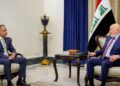
Jordan’s King Abdullah II condemned Israel West Bank measures during a meeting with Palestinian President Mahmoud Abbas in Amman, warning that the new steps represent a dangerous escalation that could fuel wider regional tensions.
The talks come amid growing international concern over Israeli decisions aimed at tightening control over the occupied West Bank and expanding settlement activity in Palestinian territories.
The Jordanian monarch stressed that these measures violate international law and undermine prospects for peace based on the two-state solution.
Jordanian and Palestinian Position
According to a statement from the Royal Court, King Abdullah II denounced what he described as illegal Israeli measures intended to entrench settlement activity and impose Israeli sovereignty over the occupied West Bank.
The king reaffirmed Jordan’s firm rejection of any decisions that violate the legitimate rights of the Palestinian people, stressing support for the establishment of an independent Palestinian state based on the two-state solution.
He also called for continued bilateral coordination with the Palestinian leadership, alongside cooperation with regional and international partners, to pressure Israel to halt what he described as a dangerous escalation.
Israel West Bank Measures Explained
The Jordanian position followed approval by Israel’s security cabinet of a package of measures that Israeli officials said would fundamentally change the legal and civil reality in the West Bank, which Israel has occupied since 1967.
Israeli Finance Minister Bezalel Smotrich and Defense Minister Israel Katz said the measures would reorganize administrative authority, including transferring powers related to settlement construction permits from Palestinian Authority-linked bodies to Israel.
The steps also include removing restrictions on Israeli purchases of land in the West Bank and expanding Israeli administrative control in parts of Palestinian cities, paving the way for further settlement expansion.
Legal and Political Background
Israel has occupied the West Bank since 1967, territory that is widely regarded as forming the core of any future Palestinian state. However, right-wing religious factions and settler groups have increasingly called for its formal annexation.
Under international law and United Nations Security Council resolutions, Israeli settlements in the occupied West Bank are considered illegal, a position rejected by successive Israeli governments.
Islamic and European Reactions
Regionally, eight member states of the Organization of Islamic Cooperation, including Jordan, issued statements condemning Israel’s expansionist and illegal policies aimed at entrenching settlements in the West Bank.
In Europe, the European Union also condemned the Israeli measures. EU spokesperson Anouar El Anouni said the steps represented another move in the wrong direction, reiterating that the bloc does not recognize Israeli sovereignty over territories occupied since 1967.
He added that any concrete action toward annexation constitutes a violation of international law, according to relevant UN Security Council resolutions.
Broader Regional Context
The developments come as regional diplomacy continues on multiple fronts. On the same day, UAE President Sheikh Mohamed bin Zayed Al Nahyan and Egyptian President Abdel Fattah al-Sisi discussed the situation in Gaza and the importance of peaceful solutions to regional crises during talks in Abu Dhabi.
According to official statements, the leaders stressed the need to implement the Gaza ceasefire agreement, allow unimpeded humanitarian aid, and push toward a just and comprehensive peace based on the two-state solution.
Conclusion:
The strong positions taken by Jordan, alongside broader Islamic and European condemnation, reflect widening international opposition to Israel West Bank measures, amid warnings that continued settlement expansion could further erode prospects for peace and increase regional instability.