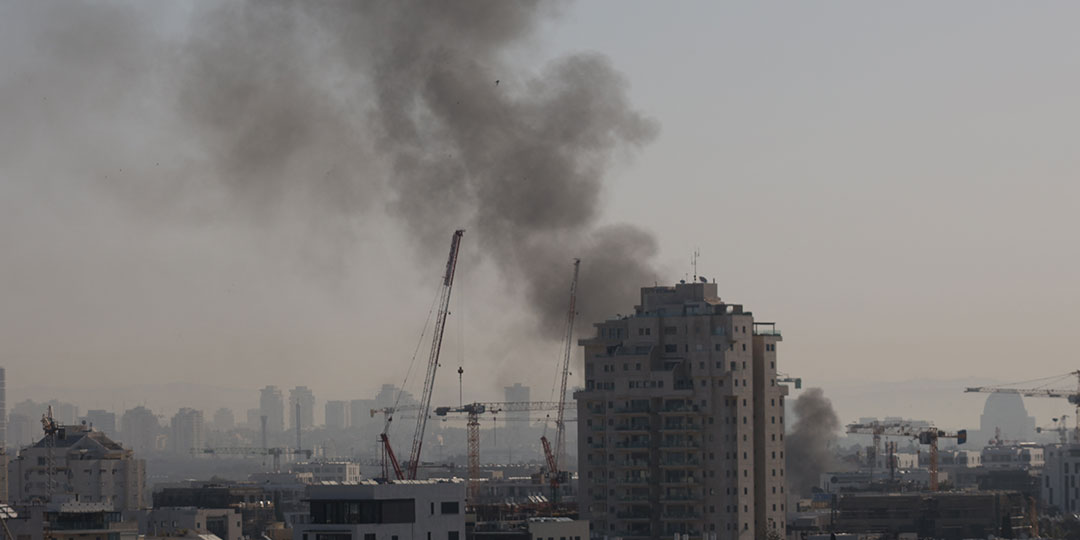

Israel’s military announced Monday that it struck a headquarters facility in Tehran belonging to Iran’s Revolutionary Guards that served as command center for directing Basij paramilitary force battalion operations across Iran. The strike represents continued Israeli targeting of Iran’s internal security apparatus following earlier elimination of Basij intelligence chief and commander Gholamreza Soleimani. Simultaneously, the Israeli military confirmed that its David’s Sling air defense system malfunctioned during Saturday’s Iranian missile strikes on Dimona and Arad, allowing two ballistic missiles to strike civilian targets and wound dozens. The convergence of Israeli offensive operations targeting Iran’s security apparatus and defensive failures against Iranian weapons demonstrates the complex tactical situation as the conflict extends into its fourth week with maritime commerce through the Strait of Hormuz reduced to only 5 percent of peacetime levels.
The combination of Israeli strikes degrading Iran’s internal security command structures with technological failures in Israeli air defense systems illustrates the multifaceted challenges facing both combatants as the conflict evolves with expanded military and economic dimensions.
Israel Strikes Tehran Basij Command Headquarters
The Israeli military announced that it struck a Revolutionary Guards facility in Tehran used as headquarters for directing Basij paramilitary force operations. The military statement characterized the strike as part of “a wave of strikes that was completed a short while ago in the heart of Tehran,” indicating coordinated multi-target operations against Iranian security infrastructure.
The Basij force comprises paramilitary battalions used for internal security operations, crowd control, and enforcement of state security apparatus across Iran. The Israeli targeting of Basij command structures reflects assessment that degrading Iran’s internal security capabilities contributes to overall pressure campaign against Iranian authorities.
Basij Force Role and Strategic Significance
The Basij paramilitary force plays central role in Iranian internal security operations, including participation in crackdowns on civilian protests and maintenance of state control over population. Human rights organizations have documented that Basij forces participated in killing thousands of civilians during recent mass protests in Iran against government policies.
The Israeli targeting of Basij command infrastructure reflects strategic assessment that disrupting Iran’s internal security apparatus contributes to undermining Iranian authorities’ grip on power and creating internal instability that could constrain government responses to external military pressure.
Command and Control Degradation
The strike on IRGC headquarters used for synchronizing Basij unit activities and conducting situational assessments targets Iran’s ability to coordinate internal security operations. By degrading command and control capabilities, Israel aims to reduce Iranian authorities’ capacity to respond cohesively to external military threats and internal security challenges simultaneously.
Israeli Military Confirms David’s Sling Malfunction
The Israeli military confirmed Monday that the David’s Sling air defense system malfunctioned during Saturday evening’s Iranian missile strikes, allowing two ballistic missiles to penetrate Israeli air defenses and strike the towns of Dimona and Arad. The malfunction of the sophisticated air defense system represents significant technological failure in Israeli defensive capabilities.
The Israeli military stated that most of the dozens of wounded from the strikes were injured by shrapnel or while rushing to shelters, with several buildings damaged in impact areas. The successful Iranian missile penetration of Israeli air defenses represents tactical victory in Iranian operation despite overall Israeli air superiority.
David’s Sling System Limitations
The David’s Sling system, operational since April 2017, was originally designed to counter heavy rockets and cruise missiles. The system functions as middle tier in Israel’s multi-layered air defense architecture, with Arrow system handling long-range ballistic missiles outside atmosphere and Iron Dome system managing shorter-range threats.
Reports indicated that Israeli military chose to employ David’s Sling against the Iranian ballistic missiles following system upgrade to preserve Arrow interceptor stocks amid concerns about extended conflict duration. The choice to use upgraded David’s Sling rather than Arrow system proved catastrophic when the system malfunctioned.
Air Defense System Upgrade and Performance
The defense ministry announced on February 11 that David’s Sling had successfully completed test series as part of “future threat readiness upgrade.” The recent upgrade was intended to incorporate “new capabilities across a wide range of challenging scenarios.” However, the Saturday malfunction demonstrates that operational deployment of upgraded system occurred before full performance validation against actual Iranian ballistic missile threats.
Iranian Missile Accuracy and Direct Impact
The successful strikes on Dimona and Arad by Iranian ballistic missiles demonstrate Iranian ability to achieve direct impact on defended targets despite Israeli air defense systems. The direct hits on civilian population centers represent successful Iranian operation despite overall Israeli claims of 92 percent interception rate for Iranian missiles.
The contrast between Israeli claims of high interception rate and successful Iranian missile penetrations raises questions about accuracy of interception statistics and actual system performance against diversified Iranian attack profiles.
Missile Accuracy Implications
The direct impact of Iranian ballistic missiles on populated towns near nuclear facilities creates radiological and humanitarian concerns beyond conventional military implications. The successful targeting of Dimona, which houses Israel’s nuclear facilities, demonstrates Iranian capability to reach defended high-value targets through Israeli air defenses.
Strait of Hormuz Shipping Collapses 95 Percent
Cargo ship and tanker traffic through the Strait of Hormuz has declined 95 percent from peacetime levels since Iranian forces effectively closed the waterway following the outbreak of conflict on February 28. Commodity carriers made only 149 crossings between March 1 and March 24, compared to approximately 2,800 crossings during equivalent peacetime periods.
Of the limited number of ships crossing the strait, 94 were oil and gas tankers, with 61 percent fully loaded and more than two-thirds traveling eastbound out of the strait toward Asian markets. The dramatic reduction in shipping reflects Iran’s effective blockade combined with shipping industry reluctance to risk passage through contested waters.
Shipping Industry Risk Assessment
The sharp reduction in transits reflects shipping industry assessment that passage through the Strait of Hormuz carries unacceptable risk despite potential profit opportunities. Insurance premiums for passage through contested waters have surged, with many shipping companies declining to attempt transit even with premium compensation.
Tehran Toll Booth System Emerges
Recent vessel passages through the Strait of Hormuz have increasingly used a purported Tehran-approved northern route around Larak Island near Iranian coast, creating what maritime industry observers have dubbed the “Tehran Toll Booth.” Lloyd’s List maritime intelligence has tracked more than 20 ships using the corridor, primarily Greek-owned vessels but also including Indian, Pakistani, and Syrian-flagged ships.
The development of the Tehran-controlled transit route reflects Iran’s ability to impose tolls and control passage while maintaining selective blockade of non-approved shipping. The Iranian Revolutionary Guard Corps is understood to verify vessel details and collect passage fees from approved transits.
Selective Blockade Strategy
The Tehran Toll Booth system represents Iranian strategy of maintaining blockade against most international shipping while permitting selective transits by friendly nations or those paying required fees. The system generates revenue for Iran while simultaneously denying shipping capacity to international commerce and maintaining economic pressure on global energy markets.
Sanctioned and Shadow Fleet Dominate Transits
Analysis of vessel transits through the Strait of Hormuz reveals that more than 40 percent of ships passing through have been under US, EU or UK sanctions. Of oil and gas tankers specifically, 57 percent operated under sanctions. The domination of sanctioned vessels and “shadow fleet” ships indicates that only vessels willing to operate under international sanctions risk passage through contested waters.
Sanctions Evasion and Shadow Fleet Operations
The prevalence of sanctioned vessels and shadow fleet ships in Hormuz transit reflects willingness of Iranian, Chinese, and other operators to operate outside international sanctions frameworks. The shadow fleet vessels are primarily owned by individuals or entities operating outside international sanctions compliance structures, enabling Iran-connected operations to continue despite sanctions.
Iranian Oil Dominates Observable Shipping
Analysis by JPMorgan commodities analysts indicates that 98 percent of observable oil traffic through the Strait of Hormuz consists of Iranian oil, averaging 1.3 million barrels daily in early March. The dominance of Iranian oil in transits reflects Iran’s ability to export controlled quantities of oil through selective permitting while denying capacity to international commerce.
Asian Markets as Primary Destination
Most oil passing through the Strait of Hormuz is directed toward Asian markets, primarily China. Chinese authorities are reportedly working on “exit plans” for large tankers stuck in the region. The diversion of LNG cargoes originally destined for Europe to Asian markets indicates global rebalancing of energy supply chains away from Europe toward Asia.
European LNG Diversion to Asia
Approximately 11 LNG tankers originally bound for Europe since March 3 have been diverted to Asian markets, reflecting restricted European supplies and higher spot prices in Asian markets. The diversion of energy supplies away from Europe toward Asia represents significant economic impact of the conflict beyond direct Middle East region.
Global Energy Market Rebalancing
The diversion of LNG cargoes and oil supplies toward Asian markets reflects rebalancing of global energy distribution away from European markets facing higher prices and reduced availability. The pattern indicates that while Asian markets benefit from access to Iranian-sourced oil and LNG, European markets face energy scarcity and price inflation.
Strategic Implications of Shipping Blockade
The effective closure of the Strait of Hormuz to international shipping represents unprecedented economic weapon against global commerce. The blockade affects approximately one-fifth of global oil and liquefied natural gas supplies in peacetime, creating systemic pressure on global energy markets and economic stability.
Israeli Offensive Against Iranian Security Apparatus
Israel’s systematic targeting of Iranian security officials and command structures reflects broader strategy of degrading Iranian authorities’ capacity to respond to external and internal challenges. The elimination of Basij intelligence chief and commander followed by strikes on command headquarters indicates Israeli intent to systematically dismantle Iran’s internal security apparatus.
Key Developments in Conflict Expansion:
- Israel strikes Tehran Revolutionary Guards Basij command headquarters
- Facility directed Basij paramilitary battalion operations across Iran
- David’s Sling air defense system malfunction confirmed Monday
- Two Iranian ballistic missiles penetrated Israeli defenses Saturday
- Dimona and Arad towns struck with direct hits
- Dozens wounded in air defense failure incidents
- Strait of Hormuz shipping reduced 95 percent from peacetime
- Only 149 cargo crossings March 1-24 versus ~2,800 in peacetime
- Tehran Toll Booth route diverts ships through Iranian territorial waters
- Iranian authorities collect passage fees from approved transits
- 98 percent of observable oil traffic consists of Iranian oil
- 40+ percent of transiting ships under international sanctions
- LNG cargoes diverted from Europe to Asia
- 1.3 million barrels Iranian oil daily transiting strait