
Israel’s military announced Saturday it had destroyed 16 aircraft belonging to the Quds Force, the branch of Iran’s Revolutionary Guards overseeing foreign operations, at Tehran’s Mehrabad International Airport. The operation formed part of a broad overnight wave of strikes across the Iranian capital, involving more than 80 Israeli fighter jets targeting military infrastructure, command centers, and missile facilities.
The operation represents one of the most intense bombing campaigns Israel has conducted since the U.S.-Israeli war against Iran began on February 28. Israeli military officials stated the strikes aim to reduce Iran’s capacity to launch retaliatory missiles against Israeli territory.
The ongoing military escalation reflects expanding regional conflict that extends beyond Iran’s borders into Lebanon, involving direct military cooperation with major Western powers. The use of British military bases for American operations marks a significant widening of Western engagement in the Middle Eastern conflict.
Aircraft Destruction at Mehrabad Airport
Israel’s Air Force “completed a broad wave of strikes across Tehran and on military infrastructure located at Mehrabad Airport,” according to a military statement released Saturday.
The statement said “16 aircraft of the Quds Force unit of the Islamic Revolutionary Guard Corps were precisely dismantled.” Israel’s military accused the Revolutionary Guards of using Mehrabad International Airport, one of two major airports serving the capital, to funnel cash and weapons to proxy forces across the Middle East, including Lebanon’s Hezbollah.
Additional Military Targets
Israeli airstrikes extended beyond aircraft destruction to encompass multiple military objectives. The military statement noted that “several Iranian fighter jets that posed a threat to Israeli Air Force aircraft operating in Iranian airspace” were also targeted.
Operations extended to command and control centers, particularly an underground command center for Iran’s air force. The strikes also targeted facilities for manufacturing ballistic missiles and their storage sites, according to Israeli military statements, as well as missile launch locations.
Scale and Nature of Overnight Operations
Deployment of Over 80 Fighter Jets
Israel’s Air Force deployed more than 80 fighter jets in the coordinated overnight assault on Saturday. Military statements indicated these aircraft “completed an additional wave of strikes targeting infrastructure belonging to the Iranian terror regime,” in Israel’s characterization of Iran’s government.
Operations included strikes on the Central Military Academy of the Revolutionary Guards, known as Imam Khomeini Military University, which Israeli authorities said “was being used as an emergency asset” and as an operations center for Revolutionary Guard forces.
Israel classified the facility as “a lawful military objective” based on its use for active military operations.
Military Leadership Participation
Israeli media reported that General Tomer Bar, commander of Israel’s Air Force, personally participated in an overnight sortie to strike Tehran, reflecting the operational significance Israel attached to the mission.
Pattern of Sustained Escalation
When Israel joined the United States in an initial massive wave of strikes against Iran at the war’s start, the Israeli military said 200 fighter jets participated in those raids, calling them “the largest in the history of the Israeli Air Force.”
The current operation with more than 80 aircraft represents sustained aerial bombardment, demonstrating Israel’s commitment to degrading Iran’s military capabilities.
British Military Facilities and Western Engagement
Expansion of American Operations from British Bases
The United Kingdom announced Saturday that the United States had begun using British military bases for “specific defensive operations” against Iran as part of the broader Middle Eastern conflict.
The British Ministry of Defence stated formally that “the United States has begun using British bases in specific defensive operations in order to prevent Iran from launching missiles at the region, which puts British lives at risk.”
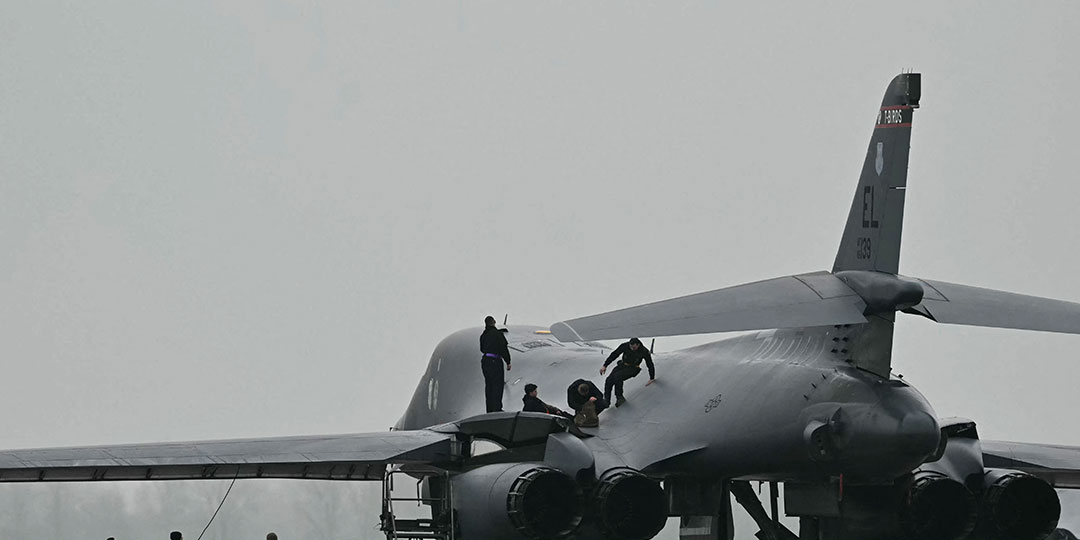
Two specific bases were authorized for American operations: RAF Fairford in Gloucestershire, southwest England, and Diego Garcia in the Chagos Archipelago in the Indian Ocean. AFP photographers documented the arrival of an American B-1 strategic bomber at RAF Fairford, and an American C-5 Galaxy transport aircraft appeared on the base’s runway. Anti-war protests were organized around Fairford following the announcement of American base usage.
Political Context and Initial Resistance
Prime Minister Keir Starmer provoked criticism from U.S. President Donald Trump by initially refusing direct engagement in the conflict between the United States and Israel on one side and Iran on the other, which began on February 28.
Trump criticized Starmer’s position sharply, comparing him unfavorably to British wartime leader Winston Churchill. Trump stated, “This person we’re dealing with is not Winston Churchill.”
However, Starmer, a former lawyer and human rights activist, subsequently agreed to the U.S. request to use the two military bases “for specific defensive purposes.”
Strategic Rationale and Legal Framework
Starmer defended his initially cautious approach, stating that any British military intervention “must always be based on a sound legal footing and a carefully considered, implementable plan.”
Later, he justified his decision to allow U.S. use of British bases, arguing that “Iranian retaliatory attacks with missiles and drones in response to American-Israeli strikes threaten British interests and those of allies in the region.”
Starmer’s position reflected a desire to avoid entanglement in another protracted regional conflict. He stated, “We all remember the mistakes made in Iraq, and we have learned from them.”
This reference invoked the 2003 Iraq invasion, which was supported by former Prime Minister Tony Blair despite massive protests involving millions in London streets. The Blair government faced accusations of fabricating evidence regarding Iraqi weapons of mass destruction.
British Public Opinion Survey
A poll released Friday surveying 1,045 British citizens found 56 percent believed Starmer was right in refusing initial British involvement in opening strikes against Iran. However, 27 percent considered his position wrong, reflecting substantial divisions over British foreign policy regarding Middle Eastern conflict.
War protesters organized demonstrations at RAF Fairford following the announcement of American base usage, indicating sustained public concern regarding military escalation.
Military Objectives and Assessment of Iranian Threat
Reducing Missile Capabilities
Israeli military officials explained that the strategic purpose of targeting missile storage facilities, manufacturing plants, and launch sites was to “reduce the scope of fire directed at the territory of the State of Israel.”
This objective reflects Israeli assessment that Iran’s continued missile development and deployment represents an existential threat requiring sustained military degradation of capabilities.
Comprehensive Infrastructure Targeting
The range of targets struck during overnight bombardment reveals a systematic approach to dismantling Iran’s integrated military system. From aircraft and fighters to command centers and missile facilities, the operation targeted the unified military infrastructure enabling Iran to project power.
Continuity of Military Strategy
Israeli military doctrine emphasizes sustained pressure on Iranian capabilities through coordinated air operations. The scale and frequency of strikes indicate a strategy of progressive degradation rather than a single decisive blow, suggesting preparations for extended military engagement.
Conclusion:
The destruction of 16 Quds Force aircraft at Mehrabad Airport and the broader wave of Israeli strikes reflect military escalation driving Middle Eastern conflict into new dimensions. The expansion of American military operations through British bases deepens Western engagement in regional conflict, moving beyond direct combat into logistical and strategic support. However, divisions in British public opinion and historical memory of previous Middle Eastern military interventions suggest persistent domestic constraints on sustained Western military commitment to the region. The conflict demonstrates how regional tensions extend beyond direct belligerents to involve major global powers in support roles that test domestic political tolerance for military engagement.