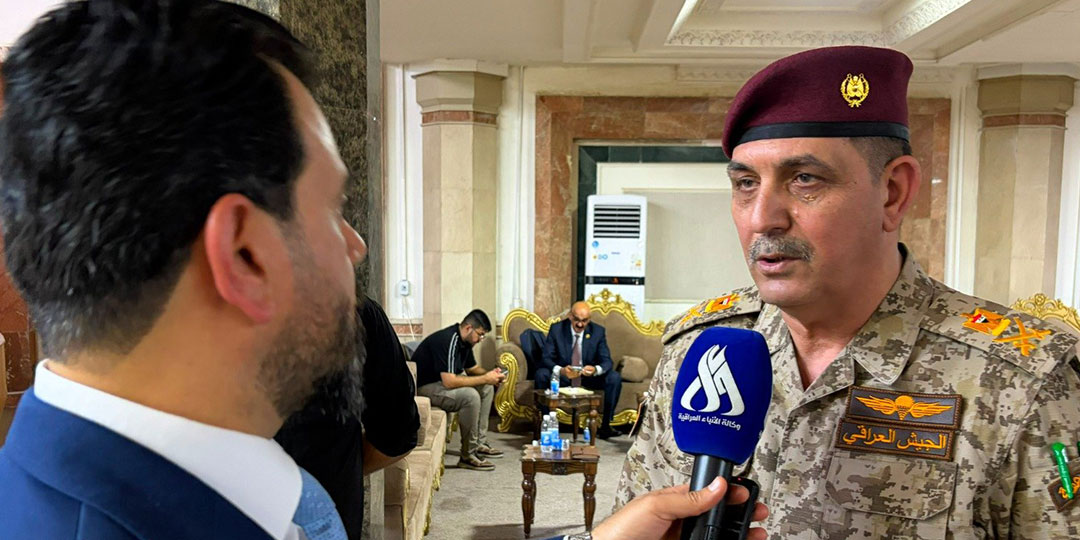

Iraq’s Defense Ministry said on Friday that it is working to complete the country’s air defense system, while spokesman Major General Yahya Rasool said Commander in Chief of the Armed Forces Ali Faleh Al-Zaidi had ordered the development plan for the air defense system to be reduced from six years to three.
Rasool told the Iraqi News Agency that Iraq’s armed forces have five service commands, namely the army, navy, air force, air defense, and army aviation, and that the overall system must be completed and operate in a balanced way. He said the air force and army aviation already have strong capabilities, but work is continuing to complete the broader defense structure.
A Faster Timeline for Air Defense
From Six Years to Three
Rasool said the army chief of staff had originally submitted a study based on a six-year timeline, in line with the budget available. However, after the commander in chief visited the air defense command, he ordered the timeline cut from six years to three, without affecting the ability to build the air defense system.
That decision, he said, is intended to speed up modernization and delivery of a more complete air defense structure within a shorter period, making the issue a major priority for Iraq’s defense establishment in the coming phase.
A System Made Up of Missiles and Radars
The Defense Ministry spokesman said air defense is not a single weapon but a complete system made up of missiles, platforms, and radars of long, medium, and short range. He said the ministry is currently working to complete these elements through continued contact and meetings with reputable international companies.
He added that Iraq already has French radars that are operating efficiently and have been deployed across air defense sectors, but the country still needs a fully integrated system to ensure greater effectiveness and flexibility.
Air Force and Army Aviation Under Development
Strong Capabilities That Still Need Expansion
Rasool said the air force and army aviation already have good capabilities, but work is ongoing to complete them as part of a broader vision for Iraq’s defense system. He said the goal is to create a balanced structure across all branches of the armed forces, with each service command functioning at full capacity.
The approach reflects Iraq’s effort to make air defense one of the key pillars of national security, especially as regional security challenges and military developments continue to evolve.
Security Media Says Iraq Has Advanced in Security Diplomacy
Cooperation Without Sacrificing Sovereignty
Meanwhile, head of the Security Media Cell Lieutenant General Saad Maan said Iraq has reached advanced stages in security diplomacy, adding that this approach has helped resolve several security files. He said security diplomacy does not mean giving up sovereignty, but rather protecting it through cooperation, coordination, and agreements.
Maan said the state now needs force to remain under the authority of the state, weapons to remain under legal cover, and the national security decision to remain one sovereign decision. His comments reflect a push to keep security policy firmly within state institutions while making use of diplomatic tools.
From “Whether” to “How”
Maan said Iraq has moved from the stage of asking whether a solution is possible to the stage of asking how it can be implemented. He said the country has moved from the question of “whether” to “how,” meaning the focus is no longer on whether a response is possible, but on the practical mechanisms needed to carry it out.
He added that all options and mechanisms remain available to achieve the required effect and response.
What the Statements Suggest
Military Modernization and Diplomatic Coordination
The remarks from the Defense Ministry and the Security Media Cell suggest that Iraq is moving along two parallel tracks: modernizing its defense capabilities, especially air defense, and strengthening security diplomacy to manage sensitive files within a sovereign framework.
The government appears to be seeking stronger military readiness on one hand and wider political and security coordination on the other, in line with the requirements of domestic stability and responses to external threats.
Sovereignty as the Core Priority
Both the military and security messaging point to sovereignty as the central objective, whether through completing the air defense system or by reinforcing the principle of a single sovereign national security decision. That makes the coming period a key one for reshaping Iraq’s defense structure and organizing its security tools more effectively.
Conclusion:
Iraq’s Defense Ministry says it is working to complete the air defense system after the commander in chief ordered the development plan accelerated from six years to three. At the same time, the Security Media Cell says Iraq has made progress in security diplomacy. Together, the statements point to a broader effort to modernize Iraq’s defense capabilities while keeping the national security decision firmly under state authority.