
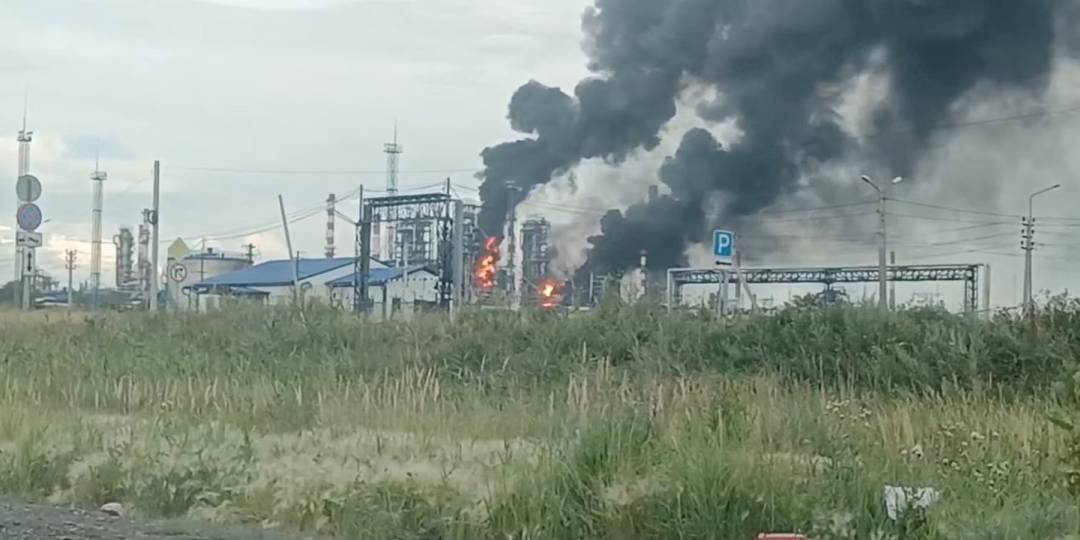

Russian emergency authorities reported a large fire at the major oil processing refinery in the Ryazan region southeast of Moscow on Thursday, October 15, 2026, following a coordinated strike using unmanned aerial vehicles and missiles. The incident coincided with an official statement from Ukrainian President Volodymyr Zelensky confirming that his military has resumed targeting Russian oil refineries, formally withdrawing from the unilateral energy truce recently put forward by United States President Donald Trump.
The industrial blaze at Ryazan occurred alongside a separate long-range naval operation conducted by Ukrainian forces, which struck the Borisoglebsk military airfield in the Voronezh region using modified Neptune cruise missiles. Ukrainian military commands reported that the deep-penetration strike inflicted structural damage on six Russian front-line strike aircraft parked on the aprons.
The synchronized strikes underscore the collapse of diplomatic attempts to establish an informal moratorium on energy infrastructure targeting. As Russian ballistic salvos continue to degrade Ukrainian regional power grids and transformer stations ahead of winter, Kyiv has returned to striking hydrocarbon processing plants deep inside Russian territory, raising fresh concerns over global refined product supplies and regional fuel price volatility.
“`
+————————————————————-+
| Strategic Infrastructure Strikes Summary |
+————————————————————-+
| Primary Industrial Target | Ryazan Oil Refinery (Rosneft) |
| Military Target | Borisoglebsk Airfield (Voronezh) |
| Munitions Deployed | Strike drones & Neptune missiles |
| Tactical Damage Reported | Distillation fires & 6 Su-34 jets|
| Diplomatic Policy Shift | Formal exit from energy truce |
+————————————————————-+
“`
Kyiv Drops Energy Truce to Resume Targeting Russian Oil Refineries
In an interview published by the Financial Times, President Volodymyr Zelensky announced that Ukrainian forces have returned to regular offensive operations against Russian downstream oil infrastructure. Zelensky explained that the decision comes after repeated Russian missile and drone strikes knocked out major Ukrainian electrical generation plants and local substations over recent weeks, leaving hundreds of thousands of civilians without power.
The Russian Defense Ministry released an operational update stating that Ukrainian formations attempted a wide-scale saturation assault against the Ryazan refining complex. While air defense batteries intercepted several incoming drones, falling wreckage and secondary detonations triggered fires across processing units and storage tanks, prompting municipal emergency crews to isolate the blaze and halt selected production trains.
Russian state media previously noted that Ukrainian drones attempted to attack refineries in both Ryazan and Saratov, highlighting a strategy by Kyiv to disrupt fuel logistics that supply Russian armed forces and maintain domestic consumer fuel markets.
Operational Impact on Downstream Energy Infrastructure
– Direct disruption to the Ryazan refinery, a vital asset with an annual processing capacity exceeding seventeen million tons supplying central Russia and Moscow.
– Recurrent drone strikes forcing emergency operational shutdowns and technical assessments across primary crude distillation units.
– Rising domestic Russian wholesale fuel price pressures as export bans and refining outages constrain diesel and gasoline inventories.
– Renewed international criticism from US President Donald Trump, who warned that hitting refining assets exacerbates global fuel deficits and drives crude prices higher.
Ukrainian Navy Deploys Neptune Missiles Against Borisoglebsk Airfield
In a synchronized long-range operation, the Ukrainian Navy confirmed that it carried out a precision strike against the Borisoglebsk military airfield in Russia’s western Voronezh region, located more than 340 kilometers from the active line of contact. The strike utilized ground-attack variants of the domestically developed R-360 Neptune cruise missile system.
Ukrainian military communiques stated that the salvos penetrated regional air defenses protecting the airfield, directly hitting revetments and service aprons. The Ukrainian Navy asserted that six modern Russian Sukhoi Su-34M multi-role fighter-bombers sustained operational damage, temporarily degrading tactical bombing sorties launched against northeastern Ukrainian frontline positions.
Military Significance of the Voronezh Air Base Strike
– Utilization of domestically upgraded Neptune cruise missiles flying at low altitudes to bypass Russian radar networks.
– Direct targeting of forward staging facilities hosting Su-34 aircraft, the primary platform used to release guided glide bombs against Ukrainian defenses.
– Demonstration of extended strike capability reaching targets over 340 kilometers across the border into Russian territory.
– Concurrent disruption of airfield ammunition depots, aircraft fuel storage facilities, and flight readiness lines.
Mutual Attrition and the Collapse of Infrastructure Safeguards
Since the outbreak of large-scale hostilities in February 2022, both military commands have issued regular operational claims that cannot be independently confirmed due to strict operational security protocols and ongoing combat conditions. However, the visible escalation against industrial and military targets signals an intensifying phase of attrition.
Energy analysts observe that mutual attacks against civilian grids and downstream refining complexes carry severe structural consequences. While Russian strikes threaten Ukraine’s power grid during freezing temperatures, Kyiv’s strikes on refining centers constrain Russia’s fuel production and military supply lines, ensuring that energy infrastructure remains central to the battlefield dynamic.
Conclusion:
The fire at the Ryazan refinery and the missile strike on Borisoglebsk airfield demonstrate that targeting Russian oil refineries and military staging bases remains central to Ukraine’s defensive strategy. With the informal energy truce abandoned and long-range weapons strikes expanding, the war continues to degrade energy security and heighten volatility across global petroleum markets.