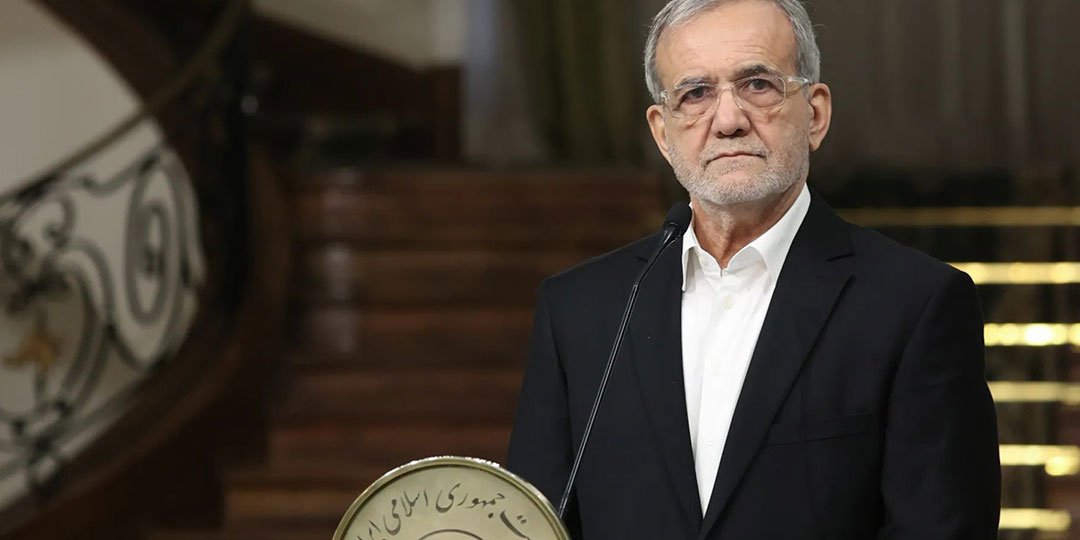

Iranian President Masoud Pezeshkian affirmed Sunday that Iran stands ready to reach “a balanced and fair agreement ensuring sustainable peace and security in the region,” during a telephone discussion with Russian President Vladimir Putin regarding Islamabad negotiations. Pezeshkian stated “The greatest obstacle to reaching a fair agreement is the existence of double standards and authoritarian tendencies from the American side,” yet affirmed that “our red line is national interests, and if America commits to international legal frameworks, the agreement will not be difficult to achieve.”
Conversely, US President Donald Trump announced a comprehensive naval blockade of the Strait of Hormuz, stating “Either the Strait opens to everyone or to no one,” while raising demands regarding Iran’s nuclear file. Iran responded through the Revolutionary Guards asserting “complete control” over the strategic waterway, while Egypt and Pakistan intensified diplomatic efforts to de-escalate tensions and maintain the ceasefire framework.
Iran Affirms Readiness for Balanced Agreement
President Pezeshkian emphasized Iran’s diplomatic flexibility during his discussion with Russian counterpart Putin. The Iranian presidency stated in an official statement “President Pezeshkian discussed by telephone with his Russian counterpart Vladimir Putin the current ceasefire announcement and the progress of Islamabad negotiations.”
Pezeshkian reaffirmed Iran’s fundamental position to Putin: “Readiness to reach a balanced and fair agreement ensuring sustainable peace and security in the region,” reflecting an Iranian vision emphasizing logic and equality.
Iranian Conditions for Agreement and Red Lines
President Pezeshkian clarified Iranian conditions with precision. He stated “The greatest obstacle to reaching a fair agreement is the existence of double standards and authoritarian tendencies from the American side,” directly referencing American negotiating practices.
He emphasized red lines clearly: “Our red line is national interests, and if America commits to international legal frameworks, the agreement will not be difficult to achieve.” This position reflects Iranian confidence that agreement remains possible if the United States adheres to international law.
Egypt and Pakistan Intensify De-escalation Diplomatic Efforts
Egyptian Foreign Minister Badr Abdelatti conducted a telephone call with his Pakistani counterpart Muhammad Ishaq Dar on Sunday. Egyptian Foreign Ministry Spokesperson Tamim Khallaf stated “Abdelatti conducted a telephone call with his Pakistani counterpart to assess the latest regional developments and coordinate shared efforts between the two countries.”
The call followed “negotiations conducted between the United States and Iran in Islamabad,” reflecting intensive regional coordination.
Assessment of Negotiations and Results
Pakistan’s Foreign Minister briefed his Egyptian counterpart on negotiation details. The statement noted that “Pakistan’s Foreign Minister briefed Minister Abdelatti during the call on negotiations conducted between the United States and Iran in Islamabad,” reflecting continued coordination importance.
Foreign Ministers Affirm Diplomatic Course
Both Egyptian and Pakistani foreign ministers emphasized the diplomatic path’s significance. The statement declared “The foreign ministers affirmed the importance of continuing shared efforts to advance the diplomatic course and prioritize dialogue and peaceful solutions, preserving security and stability and preventing further escalation in the region.”
Both ministers emphasized “the importance of continuing their steady efforts and intensified contacts to reduce escalation and advance commitment to the diplomatic course to reach consensus regarding all concerns.”
Trilateral Regional Coordination
Pakistan’s Foreign Minister praised “the level of coordination existing among Egypt, Pakistan, and Turkey,” commending “existing cooperation and shared commitment to containing tension and working jointly to advance the diplomatic course.”
Trump Escalates: Nuclear File and Naval Blockade
US President Donald Trump adopted a harder stance on Sunday. Trump stated “The Iranians have not left the negotiation table and I expect they will return,” yet added that “the reason for disagreement in negotiations is the nuclear file.”
Trump announced a new military action: “Either the Strait of Hormuz opens for everyone or for no one,” indicating “we expect many countries to help us impose a comprehensive and complete blockade on the Strait of Hormuz.”
Trump’s Assessment of Negotiations and Nuclear Ambitions
Trump expressed measured optimism: “Yesterday’s meeting in Islamabad was very good except for the nuclear weapons issue.” He added with absolute confidence “We carefully monitor Iranian nuclear sites and they cannot move anything without us seeing it, and I believe Iran will soon abandon its nuclear ambitions.”
International Cooperation on Hormuz Closure
Trump indicated anticipated international cooperation. He stated “NATO now wants to help regarding the Strait of Hormuz, and we expect Britain and other countries will send minesweepers to remove mines from the Strait of Hormuz.”
This statement reflects American efforts to mobilize an international coalition regarding the Hormuz issue.
Blockade Strategy and Military Pressure Tactics
The announced blockade represents an economic and military pressure tool intended to coerce Iran into abandoning its nuclear stance.
Revolutionary Guards Respond: Complete Strait Control
Iran responded through the Islamic Revolutionary Guard Corps with assertions of control. The Guards stated on Sunday “All transit movements in the Strait of Hormuz are subject to complete control by our armed forces.”
The Guards added a sharp warning: “Any wrong move will place the enemy in deadly vortices inside the Strait of Hormuz.” They emphasized “all movements remain under complete control of the armed forces.”
Iranian Response and Military Capabilities
The Revolutionary Guards’ response reflects Iranian confidence in its capacity to protect and control the Strait of Hormuz militarily.
American Analysis: Blockade Aims to Seize Hormuz Card
A senior American official revealed underlying objectives. The news site “Axios” reported the official stating “The American administration made this decision to end Iranian control of the passage,” stressing “we want to seize this card from Iranian hands.”
This statement reflects frankness regarding American blockade objectives.
Strategy of Seizing Strategic Card
The blockade represents American attempts to undermine one of Iran’s most important strategic and economic cards.
Parallel Military Escalation and Diplomatic Course
The current situation reflects complex parallelism between military escalation and diplomatic efforts. While Egypt, Pakistan, and Iran seek to maintain the diplomatic course, the United States escalates military and economic pressure.
Multi-Dimensional Pressure Tactics
The American administration combines naval blockades, diplomatic pressure, and nuclear threats to coerce Iranian concessions.
Indications of Division Over Negotiation Priorities
The situation reflects clear division among parties regarding settlement priorities. Iran, Egypt, and Pakistan emphasize regional peace and stability, while the United States focuses on the nuclear file and Hormuz control.
Fundamental Disagreements Over Agreement Terms
Widening gaps indicate fundamental disagreements that could obstruct comprehensive agreement.
International Legal Framework and Double Standards
Iranian President Pezeshkian’s references to “double standards” and international legal frameworks reflect deeper philosophical disagreements. Iran emphasizes adherence to international law and equal treatment, while the US approach emphasizes strategic advantage and pressure mechanisms.
Conflicting Visions of International Relations
The disagreement extends beyond specific issues to fundamental approaches to international relations and legal frameworks.
Strategic Importance of Hormuz and Nuclear Issues
Both the Hormuz blockade and nuclear demands reflect core American strategic interests. Control over Hormuz ensures influence over global energy flows, while limiting Iran’s nuclear capabilities addresses long-term strategic concerns regarding regional balance.
Interconnection of Strategic Issues
The US strategy links multiple issues together, suggesting that progress requires comprehensive settlements across multiple domains.
Timeline and Momentum Concerns
Observers question whether intensive diplomatic efforts can match accelerating military escalation. The blockade announcement suggests American determination to increase pressure regardless of ongoing negotiations.
Risk of Negotiation Collapse
If escalation continues while negotiations proceed, the risk increases that talks collapse entirely.
Conclusion:
Current developments reflect escalating tension between diplomatic course and military-economic escalation. While Iran affirms readiness for balanced agreements, the United States intensifies pressure on nuclear files and Hormuz control. Egypt and Pakistan play pivotal roles attempting to maintain diplomatic channels and de-escalate tensions. The fundamental question remains whether intensive diplomatic efforts can prevent further escalation and achieve agreement satisfying all parties, or whether fundamental disagreements will produce additional crises. The coming days will prove critical in determining whether diplomatic pressure or military threats prove decisive in shaping the region’s trajectory.