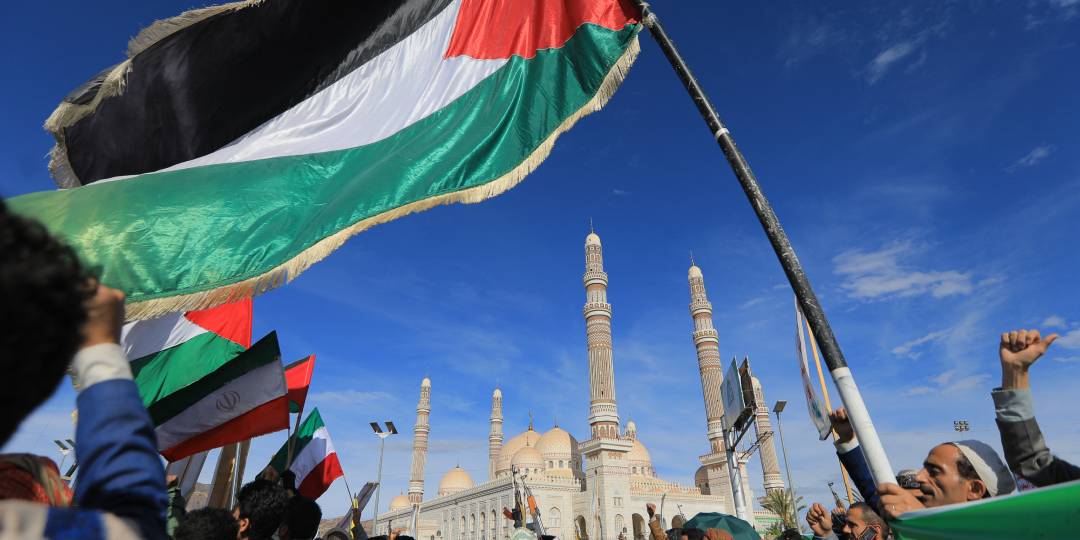

Yemen’s Houthi movement issued a stark warning Friday that it would launch direct military intervention in the month-old Middle East conflict if the United States and Israel continue attacks targeting Iran or if additional nations join the hostilities. The warning coincided with Saudi Arabia reporting the interception of a ballistic missile targeting the Riyadh region, and US President Donald Trump demanding Iran open the Strait of Hormuz as a condition for peace negotiations.
The convergence of escalation warnings, ongoing missile attacks, and diplomatic demands reflects the volatile nature of the widening regional conflict and the multiple actors now signaling potential or active involvement.
Houthis Threaten Direct Military Intervention
Yemen’s Houthi movement stated Friday: “We affirm that our fingers are on the trigger for direct military intervention.” The warning specified that direct action would occur if the United States and Israel continue strikes against Iran or if additional nations enter the conflict.
The group also warned it would act if the Red Sea was used for “hostile operations,” suggesting Houthis view the strategic waterway as critical to their decision on military engagement. This represents an escalation from the group’s previous attacks on shipping in response to regional conflicts, which have not involved direct intervention in major military operations.
Previous Houthi Red Sea Operations
The Houthis have a documented history of attacking commercial shipping in the Red Sea in response to regional conflicts. However, despite the month-long Middle East war between the United States, Israel, and Iran, the movement has thus far refrained from direct military intervention, maintaining what observers described as strategic restraint.
The Friday warning suggests this restraint may be conditional rather than permanent, contingent on the scope and targeting of external military actions.
Saudi Arabia Intercepts Ballistic Missile
Saudi Arabia’s defence ministry announced Saturday that it had intercepted and destroyed a ballistic missile fired in the direction of the Riyadh region. The interception represents one of multiple missile strikes Iran has reportedly directed against Saudi Arabia and other Gulf neighbors during the month-long conflict.
Ongoing Iranian Missile Campaign
The reported interception comes amid a broader pattern of Iran conducting missile strikes against Gulf states, including Saudi Arabia, as part of its military response to coalition actions. The accuracy and sophistication of Iranian missile systems have drawn international attention regarding the effectiveness of air defense systems deployed across the Gulf region.
Trump Issues Ultimatum on Strait of Hormuz
US President Donald Trump stated Friday that Iran must open the Strait of Hormuz to oil traffic as a condition for peace negotiations. Speaking at a Saudi-backed investment forum in Miami, Trump declared: “We’re negotiating now, and it would be great if we could do something, but they have to open it up.”
Trump characterized negotiations as ongoing despite Iranian denials of readiness to engage in peace talks, asserting that Tehran’s leadership had suffered significant military and strategic damage.
Trump’s “Strait of Trump” Nomenclature
During his remarks, Trump briefly referred to the Strait of Hormuz as the “Strait of Trump” before self-correcting, stating: “They have to open up the Strait of Trump — I mean Hormuz. Excuse me, I’m so sorry. Such a terrible mistake.”
When pressed by media on the comment, Trump responded: “There’s no accidents with me, not too many,” suggesting the naming comment was intentional rather than accidental. This reflects Trump’s established pattern of renaming major Washington landmarks and infrastructure with his own name during his second presidential term.
Trump’s Naming History
Trump has previously ordered the renaming of Washington’s Kennedy Center to the “Trump-Kennedy Center” and directed the renaming of the Gulf of Mexico to the “Gulf of America.” A Washington-based peace institute was also renamed to bear Trump’s name. The Strait of Hormuz reference represents an attempt to extend this naming pattern to international geography.
Strait of Hormuz Closure and Global Energy Impact
The Strait of Hormuz, through which approximately one-fifth of global oil normally transits, was open to international shipping before the conflict commenced. Since the conflict began, the narrow strategic waterway has effectively ground to a standstill, contributing to a significant surge in global energy prices.
US Concerns About Iranian Tolling System
US Secretary of State Marco Rubio voiced alarm Friday that Iran could establish a permanent “tolling system” for vessels transiting the Strait, effectively creating a tax or fee on international commerce. Such a system would allow Iran to generate revenue while restricting access, potentially serving as leverage in negotiations while damaging the global economy dependent on oil transit through the waterway.
Trump’s Claims of Iranian Damage and Capitulation
Trump asserted that Iran was “on the run” and claimed that Tehran’s military leadership, navy, air force, and nuclear program had all suffered “significant damage.” These claims were offered without independent verification and directly contradicted by Iranian statements asserting military resilience and continued defensive capabilities.
Trump’s Venezuela Oil Control Precedent
Trump referenced the US approach to Venezuelan oil as a potential model for Iran, stating: “It’s an option to take control of Iran’s oil as the United States has effectively done with Venezuela.” This comment suggested consideration of direct seizure or control of Iranian petroleum resources, despite the ongoing conflict and absence of US military occupation of Iranian territory.
The Venezuela reference pointed to US sanctions and asset seizure policies, raising questions about whether Trump envisioned similar unilateral economic control mechanisms or military seizure of Iranian oil infrastructure.
Broader Context of Escalating Threats
The convergence of Houthi intervention warnings, Saudi missile interceptions, and Trump’s negotiation ultimatums illustrates the multi-directional escalation pressures in the Middle East conflict. Multiple actors are signaling readiness to expand military involvement or alter strategic conditions as leverage in ongoing hostilities.
Diplomatic Complications Amid Military Escalation
Trump’s insistence on the Strait of Hormuz opening as a peace condition, combined with Houthi warnings of intervention and Iranian missile strikes, creates a complex negotiating environment where military advantage, economic coercion, and territorial control become intertwined with diplomatic objectives.
Conclusion:
Yemen’s Houthi movement warning of direct military intervention, Saudi Arabia’s report of a ballistic missile intercept, and US President Trump’s ultimatum regarding the Strait of Hormuz reflect the volatile and escalating nature of the Middle East conflict in late March 2026. The Houthis’ conditional threat of intervention suggests a threshold-based calculus governing their military decisions, while Saudi’s missile interceptions and Trump’s naming of international waterways illustrate the multiple layers of military, economic, and political competition shaping the conflict. As negotiations remain uncertain and military operations continue, the region faces potential expansion of active combatants and further disruption of critical energy infrastructure. Trump’s assertion of ongoing negotiations contradicts Iranian denials, suggesting substantial daylight remains between negotiating positions despite military pressure and economic sanctions against Iranian interests.