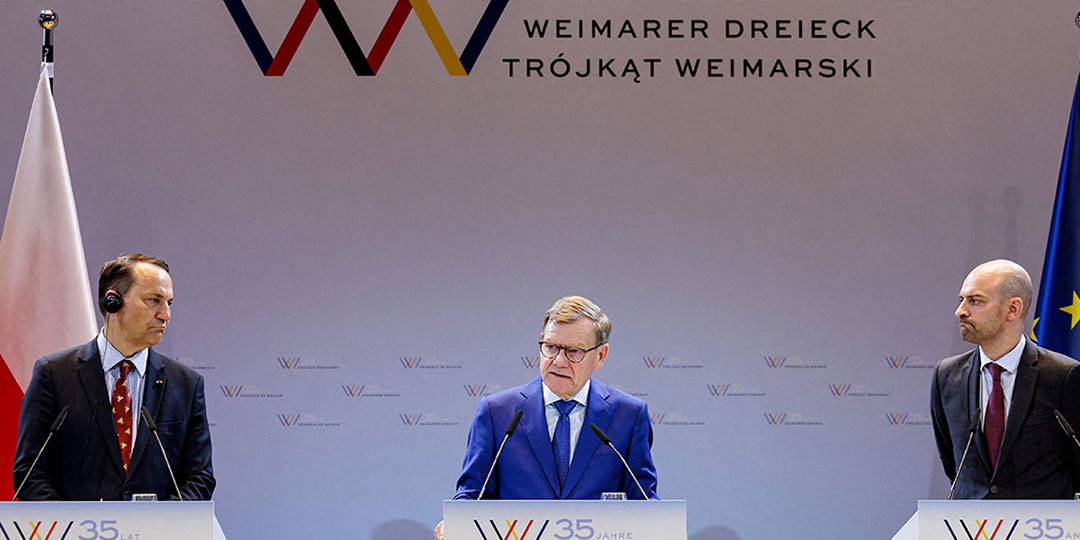

Germany, France, and Poland have discussed ways to strengthen Ukraine’s air defense, coordinate military and financial support, and counter the threats facing European states, as Russia’s war on Ukraine continues and Kyiv’s need for air protection grows.
In Washington, U.S. Secretary of State Marco Rubio said the United States is considering granting Ukraine a license to produce Patriot interceptor missiles, a move that could strengthen Kyiv’s long-term defense capabilities but would not provide an immediate fix for its urgent needs.
European Coordination Through the Weimar Triangle
Support for Ukraine’s Air Defense
German Foreign Minister Johann Wadephul, along with his French and Polish counterparts Jean-Noel Barrot and Radoslaw Sikorski, spent two days discussing closer coordination of aid, stronger Ukrainian air defenses, and ways to ensure continued military and financial support for Kyiv under the Weimar Triangle format.
The ministers said their countries want to increase pressure on Moscow to push it into serious talks on ending the war. Their discussions reflect a broader European effort to support Ukraine both on the battlefield and politically, as Russian attacks continue to threaten critical infrastructure.
Countering Hybrid Threats
The ministers also discussed swift and coordinated European responses to hybrid attacks, along with the European Union’s enlargement process and the prospects for Ukraine, Moldova, and the Western Balkans to join the bloc.
They further addressed European economic security, reducing strategic dependence on outside powers, and expanding the continent’s military capabilities.
What Is the Weimar Triangle?
A Longstanding European Platform
The Weimar Triangle was established in 1991 to strengthen cooperation between Germany, France, and Poland and to bring Warsaw closer to European and Atlantic institutions. Over time, it has become a platform for coordination on Europe’s political and security issues, especially defense and enlargement.
The latest meeting is particularly important because it comes at a sensitive stage in the war in Ukraine, with European capitals looking for more effective ways to support Kyiv and pressure Moscow.
Washington Weighs Patriot Production License for Ukraine
A Long-Term Solution, Not an Immediate One
Rubio said the U.S. is considering granting Ukraine a license to produce Patriot interceptor missiles to strengthen its air defenses against Russian attacks, but he stressed that this would not solve Kyiv’s immediate needs.
In an interview with Fox News, Rubio said the license is “still being negotiated” and that expanding production would take several years because it would require new factories and specialized facilities. Any eventual deal, he said, would not address Ukraine’s short-term needs.
Global Demand Puts Pressure on Supplies
Rubio added that global demand for interceptor missiles has risen sharply and that any increase in deliveries to Ukraine depends on availability. He also said the U.S. must keep its own stockpiles at levels sufficient to meet American defense needs before sending more to other countries.
Russia Remains at the Center of U.S. Calculations
War and Sanctions Pressure Moscow
Rubio said the war in Ukraine, along with the impact of Ukrainian strikes and sanctions on the Russian economy, is a major focus for President Vladimir Putin. At the same time, he said Washington must keep communication with Moscow open despite geopolitical differences, given that Russia possesses the world’s second-largest nuclear arsenal.
He also backed a bill that would give the U.S. president additional powers to impose secondary sanctions, tariffs, and other measures on countries and entities dealing with Moscow. He said the White House supported moving the bill through the Senate and hoped the House of Representatives would consider it.
Earlier U.S. Support for Ukraine
President Donald Trump announced during the NATO summit in Ankara on July 8 that he approved giving Ukraine a license to produce Patriot interceptor missiles, as Kyiv continues to seek stronger defenses against Russian ballistic missiles.
The move comes as Russian attacks on Ukraine continue and Kyiv’s need for additional air defense grows. The U.S. Senate passed a bill on August 7 expanding sanctions on Russia and on those helping it evade them.
Conclusion:
Germany, France, and Poland are stepping up coordination to support Ukraine’s air defense and increase pressure on Moscow, while Washington is considering a Patriot production license as a long-term way to boost Kyiv’s defensive capacity. Between European coordination and U.S. moves, Ukraine remains central to Western strategy as the war and Russian attacks continue.