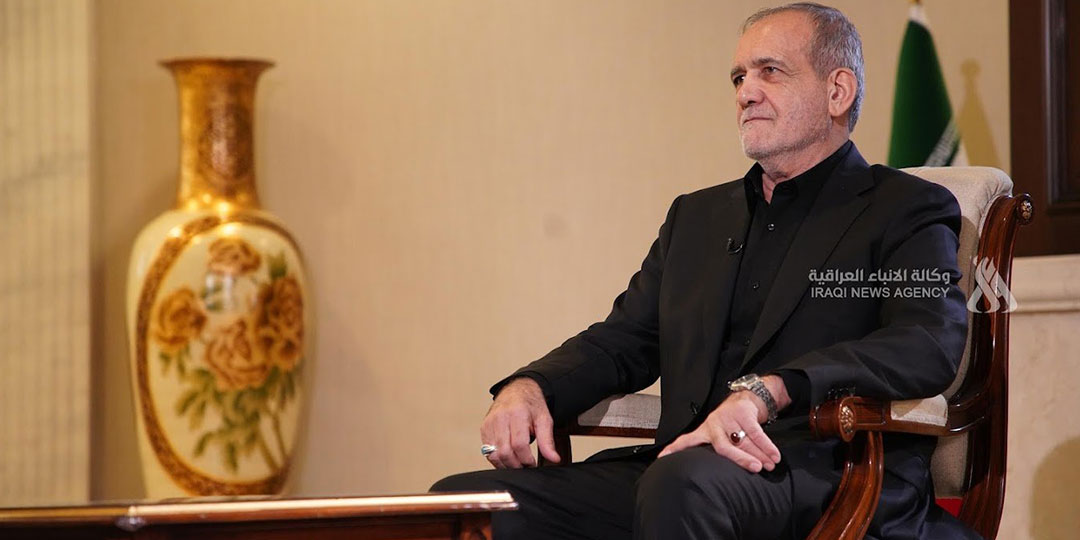

Economic war is the main battle facing Iran today, President Masoud Pezeshkian said, describing financial pressure and sanctions as the central front of confrontation.
His remarks come amid ongoing political tensions between Tehran and Washington, alongside statements from Iran’s Islamic Revolutionary Guard Corps and renewed US comments about a potential nuclear agreement.
Pezeshkian: Economic War Has Replaced Direct Military Confrontation
Speaking in remarks monitored by the Iraqi News Agency, Pezeshkian stated that “the main battle today is being fought in the arena of economic war.”
He added that “after failing in military confrontation, the enemy is now targeting our economic resilience and people’s livelihoods.”
Iranian officials have consistently framed sanctions and financial restrictions as part of a broader economic war aimed at weakening the country’s internal stability.
IRGC Downplays Risk of War, Confirms Readiness
In a separate statement, the Islamic Revolutionary Guard Corps said the likelihood of a full-scale war is low, while stressing that its forces remain fully prepared.
According to remarks carried by the Iraqi News Agency, the IRGC said, “The probability of war is low, but our forces are ready.”
Tehran Warns of Strong Response
Earlier, Iran’s Foreign Ministry warned that Tehran would respond “in the strongest possible manner” to any threat against the Iranian people. At the same time, officials reiterated that diplomacy remains an option.
The United States was cautioned against what Iranian officials described as a “strategic mistake,” signaling continued political tension despite the absence of immediate military escalation.
Vance Expresses Optimism Over Nuclear Agreement
On the US side, Vice President J.D. Vance expressed optimism that Iran could agree, under a future deal, not to develop nuclear weapons.
In comments reported by NBC News, Vance said he was “optimistic that Iran would agree, as part of any deal, not to develop nuclear weapons.”
Verification Mechanisms Remain Key Challenge
Vance added that the main difficulty lies in whether Iran would accept mechanisms ensuring compliance with any future agreement.
Verification and oversight measures have long been central points of dispute in negotiations surrounding the Iranian nuclear program.
Economic Pressure and Diplomacy Intersect
The latest statements from both Tehran and Washington highlight two central dynamics:
Military confrontation appears unlikely in the near term.
The nuclear file remains the core issue in bilateral tensions.
At the same time, economic war and sanctions continue to shape relations between Iran and the United States, with both sides balancing deterrence rhetoric and diplomatic signals.
Conclusion:
Statements from Pezeshkian and the IRGC emphasize economic pressure as the primary arena of confrontation, while US officials continue to signal openness to a negotiated nuclear framework. The situation reflects sustained political tension, reduced immediate risk of armed conflict, and an uncertain diplomatic path ahead.