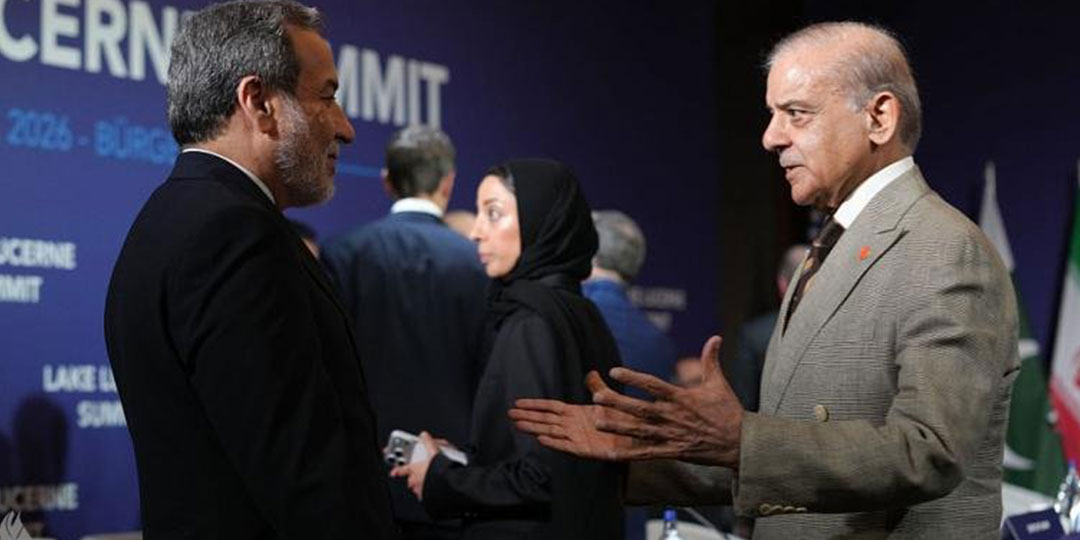

Iranian media reported on Sunday that the first round of US-Iran talks in Switzerland has concluded, while other sources indicated that discussions are still ongoing, reflecting uncertainty over the status of negotiations.
The talks, held in the Swiss resort town of Bürgenstock, mark a renewed attempt at direct engagement between Washington and Tehran amid heightened regional tensions.
Iranian Report of First Round Conclusion
Iran’s Fars News Agency cited a source within the Iranian negotiating team as saying that “the first round of quadrilateral talks in Switzerland has ended,” according to statements carried by the Iraqi News Agency (INA).
Direct US-Iran discussions had begun earlier in the day in Bürgenstock, with mediation efforts involving regional actors.
Pakistan’s Prime Minister Shehbaz Sharif described the moment as “a great day for global peace,” adding that “intensive efforts led to the meeting between Washington and Tehran, and we may return with a document for peace.”
Conflicting Reports on Ongoing Talks
However, US outlet Axios, citing a diplomatic source, reported that the Iranian delegation has not left Switzerland and that talks are still ongoing.
Iranian state television also reported that “no negotiations on the nuclear file took place during the first round,” suggesting that initial discussions may have focused on preliminary or technical issues rather than core nuclear matters.
The differing accounts highlight ambiguity surrounding the structure and progress of the negotiations.
Trump Issues Warning Over Hormuz
Meanwhile, US President Donald Trump issued strong warnings regarding Iran and the Strait of Hormuz.
Speaking to reporters, Trump said that if Iran closes the Strait, “their country will be destroyed,” adding that the United States could become “the guardian of the Strait of Hormuz” and potentially take “20 percent of the oil.”
He also warned that “if we do not reach an agreement with Iran, we will impose transit fees in the Strait of Hormuz,” and stated that “Iranian negotiators will not be able to return home if the Strait is closed.”
Iranian Response to US Threats
In response, Iranian Parliament Speaker Mohammad Bagher Ghalibaf dismissed the US statements, saying that Iran “does not pay attention to American threats.”
He added that “if these threats were effective, the United States would not be in its current state of weakness,” and warned that Iranian forces are prepared to respond.
Ghalibaf said: “No matter how much the Americans talk, we are the ones who act on the ground.”
Background of the Talks
The negotiations come as part of broader efforts to address tensions between Iran and the United States, including issues related to:
– A potential nuclear agreement
– Implementation of previous understandings
– Security in the Strait of Hormuz
– Regional developments, particularly in Lebanon
The absence of nuclear discussions in the first round may indicate a phased approach to negotiations.
Key Points
– Iranian media reports first round of talks has ended
– Other sources say negotiations are still ongoing
– No nuclear discussions reportedly held in first round
– Trump issues warnings regarding Strait of Hormuz
– Iran dismisses US threats and signals readiness to respond
Conclusion
The first round of US-Iran talks in Switzerland reflects both diplomatic engagement and continued tensions between the two sides. Conflicting reports about the status of the discussions, along with sharp political statements, underscore the fragile and complex nature of the negotiations.
The coming rounds are expected to clarify whether meaningful progress can be achieved or if the process will remain stalled amid competing pressures.