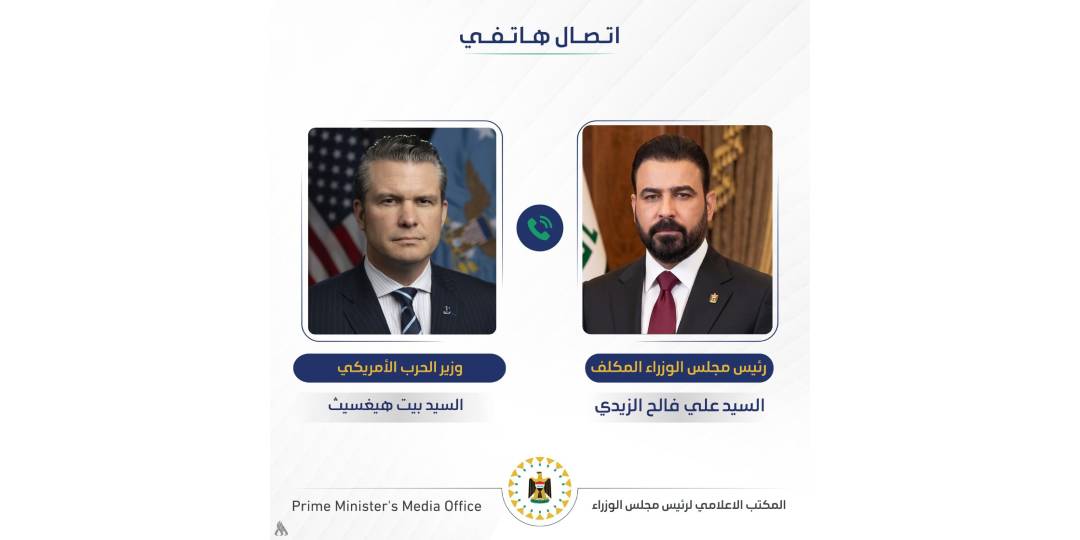

Prime Minister-designate Ali al-Sudani affirmed today in a telephone conversation with US Defense Secretary Pete Hegseth the importance of reactivating military training to strengthen the capabilities of Iraqi armed forces and enhance their efficiency. In parallel developments, Al-Sudani discussed with Libyan Prime Minister Abdulhamid al-Dbeibeh ways to promote bilateral cooperation and advance mutual interests between Iraq and Libya.
Al-Sudani’s initial conversations reflect focus on strengthening Iraq’s international, military and economic relationships.
Al-Sudani discusses security cooperation and military training with US Defense Secretary
Prime Minister-designate Ali al-Sudani received a telephone call from US Defense Secretary Pete Hegseth today Wednesday.
Hegseth congratulated Al-Sudani “on the occasion of his official designation to form the new government.”
During the call, “bilateral relations between the two countries were discussed in various fields, particularly security cooperation in accordance with the Strategic Framework Agreement between Iraq and the United States.”
Axes of US-Iraq conversation
The call included:
Official congratulations on Al-Sudani’s government formation designation
Discussion of comprehensive bilateral relations
Focus on security cooperation
Review of strategic agreement
Importance of reactivating military training programs
The conversation stressed “the special nature of relations between the two countries and the importance of working on reactivating them in military training aspects to strengthen Iraqi armed forces capabilities and enhance their efficiency.”
This priority reflects American recognition of the importance of strengthening the Iraqi army as a stabilizing factor in the region.
The focus on training represents a practical step to improve the Iraqi military’s capacity to face security challenges.
Proposed military cooperation aspects
Cooperation includes:
Reactivating military training programs
Improving armed forces efficiency
Providing American military expertise
Developing combat and tactical capabilities
Strategic Framework Agreement between Iraq and the United States
The conversation emphasized both parties’ commitment to “the Strategic Framework Agreement between Iraq and the United States.”
The agreement encompasses various aspects of security, military, economic and diplomatic cooperation.
The continuation of strategic relations between the countries reflects the importance of mutual cooperation in achieving regional stability.
Strategic cooperation pillars
Based on:
Security and military cooperation
Economic and commercial cooperation
Diplomatic and political cooperation
Information and expertise exchange
Al-Sudani discusses promoting bilateral cooperation with Libyan Prime Minister
Prime Minister-designate Ali al-Sudani discussed with Libyan Prime Minister Abdulhamid al-Dbeibeh today Wednesday “ways to promote bilateral cooperation and work on everything that achieves mutual interests between Iraq and Libya.”
Al-Dbeibeh congratulated Al-Sudani “on the occasion of his official designation to form the new government.”
The statement emphasized “efforts to support stability in the region” as a shared goal between the two countries.
Libya-Iraq cooperation axes
Cooperation encompasses:
Promoting comprehensive bilateral cooperation
Facing shared challenges
Achieving mutual interests
Supporting regional stability
Strengthening Iraq-Libya bilateral cooperation
During the conversation, “discussion focused on ways to promote bilateral cooperation, face shared challenges, and work on everything that achieves mutual interests between Iraq and Libya.”
This focus on bilateral cooperation reflects the importance of regional relationships for both countries.
The multiple conversations indicate the Libyan government’s desire to deepen relations with Iraq.
Mutual interests and economic opportunities
Cooperation can include:
Economic and commercial cooperation
Expertise and knowledge exchange
Security and defense cooperation
Coordination on regional issues
Iraq’s strategic position in regional and international relations
Al-Sudani’s initial conversations reflect:
The importance of Iraq’s strategic position and the role it can play in regional stability.
Iraq seeks to build multi-party relations with regional and international powers.
The conversations represent the beginning of active foreign policy by the new government.
New government’s initial priorities
Include:
Strengthening security and stability
Improving military capabilities
Developing international relations
Achieving regional stability
Role of military training in strengthening armed forces
The importance of reactivating training comes as a practical step to:
Improve soldier and officer efficiency
Develop combat capabilities
Modernize military methods
Keep pace with modern security developments
Benefits of regular training programs
Training programs provide:
Development of military skills
Enhancement of morale
Building confidence and discipline
Improvement of combat readiness
Continued American interest in Iraqi stability
The call from the US Defense Secretary reflects:
Continued American interest in Iraq’s stability and security.
This interest comes in the context of American interests in the region and Middle East.
It affirms the importance of the strategic partnership between the two countries.
American strategic objectives in Iraq
Include:
Ensuring security stability
Preventing Iranian influence
Protecting American interests
Strengthening the Iraqi army
Positive beginnings for the new government
Al-Sudani’s initial conversations reflect:
Positive beginnings for active and effective foreign policy.
They indicate the new government’s commitment to promoting international relations.
They highlight the importance of security and military stability in government priorities.
Diplomatic engagement and partnership building
The conversations demonstrate:
Recognition that peaceful solutions require multilateral support
Trust-building through continuous dialogue
Confidence-building measures between regional actors
International community’s role in guaranteeing stability
Emerging cooperation mechanisms
Cooperation involves:
Regular high-level diplomatic contact
Coordination between key parties
International mediation and support
Transparent communication channels
Long-term implications for Iraqi security architecture
Renewed cooperation could establish:
Strengthened security framework
Enhanced military readiness
Increased international partnership
Mechanism for future cooperation
Conclusion:
Prime Minister-designate Ali al-Sudani’s initial conversations reflect clear focus on strengthening security, stability and international cooperation. The emphasis on reactivating military training and promoting regional cooperation indicates that the new government seeks to build a strong foundation for stable governance that serves Iraq’s and the region’s interests.