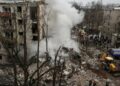


A drone struck the US embassy in Baghdad on Saturday, according to Iraqi security sources, with AFP journalists on the ground observing black smoke rising from the diplomatic complex. The attack marked the second assault on the US mission since the Middle East conflict began on February 28, coming hours after airstrikes killed at least one “key figure” from the Iran-backed Kataeb Hezbollah group and wounded two others in the Iraqi capital.
The coordinated pattern of strikes targeting Iran-backed military groups followed by retaliatory attacks on US diplomatic and military installations reflects Iraq’s transformation into a direct proxy battleground between Washington and Tehran. Iraq’s integration into the broader Middle East conflict, despite its stated neutrality, demonstrates the difficulty of remaining outside a war expanding across the region and pulling in nations along sectarian and geopolitical lines.
Drone Attack on US Embassy in Baghdad Confirmed
An Iraqi security official confirmed that a drone struck the US embassy complex in Baghdad on Saturday, with a second security source corroborating the attack on the diplomatic mission. An AFP journalist at the scene reported seeing smoke rising from the embassy compound, providing visual confirmation of the strike.
The attack occurred shortly after airstrikes in Baghdad’s capital killed members of Iran-backed military groups, suggesting a pattern of rapid escalation and retaliation. The timing indicates potential coordination between targeting decisions and response operations, though no group has claimed responsibility for the embassy attack.
The US embassy did not immediately respond to AFP requests for comment on the incident, maintaining diplomatic silence on operational details. The embassy’s non-response reflects standard practice during active security situations, though it also prevents immediate clarification on the extent of damage or casualties.
Second Embassy Attack Since War’s Start
The Baghdad embassy strike marks the second time the US diplomatic mission has come under attack since the war began on February 28. The escalation pattern suggests that Iran-backed groups view US diplomatic installations as legitimate targets in the broader conflict, not protected civilian facilities deserving of restraint.
Previous attacks on US diplomatic facilities across the Middle East during the conflict, including strikes on embassies in Kuwait and the UAE, indicate a coordinated strategy by Tehran’s proxy forces to target American interests across multiple countries and facility types. The pattern extends beyond military installations to encompass diplomacy and symbolic representation of US presence.
Disputed Cause of Embassy Attack: Drone Versus Rocket
Security sources offered conflicting accounts regarding the precise nature of the attack. One security official stated that a drone had struck the embassy, while another reported that a projectile, believed to be a rocket, had impacted the diplomatic complex or its associated airbase. The dispute over attack methodology reflects the difficulty of immediate battlefield assessment in urban environments with multiple simultaneous operations.
The distinction between drone and rocket attacks carries operational significance, as drones suggest precision targeting capability while rockets indicate area fire with less precise targeting. The discrepancy may also reflect multiple simultaneous attacks on the complex, with both drone and rocket systems employed, though this remains unconfirmed.
Coordinated Airstrikes Target Iran-Backed Kataeb Hezbollah
Hours before the embassy attack, airstrikes targeted the powerful Iran-backed military group Kataeb Hezbollah, killing at least one “key figure” and wounding two others, according to multiple security sources. The strikes reflected a two-pronged operation: an initial missile strike on a house at 02:15 am Baghdad time, followed two hours later by an airstrike on a vehicle in eastern Baghdad.
A security source reported: “At 02:15 am, a missile struck a house that was being used by Kataeb Hezbollah,” with the source adding that “a key figure was martyred” and two group members were wounded. The designation of a casualty as a “key figure” suggests targeting of leadership cadre rather than rank-and-file fighters.
A second airstrike struck a vehicle in eastern Baghdad approximately two hours later, killing one member of the Hashed al-Shaabi (Popular Mobilisation Forces), which incorporates brigades from Iran-backed groups including Kataeb Hezbollah. A Hashed al-Shaabi official confirmed that the victim belonged to Kataeb Hezbollah, establishing the connection between the two operations.
Kataeb Hezbollah’s Role in Iraqi Conflict
Kataeb Hezbollah represents one of the most powerful Iran-backed military groups operating in Iraq, commanding significant operational capability and political influence. The group, along with other Tehran-aligned factions, operates under the umbrella organization known as the Islamic Resistance in Iraq, which Washington has designated as a terrorist organization.
The group’s prominence in Iraqi politics and military affairs reflects Iran’s deep penetration of Iraqi security institutions and paramilitary structures. Since the 2003 US invasion, Iran-backed groups have grown from marginalized militias into integrated components of Iraq’s formal military structure, with many brigades formally incorporated into the Hashed al-Shaabi.
Pattern of Multi-Location Explosions Across Baghdad
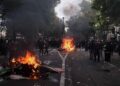
Beyond the embassy strike and Kataeb Hezbollah targeting, multiple explosions were reported across Baghdad on Saturday morning. AFP journalists heard blasts followed by ambulance sirens, with witnesses reporting smoke rising from the Arasat neighborhood, where several Iran-backed groups maintain operational bases.
Residents in the Zayouna district in eastern Baghdad reported that the force of blasts shook their houses, indicating significant explosive force deployed across multiple locations. The pattern suggests either multiple simultaneous attack operations or a series of strikes coordinated across different time intervals to maintain pressure on Iranian-backed targets.
Civilian Impact and Urban Warfare Pattern
The distribution of explosions across Baghdad neighborhoods highlights the civilian population’s exposure to the conflict between US-backed forces and Iran-aligned groups. The targeting of houses and vehicles in residential and commercial districts raises civilian casualty and collateral damage concerns, though specific civilian impact figures were not immediately available.
The pattern reflects Iraq’s transformation into an urban battleground where Iranian proxy forces, US military assets, and Iraqi civilian populations coexist in tense proximity. Neither the proxy forces nor US operations maintain clear geographic separation from civilian areas, creating inherent risks for non-combatants.
Iraq’s Struggle to Maintain Neutrality in Broader Conflict
Iraq, officially designated as a neutral party in the US-Israeli conflict with Iran, has struggled to prevent its territory from becoming a direct proxy battleground. Despite government declarations of neutrality, both US forces and Iranian-backed groups maintain significant operational presence in Iraqi territory, with each conducting military operations that inevitably pull Iraq into the broader conflict.
The US maintains several military bases across Iraq as part of the anti-ISIS coalition, providing a permanent operational foothold for Washington. Iran-backed groups, integrated into Iraq’s formal military structures, provide Tehran with comparable institutional leverage and operational access. The result is a dynamic where Iraq’s formal neutrality masks deep structural integration into both sides’ military and political ecosystems.
Islamic Resistance in Iraq and Designated Terrorist Organizations
Washington has designated several Tehran-backed armed groups operating in Iraq as terrorist organizations, including those operating under the “Islamic Resistance in Iraq” umbrella. These groups have claimed daily drone and rocket attacks against US bases across the region, indicating sustained operational capability and intent to maintain pressure on American military presence.
Since the war began on February 28, multiple strikes across Iraq have targeted members of these groups, reportedly conducted by US and Israeli forces. The sustained attrition of group membership and leadership through targeted strikes may be intended to degrade Iranian proxy capability in Iraq, though the groups continue demonstrating operational capacity to conduct attacks and retaliate.
Attribution Uncertainty and Operational Opacity
No security sources identified who conducted the airstrikes targeting Kataeb Hezbollah, and the targeted group itself has not commented on the attacks. The attribution gap reflects operational security practices on both sides, with neither attackers nor defenders immediately claiming responsibility or providing battlefield assessments.
The silence from Kataeb Hezbollah regarding the strikes that killed a “key figure” appears unusual given the group’s typical pattern of public statements. The restraint may reflect uncertainty about the exact nature and scale of losses, operational security concerns, or deliberate strategy to avoid escalatory rhetoric while assessing damage and planning response operations.
Escalating Cycle of Tit-for-Tat Operations
The sequence of Saturday’s events in Baghdad reflects an accelerating pattern of action and reaction: airstrikes target Iran-backed groups, followed by drone or rocket attacks on US facilities. The cycle demonstrates both sides’ commitment to maintaining military pressure despite the humanitarian costs and risks of continued escalation.
The pattern parallels broader regional dynamics visible across Lebanon, the Gulf states, and Iran itself, where each military action generates rapid retaliation, sustaining the conflict at high intensity without apparent off-ramps toward de-escalation or negotiated settlement.
Conclusion:
The drone strike on the US embassy in Baghdad, occurring hours after airstrikes killed Kataeb Hezbollah leadership, demonstrates Iraq’s transformation into a direct military battleground in the broader US-Iran conflict. Multiple explosions across Baghdad, disputed attack methodologies, and the pattern of coordinated strikes followed by retaliatory attacks indicate the conflict’s intensification in Iraq despite the country’s stated neutrality. With Iran-backed groups embedded in Iraq’s military institutions and US forces maintaining permanent operational bases, Iraq will likely remain a principal venue for proxy conflict as the Middle East war persists.