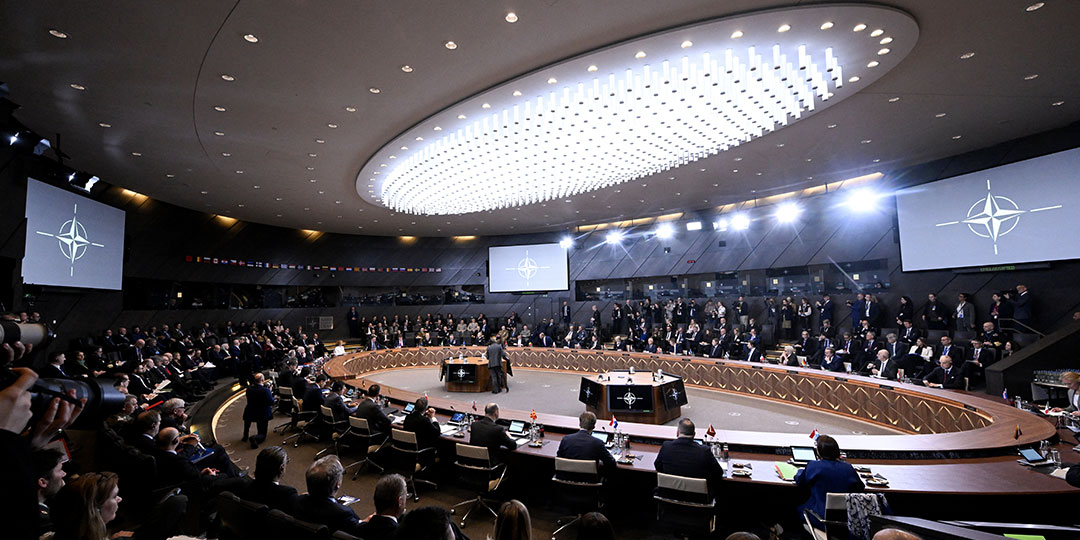

NATO announced Thursday that it has reinforced its ballistic missile defence capabilities across all 32 member states in response to escalating Iranian missile and drone attacks across the Middle East. The decision followed the successful interception of an Iranian ballistic missile targeting Turkey, marking a sharp escalation in regional military tensions. Alliance officials confirmed the enhanced defence posture will remain at heightened alert until the threat from Iranian strikes diminishes.
The move underscores growing Western military commitment to containing Iran’s campaign of retaliation following US-Israeli strikes that killed Iran’s supreme leader Ayatollah Ali Khamenei over the weekend. Iran has since unleashed waves of missiles and drones against targets across the region, prompting swift defensive responses from NATO and its regional partners.
NATO Intercepts Iranian Missile Over Turkey
NATO service members identified and intercepted an Iranian ballistic missile in less than 10 minutes, the alliance’s spokesperson Colonel Martin O’Donnell said in a statement Thursday. The operation demonstrated rapid coordination between allied land and sea-based defence systems, which detected the threat, confirmed its trajectory, and launched an interceptor to neutralize it before it reached Turkish territory.
Turkey’s Defence Ministry confirmed the interception, stating that NATO systems “intercepted and neutralised a ballistic missile fired from Iran and detected heading towards Turkey.” However, a Turkish official speaking anonymously suggested the missile may have been aimed at a military base in Greek Cyprus but veered off course, contradicting NATO’s public assertion about the intended target.
O’Donnell declined to provide additional details about the missile’s intended destination, citing operational security concerns.
Alliance Commitment to Heightened Defence
During an ambassador-level meeting in Brussels, NATO’s member states unanimously agreed to maintain the strengthened ballistic missile defence posture at its elevated level for the duration of the Iranian threat. The alliance condemned Iran’s targeting of Turkey and reiterated its commitment to collective defence under NATO’s Article 5 provisions.
“The alliance’s heightened posture reflects serious concern among all 32 member states regarding Iran’s indiscriminate attacks across the region,” the statement said.
UK and Western Powers Reinforce Regional Presence
As NATO elevated its defensive posture, Western military powers moved to strengthen their regional presence. Britain announced it would deploy four additional Typhoon fighter jets to Qatar, joining existing RAF squadrons to bolster defensive operations across the Gulf region.
UK Prime Minister Keir Starmer also confirmed the dispatch of two Wildcat helicopters armed with Martlet missiles to Cyprus on Friday, where RAF personnel had already faced a drone strike on the Akrotiri base earlier in the week. An Iranian-made unmanned drone struck a hangar at the base Monday, prompting Britain to reinforce air defences and accelerate troop rotations.
Defence Secretary John Healey visited Cyprus to assess damage and coordinate with Cypriot authorities, emphasizing that British defence measures would adapt to the evolving conflict. Britain has also deployed HMS Dragon, a Type 45 air defence destroyer capable of launching eight missiles in under 10 seconds.
European Diplomatic Efforts Amid Military Escalation
French President Emmanuel Macron called Thursday for immediate de-escalation, urging both Israel and Hezbollah to halt military operations along the Lebanon-Israel border. Macron stated that “everything” must be done to prevent Lebanon from being drawn deeper into the widening conflict, following Hezbollah’s initial strikes on Israel in retaliation for Ayatollah Khamenei’s killing.
Macron pledged French support to strengthen Lebanon’s armed forces and announced humanitarian assistance for tens of thousands of Lebanese civilians fleeing southern regions affected by military operations. France committed to provide armoured transport vehicles and medicines to Lebanese authorities as part of broader stabilization efforts.
US Signals Support for Kurdish Operations Against Iran
US President Donald Trump indicated Thursday that Washington would support Iranian Kurdish fighters conducting military operations inside Iran as part of the broader campaign against Tehran. “I think it’s wonderful that they want to do that. I’d be all for it,” Trump said in remarks to Reuters.
Trump declined to specify whether the United States would provide direct air support to Kurdish forces. Iranian Kurdish groups, based in autonomous Iraqi Kurdistan, have faced intensified Iranian military pressure since the conflict began, with Tehran accusing them of collaborating with Western and Israeli interests.
Key Points on Kurdish Involvement:
Iranian Kurdish groups represent some of Tehran’s most organized armed opposition
Experts assess they could potentially support special forces operations to destabilize Iran
Historical tensions between Kurdish autonomy movements and Iranian state authority complicate their role
Multiple Kurdish factions hold divergent political objectives, from autonomy to territorial integrity
Why This Matters
The rapid military escalation signals a fundamental shift in regional security dynamics. NATO’s enhanced missile defence posture represents the first comprehensive alliance-wide response to Iranian attacks on member states. Simultaneous Western deployments of air defence systems, fighters, and naval assets indicate preparation for prolonged confrontation.
The conflict trajectory also carries implications for Iraq and other regional states, with military operations expanding beyond traditional battlefields. Lebanese authorities are particularly concerned about further territorial expansion of the fighting, while Iraqi Kurdistan faces heightened tensions as Iranian forces target Kurdish positions within and across its borders.
Conclusion:
NATO’s strengthened ballistic missile defence posture reflects the severity of escalating Iranian military operations across the Middle East. As Western powers reinforce regional military presence and diplomatic efforts intensify, the conflict shows signs of becoming increasingly regionalized. The success of the Turkish missile interception demonstrates technological capabilities, but also underscores the persistent threat level facing alliance members and regional partners.