
Hezbollah attack on Haifa naval base marked the group’s twelfth operation on Tuesday as confrontations expanded across Lebanon. The attack came while Israel continued a wave of airstrikes stretching from Beirut’s southern suburbs to Baalbek in the east and towns south of the capital.
Lebanese authorities reported multiple casualties from Israeli raids, including strikes on residential areas, hotels, and densely populated districts.
Hezbollah says it targeted Haifa naval base with missiles
According to a statement issued by Hezbollah, the group launched a barrage of what it described as “high-quality missiles” at the Haifa naval base at 8:00 pm local time. The group said the operation came in response to what it called “criminal Israeli aggression” that had struck dozens of Lebanese towns and neighborhoods including Beirut’s southern suburbs.
The Israeli military confirmed that several incoming projectiles were detected around the same time and said most had been intercepted.
Background on cross-border escalation
The exchange of fire between Hezbollah and Israel has intensified in recent days as Israeli operations push deeper into Lebanese territory. Hezbollah has increased its targeting of Israeli military sites while Israel has expanded its strikes into areas not typically associated with Hezbollah presence.
Israeli airstrike hits residential building in Baalbek
Lebanon’s state-run National News Agency (NNA) said Israeli aircraft struck a four-story residential building in Baalbek at dawn on Wednesday. Baalbek is a key area of Hezbollah influence.
NNA confirmed that several people were killed and rescue teams were working to pull families from under the rubble. The final number of casualties had not been released at the time of reporting.
Repeated Baalbek strikes highlight shift in Israeli targeting
Wednesday’s raid follows earlier Israeli attacks on eastern Lebanon, reflecting an expanded geographical scope of Israeli operations. Baalbek, far from the southern front, has historically been less frequently targeted.
Six killed in Israeli strikes on Aramoun and Saadiyat
Lebanon’s health ministry reported that Israeli attacks on the towns of Aramoun and Saadiyat south of Beirut left six people killed and eight wounded. These areas lie outside Hezbollah’s traditional strongholds.
The ministry described the casualty count as preliminary as medical teams continued operations in the affected zones.
Civilian areas increasingly at risk
Strikes on Aramoun and Saadiyat point to a growing pattern of Israeli operations in civilian-populated areas, raising concerns in Lebanon over the widening impact beyond known confrontation lines.
Israeli strike hits hotel in Hazmieh, east of Beirut
NNA said an Israeli airstrike targeted a hotel in the Hazmieh suburb, marking the first such attack in the predominantly Christian district. Ambulances were deployed to the scene though casualty figures were not immediately available.
Hazmieh, near Beirut’s eastern gateway, is not typically linked to Hezbollah activity which made the strike notable among Wednesday’s incidents.
Airstrike hits Hezbollah stronghold in southern Beirut
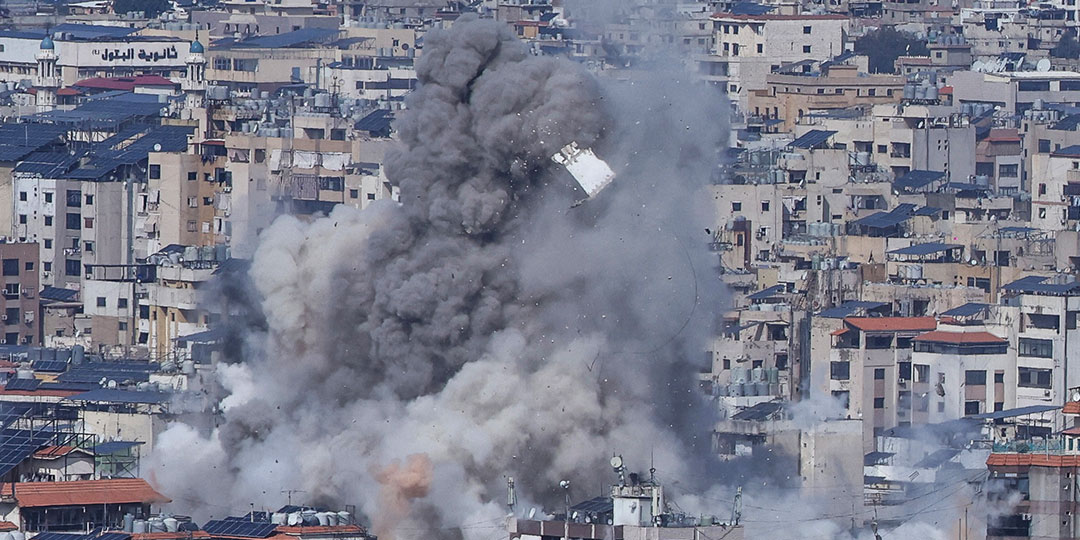
AFPTV footage confirmed a strike on a southern Beirut neighborhood considered a Hezbollah bastion. The attack came shortly after Israeli forces issued an evacuation order.
The raid is part of a series that earlier targeted areas near the presidential palace and expanded into districts south of Beirut and the historic city of Baalbek. Lebanese sources said at least 11 people were killed in the broader set of operations.
Why these strikes matter regionally
For Iraq and the wider region, the escalation raises concerns over a potential expansion of conflict fronts that could further destabilize regional security. Lebanon remains a critical part of the regional equation especially amid tensions involving Iran-aligned groups.
Conclusion:
The Hezbollah attack on Haifa naval base and the multiple Israeli strikes across Lebanon mark a significant escalation in cross-border hostilities. With casualties rising and strikes expanding into new areas, the situation remains volatile as both sides signal readiness for continued confrontation.