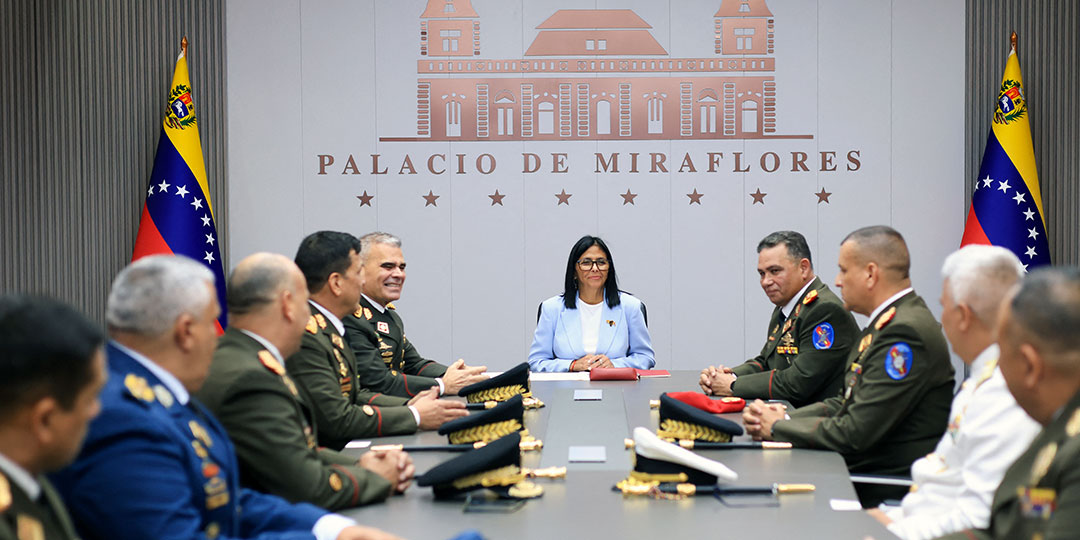

Venezuela’s interim president Delcy Rodriguez has orchestrated sweeping overhaul of the country’s military hierarchy, removing entrenched commanders and installing officers assessed as acceptable to the United States, according to military and political sources. The most dramatic move involved removing long-serving Defense Minister Vladimir Padrino Lopez and replacing him with former intelligence chief Gustavo Gonzalez Lopez, widely characterized as Washington’s preferred choice for military leadership. The military restructuring represents systematic reversal of two decades of Venezuelan military realignment toward Russia and Cuba under leftist presidents Hugo Chavez and Nicolas Maduro, indicating broader geopolitical shift reorienting Venezuela toward US strategic influence.
The military overhaul reflects Rodriguez’s broader strategy since assuming interim presidency following Maduro’s January ouster by US-backed opposition. The restructuring seeks to restore Cold War-era military relationships between Venezuela and the United States that were severed under Chavez’s leftist revolution, including resumption of weapons purchases, officer training exchanges, and potential establishment of US military presence within Venezuelan territory.
Sweeping Military Leadership Replacement
Rodriguez replaced the entire Military High Command this week, followed by appointment of eight new leaders of Venezuela’s Strategic Regions of Integrated Defense (REDI), responsible for “peace, sovereignty and security across the national territory.” Rodriguez announced the REDI leadership changes on Telegram Friday, stating that “with this reform, we are reinforcing the operative capabilities of the REDI.”
Military affairs journalist Sebastiana Barraez characterized the eight new REDI leaders as “the ones who really control the military,” indicating that the REDI leadership changes represent substantive shift in command authority rather than symbolic restructuring. The successive waves of leadership replacements throughout this week demonstrate coordinated campaign to eliminate Maduro-era military leadership across command hierarchy.
Systematic Elimination of Maduro-Era Leadership
The pattern of military leadership replacements indicates deliberate strategy to remove officers loyal to Maduro’s government and install commanders presumed to support Rodriguez’s realignment toward Washington. The successive announcements of leadership changes throughout the week suggest coordinated purge designed to minimize internal military resistance to command transitions.
Gustavo Gonzalez Lopez Installation as Defense Minister
Rodriguez installed Gustavo Gonzalez Lopez as new defense minister, replacing Vladimir Padrino Lopez who had headed Venezuela’s military for nearly a decade under Maduro. Gonzalez Lopez previously served as chief of Venezuela’s presidential guard, head of DGCIM counterintelligence service, and twice served as director of SEBIN intelligence service.
Military affairs journalist Barraez characterized Gonzalez Lopez as “the United States’ man in the armed forces,” describing him as “pragmatic and not ideologically tied to the left.” The characterization suggests that Gonzalez Lopez is perceived as alignment with US geopolitical interests rather than Venezuelan nationalist or leftist ideology.
Controversial Human Rights Record
Human rights group Provea characterized Gonzalez Lopez’s appointment to security leadership as “recycling impunity,” noting that he remains under US sanctions for alleged human rights violations. Provea referenced Gonzalez Lopez’s tenure at SEBIN, where opposition figure Fernando Alban died in custody after falling from a tenth-floor window. Official authorities characterized the death as suicide, while opposition groups alleged murder.
The appointment of an official with alleged human rights violations to a top security position during a transition government raises concerns regarding potential impunity for future human rights abuses and suggests that security considerations may override human rights protections in the interim government’s priorities.
Restoration of Pre-Chavez US Military Relationships
A retired Venezuelan general told AFP that Washington’s objective involves restoring pre-Chavez military doctrine emphasizing US alignment that was abandoned under Hugo Chavez’s leftist government. The restoration would involve resumption of Venezuelan weapons purchases from the United States, renewal of officer training exchanges, and potential replacement of Russian and Cuban military equipment with US-origin systems.
The general characterized the shift as designed to “roll back two decades of cooperation with Russia and Cuba, whose advisers helped reshape the armed forces and supplied weapons from rifles to Sukhoi fighter jets.” The transition would require substantial military procurement expenditures to replace Russian equipment with US-compatible systems, creating significant budgetary implications for Venezuela’s economically distressed government.
Equipment Replacement and Training Transition
The retired general indicated that much of the Russian equipment currently in Venezuelan military inventory would require replacement if Venezuela transitions to US technology and training systems. The replacement would necessitate substantial military spending at a time when Venezuela’s economy remains severely distressed following decades of mismanagement and international sanctions.
Potential US Military Base Establishment
The retired general suggested that the United States might establish a temporary military base in Venezuela to facilitate the transition of military systems and training, characterizing such a move as “cut[ting] against years of anti-imperialist rhetoric from the former government.” The potential base establishment would represent dramatic geopolitical reversal, as the anti-US stance constituted core element of Chavez’s political ideology and Venezuelan government rhetoric for two decades.
The base establishment would carry symbolically charged implications regarding US military presence in the Western Hemisphere and would reverse decades of Venezuelan government positions opposing US military intervention in Latin America.
Symbolic Reversal of Anti-Imperialist Doctrine
The potential US military base establishment would represent explicit repudiation of anti-imperialist ideology that characterized Venezuelan government positions throughout the Chavez and Maduro eras. The acceptance of US military presence would contradict foundational principles of the Bolivarian Revolution that positioned Venezuela as leader of anti-US regional positioning.
Allegations of Washington Direction
Cleberth Delgado, a former intelligence official now in exile, characterized the military changes as transition guided by “instructions” from Washington, though the United States has not publicly confirmed any such role. Delgado stated that “these appointments would not have been possible without US approval,” indicating that Venezuelan military restructuring decisions require implicit or explicit US concurrence.
The allegation that Venezuela’s military appointments require US approval suggests subordination of Venezuelan military decision-making to US strategic interests, indicating loss of Venezuelan sovereign authority over security affairs during the interim government period.
Sovereignty and US Influence
Allegations of US direction of Venezuelan military appointments raise questions regarding the interim government’s sovereignty and independence. The characterization of military decisions as requiring US approval suggests asymmetrical power relationship between interim government and Washington, with Venezuela’s government subordinated to US strategic preferences.
Transitional Government Stability Concerns
Rodriguez’s allies characterize the military changes as necessary to stabilize the country following Maduro’s ouster, citing lingering coup concerns and uncertainty regarding the interim government’s duration. The military restructuring aims to consolidate interim government control over the armed forces and prevent potential military intervention against the transition process.
The ongoing instability suggests that the Rodriguez government may face challenges in consolidating authority over the military and maintaining control over the armed forces during the transition period.
Economic Context and US Investment
Rodriguez has pursued economic liberalization since assuming interim presidency, allowing increased US investment in Venezuela’s energy sector and restoring some economic relationships with Washington. The military realignment accompanies broader economic reorientation toward the United States, including relaxation of previous restrictions on US business activities and energy sector investments.
The parallel economic and military reorientation suggests comprehensive realignment of Venezuelan policy across security and economic dimensions, fundamentally restructuring Venezuela’s international relationships.
Key Developments in Venezuelan Military Realignment:
Venezuela replaces entire Military High Command
Defense minister Vladimir Padrino Lopez removed
Gustavo Gonzalez Lopez installed as new defense minister
Eight new REDI regional leaders appointed
Officers with alleged US acceptance installed in key positions
Pre-Chavez US military relationships being restored
Russian and Cuban military advisers and equipment being phased out
Potential establishment of temporary US military base discussed
Military restructuring characterized as requiring US approval
Cold War military alignment being reversed
Venezuelan military redirecting from Russia-Cuba orientation to US alignment
Economic liberalization accompanying military restructuring