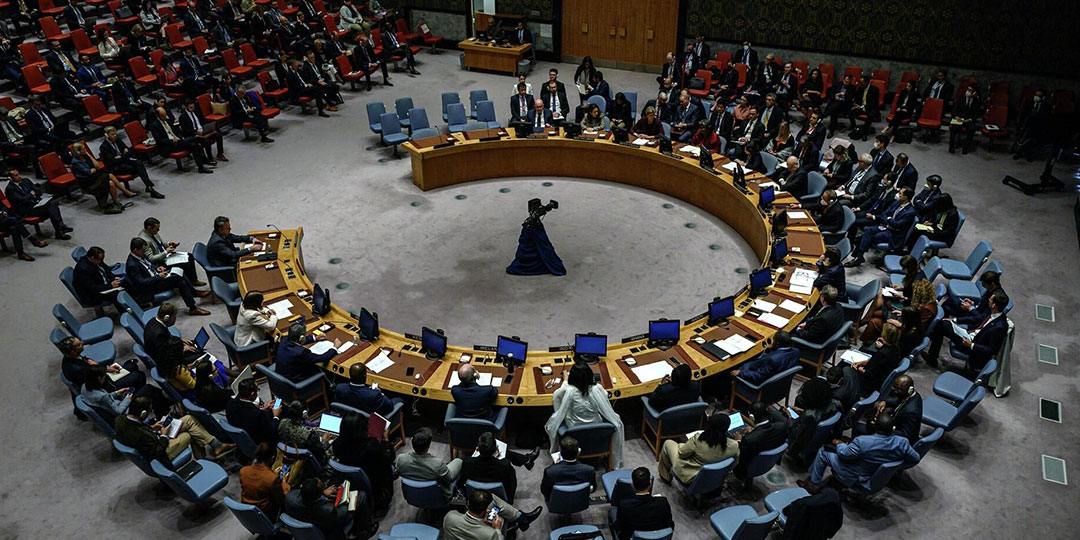

The United Nations Security Council on Friday approved extending sanctions on Sudan until October 9, 2026, a move that reflects continued international attention to the country’s political and security situation. The Council said it adopted a resolution drafted by the United States to renew the sanctions regime for the coming period.
The decision comes as Khartoum continues to stress its commitment to a just and comprehensive peace, while also pushing ahead with reconstruction efforts and economic recovery despite the difficult circumstances facing the country.
Security Council Extends Sanctions Until 2026
Resolution Drafted by the United States
The Security Council said in remarks cited by the Iraqi News Agency that it adopted a U.S.-drafted resolution renewing the sanctions regime imposed on Sudan until October 9, 2026. The move means the international sanctions framework will remain in place for another period as the search continues for a political and security solution to Sudan’s crisis.
The extension is part of a series of international measures tied to the situation in Sudan, where the global community continues to monitor political, humanitarian, and security developments closely.
Continued International Pressure
The decision reflects ongoing international pressure on Sudan, keeping sanctions in place as a tool of political oversight and influence. At the same time, Khartoum says the priority should be stability, internal reconciliation, and rebuilding state institutions.
Sudanese Prime Minister Reaffirms Commitment to Peace
Just and Comprehensive Peace
In Khartoum, Sudanese Prime Minister Kamil Idris said his government remains committed to a just and comprehensive peace and is adopting a new philosophy for post-war reconstruction. His remarks came during a speech to the Sudanese Media Forum in the capital.
Idris called for discussion of a shared national project and what he described as “national recovery” as both an official and public plan, pointing to the major challenge of Sudanese dialogue that includes everyone.
Reconstruction and Economic Recovery
The prime minister said the state remains committed to improving the economic situation and rebuilding the country despite the current challenges. He pointed in this context to the return of universities to their main campuses in Sudan and the preparation of the university environment for students, as part of efforts to restore normal institutional life.
Fighting Corruption and Smuggling a Priority
Civil Service Reform
Idris stressed the state’s commitment to fighting corruption in all its forms and combating smuggling and drugs, as well as reforming the civil service and improving conditions for its employees. His remarks reflect the government’s intention to rebuild public institutions on a more transparent and efficient basis.
Dialogue With the International Community
He also said dialogue with the international community remains ongoing, while emphasizing sovereignty and national constants. The statement suggests Khartoum wants to keep channels open with international partners while preserving independent national decision-making.
Meetings With the International Quintet
Political and International Coordination
Earlier, the prime minister and the deputy head of Sudan’s transitional council met with a delegation from the international quintet on Sudan, which includes the United Nations, the African Union, the Intergovernmental Authority on Development (IGAD), the Arab League, and the European Union. The meeting formed part of wider international efforts to support stability and a political settlement in Sudan.
Importance of Engagement
These contacts highlight the importance of coordination between Khartoum and the international and regional institutions involved in the Sudan file, especially given the need for solutions that respect sovereignty while supporting stability and reconstruction.
Conclusion:
While the Security Council has extended sanctions on Sudan until October 2026, the Sudanese government continues to emphasize just peace, reconstruction, anti-corruption efforts, and institutional reform. Khartoum appears to be balancing openness to international dialogue with a firm commitment to national sovereignty at a time when the country is still seeking a sustainable path to stability.