
The United Arab Emirates faced one of the most intense air battles of the ongoing regional conflict on Saturday, as its air defense systems intercepted 15 ballistic missiles and 119 unmanned aircraft launched by Iran. The staggering figures underscore the mounting pressure on UAE’s defensive infrastructure amid relentless Iranian retaliation strikes targeting Gulf states allied with the United States and Israel.
The interception operations forced a temporary suspension of activities at Dubai International Airport, the world’s busiest by international passenger traffic, disrupting thousands of travelers and global supply chains. Debris from successful air defense operations caused a limited incident, though authorities confirmed no civilian casualties.
This development marks a critical escalation in the broader regional conflict, with Iran extending strikes deep into Gulf territory as retaliation for ongoing American and Israeli bombardment of Iranian mainland targets.
Scale of Attacks and Emirates’ Defensive Capabilities
The UAE Ministry of Defense announced in an official statement via X (formerly Twitter) that its air defenses detected 16 ballistic missiles, successfully destroying 15 while one fell into the sea. The ministry added that it detected 121 unmanned aircraft, intercepting 119 of them, with two falling within UAE territory.
These interception rates demonstrate high operational effectiveness, with air defense systems achieving approximately 98 percent success rate against drones and 94 percent against ballistic missiles. The performance reflects substantial UAE investments in advanced defense systems over the past decade, including Patriot, THAAD, and AVAD platforms.
Despite the impressive defensive performance, falling debris from interception operations caused a limited incident in Dubai, illustrating the collateral effects of intense aerial combat even when defenses successfully neutralize incoming threats. Dubai government officials described the incident as resulting from “falling debris caused by a successful air defense interception.”
Impact on Aviation Operations and Global Air Traffic
Airport authorities suspended operations at both Dubai International Airport and Dubai World Central (Al Maktoum) temporarily for safety reasons. The airport authority stated: “In order to ensure the safety of passengers, employees, and airline crew, operations were temporarily suspended.”
Operations resumed partially later in the day, with a limited number of flights resuming service. Airport management advised travelers to remain away from facilities unless their airlines confirmed flights, warning that schedules would remain subject to change. Flight tracking data from FlightRadar24 showed commercial aircraft circling the airport in holding patterns as operations remained disrupted.
An AFP correspondent reported hearing powerful explosions and witnessing smoke plumes rising over airport areas during the interception operations. The disruptions reflected the wider challenge facing commercial aviation in conflict zones, where safety protocols require immediate suspension despite successful defensive measures.
Broadening Iranian Target Selection and Economic Impact
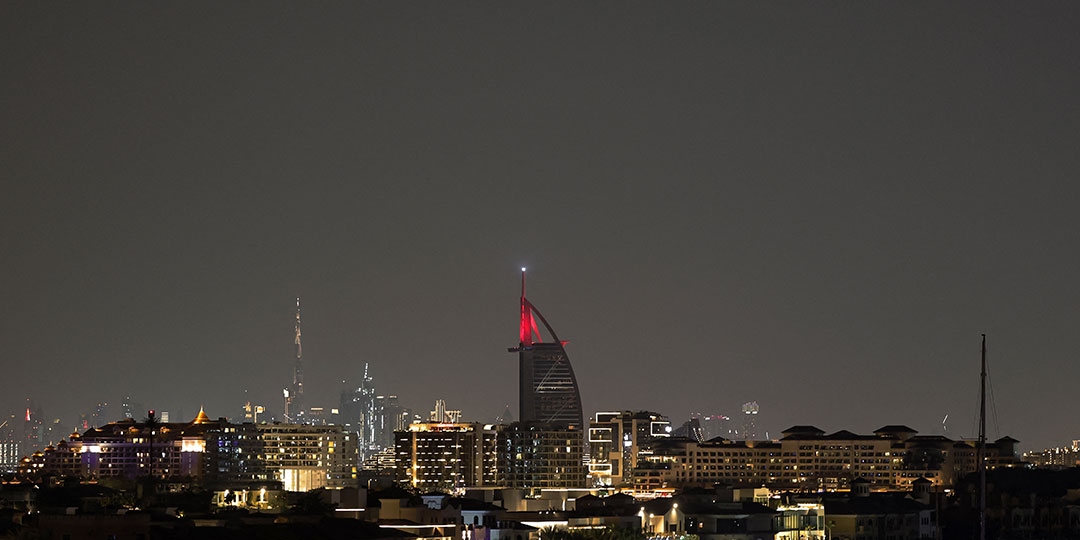
Iranian attack strategy has expanded to encompass multiple civilian and economic infrastructure targets across the Emirates. Previous strikes this past week targeted Abu Dhabi International Airport, the luxurious Palm Jumeirah development, and the iconic Burj Al Arab hotel.
Debris from an unmanned aircraft ignited a fire at the American consulate in Dubai on Tuesday, causing significant damage to the building. Four Dubai airport staff members were injured and one terminal facility damaged on the first day of the American-Israeli war with Iran, according to airport management. The diversification of targets signals an Iranian strategy aimed at pressuring Gulf states hosting American military forces and Israeli allies by striking economic and civilian infrastructure.
These attacks have extended far beyond military objectives, hitting tourist destinations, residential areas, and commercial hubs. Such targeting suggests Iran’s intent to inflict economic damage and demonstrate reach capabilities to civilian populations across the Emirates, intensifying pressure on the government and business community.
Tourism, Commerce, and Global Supply Chain Disruption
Dubai International Airport ranks among the world’s busiest facilities by international passenger volume, serving as a critical hub for passengers and cargo bound for Asia, Africa, and the Middle East. Repeated operational suspensions directly impact thousands of daily travelers and disrupt global supply chains dependent on swift cargo transfers through the region.
Emirates Airlines, the region’s largest carrier, initially suspended all flights to and from Dubai until further notice before later resuming limited operations. Resumption of limited flights began Monday despite the continuation of daily drone attacks. The disruptions underscore the vulnerability of critical transportation infrastructure to sustained drone and missile campaigns.
Economic consequences extend across the tourism and hospitality sectors, with attacks striking major hotels and tourism facilities. These impacts signal the conflict’s expansion beyond military theaters into civilian economic activity, affecting employment, investment, and revenue generation across the Gulf’s tourism-dependent economies.
Broader Context of Iranian Retaliation Against Gulf States
The strikes on the UAE form part of a larger Iranian strategy targeting Gulf states allied with Washington and Tel Aviv. The Iranian Revolutionary Guard Corps has repeatedly announced strikes against American military installations throughout the region, signaling a coordinated campaign against both direct and indirect American military presence.
Iranian President Masoud Pezeshkian issued a public apology to neighboring Gulf states for previous Iranian attacks, stating that Tehran would refrain from targeting them in the future unless attacks originate from their territory. However, attacks have continued following the apology, indicating sustained escalation despite limited de-escalation attempts. This contradiction suggests either fractured command authority within Iranian forces or a deliberate strategy of maintaining pressure regardless of diplomatic signals.
UAE authorities described the attacks as “ballistic missile and unmanned aircraft threats originating from Iran” without specifying particular military targets, reflecting political sensitivity regarding implications of the broader regional conflict for diplomatic and commercial relationships throughout the Gulf.
Air Defense Infrastructure and Military Readiness
The UAE has invested substantially in developing multi-layered air defense systems incorporating Patriot, THAAD, AVAD, and complementary defensive technologies. Recent events have demonstrated the effectiveness of these investments in countering successive waves of coordinated attacks employing diverse platforms.
The Emirates elevated military readiness and security alert levels following the conflict’s outbreak, intensifying security measures at critical infrastructure and border crossings. Authorities warned civilians and private sector employees of potential attack recurrence and mandated compliance with safety protocols. However, the volume of attacks suggests defensive systems operating near maximum capacity, raising questions about sustainability of current defense posture under prolonged bombardment.
Regional and International Ramifications
The attacks illuminate how traditional Gulf states face direct exposure to expanded Iran-America-Israel conflicts. While the UAE maintains a formally neutral public position, hosting American military forces and bases renders it a direct target for Iranian retaliation strikes, complicating its delicate diplomatic balance.
Multiple Gulf nations called for Iranian restraint while expressing concern over sustained escalation. The Arab League convened emergency sessions to discuss “Iranian aggressions against Arab territories,” signaling regional consensus regarding the severity of the threat. The situation reflects the region’s complex dynamics, where Gulf states balance economic interests, security requirements, and increasingly volatile regional relationships.
International responses have ranged from concern about escalation to tacit acceptance of the conflict’s expansion into Gulf territory. The disruption of global shipping, energy markets, and air transportation highlights how localized regional conflicts rapidly acquire international dimensions affecting global commerce and security.
Conclusion:
Iranian strikes against the UAE represent a critical escalation in the expanding regional war. Despite the demonstrated effectiveness of UAE air defenses in intercepting the majority of incoming threats, the continuation of successive attack waves signals a protracted war of attrition. Economic impacts on aviation, tourism, and international shipping will intensify with conflict persistence, threatening regional stability and broader international trade patterns. The coming weeks will likely determine whether current defensive capabilities can sustain protection against potential expanded Iranian operations or whether Gulf states must escalate their own response measures.