
US President Donald Trump reiterated a strict deadline Saturday, giving Iran 48 hours to reach a peace agreement ending the month-long conflict or face what he described as “hell” through expanded military strikes. The ultimatum came amid a surge of US-Israeli airstrikes targeting Iran’s nuclear facility, universities, and industrial infrastructure. The escalating military campaign has already claimed at least one life and marked a critical turning point in the conflict with the shooting down of an American F-15E fighter jet over Iranian territory.
Trump’s renewed threat signals Washington’s impatience with diplomatic channels and represents an attempt to impose a time-constraint on negotiations. The statement underscores the dangerous trajectory of the conflict, which has expanded from purely military targets to civilian infrastructure, drawing international warnings about humanitarian consequences and potential nuclear risks.
Trump’s Direct Threats on Social Media
The US President posted a stark warning on his Truth Social platform, stating: “Remember when I gave Iran ten days to make a deal or open the Strait of Hormuz? Time is running out. Only 48 hours remain before hell descends upon them!”
Trump had previously set April 6 as a final deadline for Iran to open the strategic Strait of Hormuz, which Tehran has effectively blockaded since the onset of US-Israeli attacks on February 28. Failure to comply, Trump warned, would result in large-scale strikes against Iran’s energy infrastructure and potentially broader military escalation.
Washington’s Three Core Demands
Trump’s conditions center on three primary demands: reaching an agreement to end the war, reopening the Strait of Hormuz to international maritime traffic, and preventing Iranian territory from being used as a launch point for attacks on American and Israeli interests. These demands represent Washington’s attempt to fundamentally reshape the regional balance of power in its favor.
In an interview with NBC News, Trump dismissed the loss of the F-15E fighter jet as inconsequential to prospects for negotiations with Tehran, characterizing the incident as a minor tactical matter within the broader military calculus rather than a significant setback.
American Fighter Jet Shot Down Over Iran
Iranian military forces announced Saturday that they had shot down an American F-15E fighter jet over southwestern Iran. An Iranian Revolutionary Guard spokesman confirmed the downing and stated that “search operations are continuing” for the crew members.
American media outlets reported that one pilot successfully ejected via parachute and was extracted from Iranian territory through an operation conducted by US special forces. However, the fate of the second crew member, a weapons system officer responsible for the aircraft’s armament systems, remains unknown.
Symbolic Setback for US Air Superiority Claims
The shootdown represents a symbolic blow to US air superiority claims, particularly given repeated statements from Trump and American officials asserting complete dominance of Iranian airspace. Iran also announced the downing of a second American aircraft, an A-10 support plane that subsequently crashed in the Persian Gulf, though its pilot was reportedly rescued.
Since the outbreak of war five weeks ago, no American servicemen have been killed on Iranian territory nor have any been captured. However, 13 US military personnel have been killed in Kuwait, Saudi Arabia, and Iraq. The loss of the advanced F-15E underscores the military costs of the expanded conflict.
Expanded Campaign Against Civilian Infrastructure
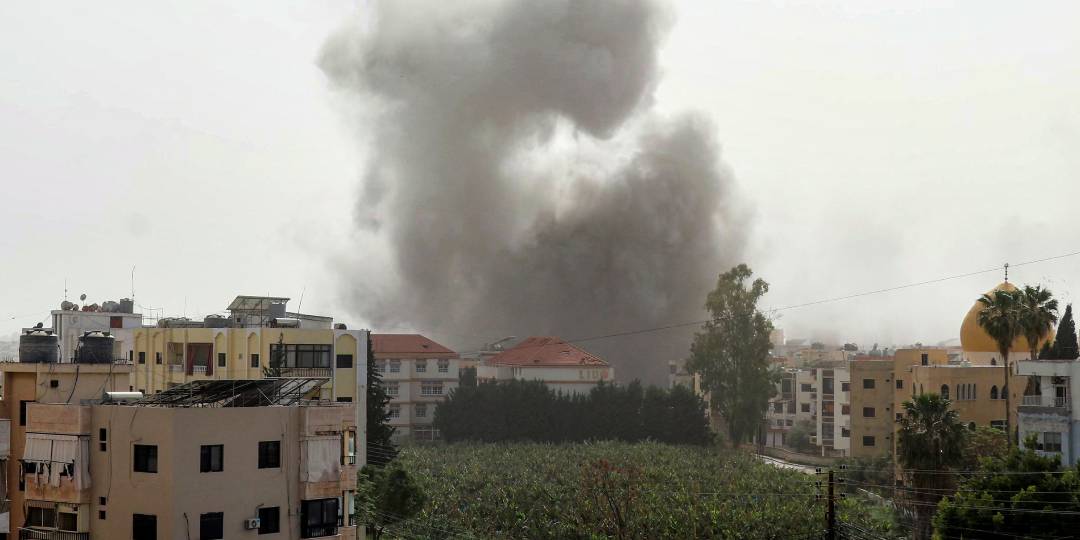
Iran experienced a new wave of US-Israeli strikes Saturday targeting critical civilian facilities. Iran’s Minister of Science, Hossein Simaei Saraf, announced that “more than 30 universities have been directly targeted since the war began,” pointing to Shahid Beheshti University in northern Tehran, which suffered heavy bombing on Friday.
Strikes near the Bushehr nuclear plant killed one security personnel assigned to the facility. Iranian authorities confirmed that the reactor itself sustained no direct damage, and the International Atomic Energy Agency reported no increase in radiation levels following the strike.
Nuclear Hazard Warnings and International Concerns
Iran’s Foreign Minister Abbas Araghchi issued a grave warning regarding continued strikes near the nation’s only nuclear power plant, stating that sustained attacks “could cause a radiation leak that would end life in Gulf Cooperation Council capitals, not in Tehran.” Geographically, the Bushehr plant sits on the Persian Gulf coast in southwestern Iran, closer to Gulf capitals than to Tehran.
Russia, which constructed the plant and participates in its operation, condemned the strikes. Russian Foreign Ministry spokeswoman Maria Zakharova stated: “We strongly condemn this vicious act that resulted in the death of a person,” and called for an immediate halt to all strikes on Iranian nuclear facilities.
Russia began evacuating 198 Rosatom nuclear company employees from the Bushehr plant on Saturday. Alexei Likhachev, Director-General of Rosatom, stated that “the main evacuation wave for Rosatom personnel from Iran began today as planned,” approximately 20 minutes after the strike.
Strikes Expand to Petrochemical and Defense Facilities
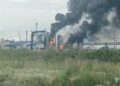
US-Israeli strikes expanded across multiple Iranian targets on Saturday. Petrochemical complexes in Mahshahr, Khuzestan province in southwestern Iran, came under attack, resulting in five wounded and damage to several industrial companies. A cement factory in Bandar Khomeini in southern Iran was also targeted.
In neighboring Iraq, strikes continued on border crossings. An airstrike hit a commercial checkpoint at an Iraq border crossing, resulting in one death. Iraqi authorities confirmed suspension of cargo and passenger movement through the Shulamiya crossing as a precaution.
Iranian Countermeasures and Regional Escalation
Iran responded to the strikes by launching additional missiles and drones against Israel and Arab nations throughout the region. In Bahrain, debris from intercepted drones caused minor injuries to four people and inflicted material damage.
In Israel, a woman sustained minor injuries from flying glass in Tel Aviv suburbs early Saturday following sirens activated due to Iranian missiles. The Iranian Revolutionary Guard announced targeting of a commercial vessel (MSC Eshika) linked to Israel flying a foreign flag in Bahrain’s Khalifa bin Salman Port, claiming a drone strike caused the ship to catch fire.
Global Economic Crisis and Hormuz Strait Closure
Iran’s closure of the strategic Strait of Hormuz creates mounting global economic concern as the conflict persists. Turkey announced passage of a second ship since the war began through the strait. India similarly announced that a tanker carrying its flag loaded with liquefied natural gas safely transited the waterway.
However, Iranian targeting of commercial vessels reflects Tehran’s strategy to impose maritime constraints as military retaliation against the de facto American economic blockade and demonstrates Iran’s willingness to risk escalation.
American Punitive Measures Against Iranians in US Territory
The US State Department announced the detention of two relatives of late Iranian military commander Qasem Soleimani, who was killed in a US drone strike in Iraq in 2020. They were detained after Secretary of State Marco Rubio revoked their legal residency status.
The State Department identified one detainee as Hamideh Soleimani Afshar, accusing her of “spreading propaganda for the Iranian regime, celebrating attacks on American soldiers and military positions, and glorifying the Iranian Revolutionary Guard.” Rubio stated that while living in the United States, Afshar “published Iranian regime propaganda, celebrated attacks on US soldiers and military positions in the Middle East, praised the new Iranian Supreme Leader, denounced America as the ‘Great Satan,’ and expressed steadfast support for the Islamic Revolutionary Guard Corps, designated as a terrorist organization.”
Deportation Policy and Targeting of Iranian Families
Rubio declared on social media platform X that “the Trump administration will not allow our country to harbor foreign nationals who support terrorist regimes hostile to America.” He added: “This week, I revoked the legal status of Afshar and her daughter. They are now in the custody of immigration and customs enforcement, pending deportation from the United States.”
The State Department also revoked the legal status of Fatima Ardeshir Larijani, daughter of Iranian Supreme National Security Council secretary Ali Larijani, who was assassinated in a March Israeli airstrike. The US barred Larijani and her husband from future entry to American territory.
Conclusion:
Trump’s renewed threats and accelerating military escalation signal an extremely critical juncture in US-Iranian confrontation. The 48-hour window will determine whether rapid diplomatic negotiations remain possible or whether the conflict will descend into more destructive military operations. Targeting of civilian and nuclear facilities, combined with the loss of an advanced American fighter jet, indicates the conflict has entered a dangerous new phase with immense risks to regional and global stability. The international community watches anxiously as developments unfold that could reshape the Middle East and destabilize global energy markets.