

President Donald Trump appealed to Japan, China, France, South Korea, and Britain on Saturday to deploy naval warships to protect the Strait of Hormuz, acknowledging that despite claims of total Iranian military destruction, Tehran maintains capacity to disrupt global oil supplies. The call for international burden-sharing reflects mounting pressure on the Trump administration to resolve a shipping crisis that has sent oil prices surging 40 percent and disrupted one-fifth of global crude commerce.
Iran responded to the Hormuz protection initiative with continued missile and drone attacks across the Gulf region, striking the US embassy in Baghdad for the second time, attacking Emirati energy infrastructure in Fujairah, and targeting US military installations. The continued Iranian operations directly contradict Trump’s assertions of military “decimation,” exposing the gap between US battlefield claims and operational reality as the conflict enters its third week with no diplomatic resolution visible.
Trump’s Call for International Fleet to Secure Shipping Lane
Trump announced that countries dependent on oil transiting the Strait of Hormuz “must take care of that passage, and we will help” with American naval forces. The statement reframes the conflict from a bilateral US-Iran confrontation into a multilateral responsibility-sharing arrangement, implicitly acknowledging that US forces alone cannot guarantee shipping security against Iranian threats.
“Many Countries, especially those who are affected by Iran’s attempted closure of the Hormuz Strait, will be sending War Ships, in conjunction with the United States of America, to keep the Strait open and safe,” Trump posted on social media. He specifically named China, France, Japan, South Korea, and Britain as potential participants, though he acknowledged his phrasing used “hopefully” indicating uncertainty about Allied commitment.
The Strait of Hormuz, only 54 kilometers wide at its narrowest point, handles approximately one-fifth of global crude oil and liquefied natural gas supplies. Iranian threats to close the waterway have made it a focal point for international concern as oil prices have surged past $100 per barrel.
Japan’s Cautious Response to Hormuz Deployment Request
Japanese policymakers expressed deep reluctance to deploy warships to the Gulf, with senior policy advisers indicating the “threshold is extremely high” for military participation. Takayuki Kobayashi, policy chief of Prime Minister Sanae Takaichi’s ruling Liberal Democratic Party, stated on Sunday that while Japanese law does not rule out the possibility, deploying naval forces required examination with “great caution.”
Japan’s hesitation reflects constitutional constraints on military deployment abroad, particularly contentious in the officially pacifist nation where many voters support the US-imposed 1947 war-renouncing constitution. Sending Self-Defense Forces to the Gulf region remains politically sensitive and faces domestic opposition concerns.
Japan ranks as the world’s fifth-largest oil importer, with 95 percent sourced from the Middle East and 70 percent transiting the Strait of Hormuz. The vulnerability of Japanese energy supplies creates immediate economic incentive for Hormuz protection, yet political constraints prevent straightforward military participation.
Kobayashi indicated that Prime Minister Takaichi expected to visit Washington this week for talks with Trump about the Hormuz deployment issue and broader security matters, suggesting Japan seeks clarification of US intentions and potential alternatives to direct military involvement.
Continued Iranian Attacks Defy Trump’s Defeat Claims
Despite Trump’s repeated assertions that Iran’s military has been “completely decimated” and “beaten,” Iranian forces continued systematic attacks across the Gulf region on Saturday. The Revolutionary Guards claimed to have launched missiles at the Al-Kharj base in Saudi Arabia hosting significant US military personnel, demonstrating sustained capability to strike American installations despite reported destruction of Iranian air defenses.
Qatar evacuated parts of downtown Doha and intercepted two missiles, with AFP journalists reporting blasts in the capital. Air raid sirens sounded across multiple Gulf locations as Iranian drone and missile attacks continued unabated. Kuwait’s civil aviation authority reported a drone strike damaged the international airport’s radar system, while security sources confirmed the US embassy in Baghdad was struck for the second time during the conflict.
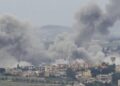
Clouds of black smoke rose over Fujairah in the UAE, a major Emirati oil storage and export terminal, shortly after Iran’s military warned UAE civilians to avoid port areas. The targeting of critical energy infrastructure underscores Iran’s strategy to inflict economic damage despite military losses.
US Embassy in Baghdad Attacked; Americans Urged to Leave
The US embassy in Baghdad came under drone attack on Saturday, marking the second such strike during the conflict. Security sources told AFP that the diplomatic facility was directly hit, though no immediate casualty reports emerged. US officials in Baghdad subsequently issued urgent advisories urging American citizens to “leave now,” warning them not to approach the embassy or consulate in Erbil “in light of the ongoing risk of missiles, drones, and rockets in Iraqi airspace.”
The embassy attack parallels earlier drone strikes on the Emirati consulate in Iraqi Kurdistan, which was targeted for the second time within a week. The pattern of attacks on diplomatic facilities signals Iranian strategy to target US presence across the region systematically.
Trump’s Contradiction Between Rhetoric and Reality
Trump’s appeal for international assistance contradicts his earlier claims that Iran faces complete military defeat. His acknowledgment that countries must help secure the Strait of Hormuz implicitly recognizes that Iranian capacity to threaten shipping persists despite US bombardment campaigns.
Trump stated: “It’s easy for them to send a drone or two, drop a mine, or deliver a close range missile somewhere along, or in, this Waterway, no matter how badly defeated they are.” The acknowledgment reveals the gap between US public claims of Iranian military destruction and actual Iranian operational capability to threaten critical infrastructure.
This rhetorical inconsistency reflects the broader challenge facing the US campaign: despite reportedly striking over 15,000 targets in Iran and the Pentagon announcing the first six days cost $11.3 billion, Iranian forces maintain sufficient capability to sustain military operations and conduct strategic strikes against both military and economic targets.
Lebanon Death Toll Exceeds 800 as Israel Battles Hezbollah
The conflict has produced catastrophic consequences in Lebanon, where Israeli military operations targeting Hezbollah have killed at least 826 people according to Lebanese authorities. The death toll represents a dramatic increase from earlier casualty figures, reflecting intensifying air strikes and ground operations across Lebanese territory.
Israel has issued evacuation orders covering hundreds of square kilometers of Lebanese territory, displacing hundreds of thousands of civilians and triggering warnings of humanitarian disaster. The displacement scale creates additional humanitarian pressure on an already strained Lebanese state facing multiple crises simultaneously.
Hezbollah confirmed engagement in “direct clashes” with Israeli forces in the southern Lebanese town of Khiam late Saturday, involving light and medium weapons as well as rocket-propelled projectiles. The group’s continued military operations despite heavy bombardment demonstrate its capacity to sustain combat despite significant losses.
Global Economic Disruption Continues
Oil prices remained above $100 per barrel with Brent crude trading at elevated levels reflecting persistent supply disruption fears. Shipping through the Strait of Hormuz has effectively ceased, with Lloyd’s List Intelligence reporting only 77 vessels transited in March compared to 1,229 during the same period last year.
The dramatic reduction in maritime traffic reflects both Iranian threats and widespread shipper reluctance to risk transit through contested waters. Twenty oil tankers and cargo ships have been attacked since the war began, according to AFP monitoring with maritime security groups.
Global consequences extend beyond energy markets. Formula One announced cancellation of April’s Bahrain and Saudi Arabia races due to war disruption. African nations face potential economic growth reduction of up to three percentage points if fuel shortages persist, with most African countries maintaining reserves for only 15 to 25 days compared to the International Energy Agency standard of 90 days.
International Diplomatic Positioning
France and Britain have mobilized naval forces, with France dispatching an aircraft carrier to the Mediterranean and Britain sending a warship toward the eastern Mediterranean in response to regional instability. However, both nations have characterized their missions as “defensive” rather than offensive support for US military operations, indicating reluctance for direct military alignment with Trump’s Iran campaign.
Japan’s hesitation, combined with the diplomatic framing from European allies, suggests international reluctance to fully embrace Trump’s vision for a multilateral military coalition to secure the Hormuz. Countries recognize dependence on Gulf oil supplies but resist direct military involvement in what some characterize as primarily a US-Iranian confrontation.
Iranian Leadership Transition and Stability Claims
Iran’s new supreme leader Mojtaba Khamenei, who assumed office following his father Ali Khamenei’s killing on February 28, has not appeared in public and is reportedly wounded. Iranian officials claimed on Saturday that “there is no problem with the new supreme leader,” suggesting efforts to project stability and continuity despite uncertainty about succession arrangements.
The absence of Iran’s supreme leader from public view amid continued military operations raises questions about regime control and decision-making authority during wartime. If the new supreme leader is substantially incapacitated, it could indicate military decisions are being made by other officials, potentially explaining the continuation of attacks despite military losses.
Conclusion:
Trump’s appeal for international naval reinforcement to protect the Strait of Hormuz represents an implicit acknowledgment that sustained Iranian military capability poses unresolved threats to global oil supplies three weeks into the conflict. Despite claims of Iranian military decimation, Iranian forces continue systematic attacks on diplomatic facilities, energy infrastructure, and military installations across the Gulf region. Japan’s cautious response to Hormuz deployment requests, combined with European reluctance to characterize operations as offensive support, suggests that Trump’s vision for a coordinated international coalition faces significant diplomatic obstacles. With Lebanon’s death toll exceeding 800, Iranian strikes continuing across the Gulf, and shipping effectively halted through the Strait of Hormuz, the conflict shows no signs of rapid resolution despite Trump’s earlier predictions of near-term conclusion.