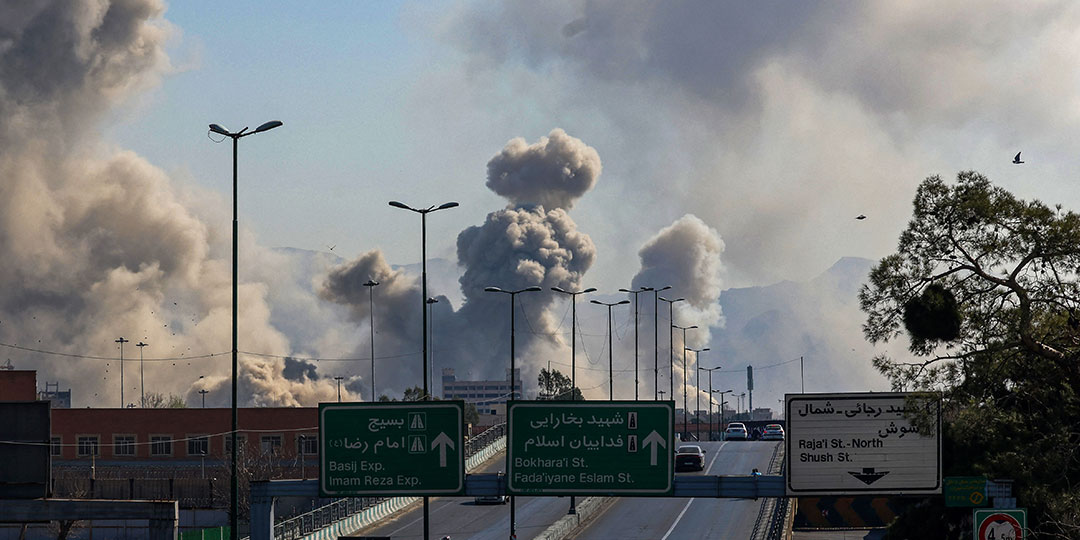

Multiple explosions struck Tehran on Thursday morning in its western districts and surrounding areas, according to reports from Iranian local media outlets. The blasts came after Israel announced a new round of aerial strikes against the Iranian capital, amid an accelerating military conflict marking the most direct confrontation the Middle East has witnessed in years.
Journalists from Agence France-Presse heard fighter jets roaring over western Tehran, followed by distant but powerful explosion sounds. Simultaneously, Iran’s Farsi news agency reported explosions in western Tehran, while local newspapers reported at least one blast in the nearby city of Karaj, west of the capital.
Iran launched a fresh wave of missiles and unmanned aircraft early Thursday morning in response to sustained American and Israeli attacks targeting the capital and multiple Iranian cities.
Scale of Escalation and Military Operations
The White House described the situation on Thursday as the Iranian system being “completely crushed” on the fifth day of the American-Israeli offensive against the Islamic Republic. White House spokesperson Carolyn Leavitt stated that “the rogue terrorist regime in Iran is currently being completely crushed” under the weight of the strikes.
The conflict has expanded to an unprecedented scale across the Middle East and beyond. Washington announced the sinking of an Iranian frigate off Sri Lankan shores, resulting in dozens of naval personnel killed. NATO forces also intercepted an Iranian missile heading toward Turkish airspace.
Strike Rates and Military Losses
General Mark CQ Brown, chairman of the U.S. Joint Chiefs of Staff, stated that Iran’s ballistic missile launch rate has declined by 86% compared to the opening days of the war, while drone attacks have fallen by 73%.
Israeli military spokesperson Nadav Shoshani reported that Israel has disabled approximately 300 ballistic missile launch platforms, and that operations against these systems and their stockpiles are reducing the volume of daily missile launches.
Nevertheless, Iran has continued launching missiles and drones toward Israel and multiple countries across the Gulf region.
Regional Tensions and Ground Operations in Lebanon
Ground operations in Lebanon escalated after Hezbollah fired rockets at Israel, stating they were “retaliation” for the death of Supreme Leader Ayatollah Ali Khamenei. Israel responded with extensive strikes and initiated ground operations in southern Lebanon, resulting in at least 72 deaths and the displacement of 83,000 people.
Hezbollah announced its fighters are engaged in “direct” clashes with Israeli forces that have infiltrated the town of Khiyam, and are launching anti-tank missiles against advancing Israeli tanks.
French President Emmanuel Macron urged Israeli Prime Minister Benjamin Netanyahu to “preserve Lebanese territorial unity and refrain from ground operations.”
Iranian Response in Other Areas
The Islamic Revolutionary Guard announced targeting Iranian Kurdish opposition factions in Iraqi Kurdistan. Iran also warned maritime traffic against entering the strategic Strait of Hormuz, declaring full control of the waterway.
Tanker traffic through the Strait of Hormuz has declined by 90% since the outbreak of the war, according to Kpler’s energy market analysis platform.
Human Casualties and Humanitarian Impact
The Iranian Red Crescent reported that American and Israeli operations have resulted in more than one thousand deaths in Iran, though Agence France-Presse has not been able to independently verify this figure.
Israeli authorities announced 10 deaths from Iranian strikes. Kuwait’s Ministry of Health also reported the death of an 11-year-old girl after shrapnel injuries from an attack on Kuwaiti territory.
The U.S. military has identified four of six American servicemen killed in the war so far, noting they died in a drone attack on Kuwait.
Gulf States and Regional Positioning
Qatar called on Iran to immediately cease attacks on regional countries, stating that Iranian strikes “seek to harm neighbors and drag them into a war that is not theirs.”
The United Arab Emirates and Qatar intercepted Iranian missile and drone attacks on Wednesday. U.S. Secretary of State Marco Rubio described Iran’s violation of Turkish sovereignty as “unacceptable.”
Impact on Maritime Traffic and International Transport
Major shipping companies have suspended operations through the Strait of Hormuz due to Iranian threats. Maritime agencies reported multiple vessels have been targeted, and transit operations through the vital energy export chokepoint have declined sharply.
The United States has urged all its citizens to leave the region. Governments including Britain and France have dispatched special evacuation flights for their nationals, while air traffic has been severely disrupted.
Naval Losses
Washington announced the sinking of the Iranian frigate “Dena” off Sri Lankan shores on Tuesday. Sri Lanka’s navy recovered the bodies of 87 Iranian sailors from waters near the southern city of Galle, while 61 remain missing.
Conclusion
The Middle East is experiencing the most severe military crisis in recent years, with rapidly expanding conflict involving multiple nations and territories. Explosions in Tehran reflect the unprecedented level of escalation between Iran and American-Israeli forces, while the humanitarian and economic consequences of the war continue to broaden across the region and globally.