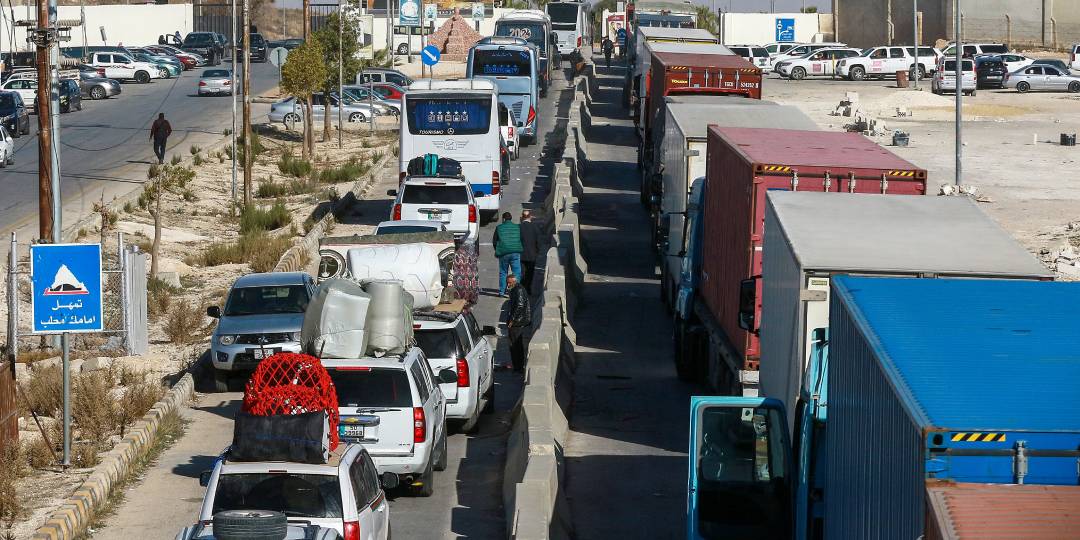

Lebanon and Jordan have begun official contacts with Damascus to address the ban on non-Syrian trucks, following a Syrian decision to block foreign trucks carrying goods destined for the local Syrian market.
The move has disrupted land transport routes and supply chains, leading to congestion at key border crossings with both countries.
Officials in Beirut and Amman told Agence France-Presse that discussions are ongoing as they await a formal response from the Syrian side.
Truck Congestion at the Lebanese-Syrian Border
Dozens of Lebanese trucks were seen lined up at the Masnaa border crossing after being denied entry into Syria, according to an AFP photographer.
Lebanon’s Director General of Land and Maritime Transport Ahmad Tamer said discussions are underway with Damascus, expressing hope that a meeting would be held soon to reach practical solutions.
Impact on Lebanese Supply Chains
Tamer noted that the issue is an internal Syrian matter and not directed at Lebanon or bilateral relations. However, he stressed that any disruption to land transport directly affects supply chains and commercial activity.
He pointed to daily trade exchanges between Lebanon and Syria, including ports, production centers, and agricultural trade, adding that Syria remains Lebanon’s only land export route to Gulf markets.
According to Lebanese officials, around 500 Lebanese trucks cross into Syria each day.
Syrian Decision and Transit Exemptions
Syria’s General Authority for Border Crossings and Customs issued a decision barring non-Syrian trucks from entering Syrian territory via land crossings. Goods destined for the Syrian market must now be unloaded exclusively at designated customs points at the borders.
Key elements of the decision include:
A ban on non-Syrian trucks entering Syria.
Mandatory unloading of goods at border customs points.
An exemption for transit shipments heading to third countries.
A source at the authority told AFP the measure aims to regulate freight movement through border crossings.
Jordan Also Affected by the Ban
In Jordan, Transport Ministry spokesperson Mohammad Duwairi said talks are underway with Damascus to allow foreign trucks to enter and transit Syria.
He explained that Jordanian trucks are currently unloading cargo at the free zone near the Nassib crossing, despite what he described as logistical disruption.
Before the decision, about 250 Jordanian trucks were entering Syria daily.
Concerns from Jordan’s Transport Sector
The Syrian measure has raised serious concerns among Jordanian transport companies, which warn that the back-to-back transport system at the border will increase costs and delays, particularly given limited infrastructure on the Syrian side.
Industry representatives say the new system could lead to:
Slower export deliveries.
Higher operational costs.
Loss of time and cost advantages for shipments via Aqaba Port.
Objections from Lebanon’s Transport Unions
In Lebanon, transport unions rejected what they described as additional burdens resulting from unilateral measures.
Following a meeting at the Transport Directorate, union representatives called on the Ministry of Public Works and Transport to protect the sector, including by considering reciprocal measures regarding Syrian trucks entering Lebanon.
Conclusion:
The ban on non-Syrian trucks has placed immediate logistical and economic pressure on Lebanon and Jordan at a time when all three countries are seeking to reset economic relations following regional political changes. The outcome of ongoing talks with Damascus will be key to preventing wider trade disruptions.