
Najaf Arbaeen security plan was announced on Thursday as Najaf police said they had approved a comprehensive security and intelligence strategy to protect the Arbaeen pilgrimage. The plan includes dividing the province into 10 security zones and opening joint operations rooms with the participation of security forces, the Popular Mobilization Forces, and government departments.
Najaf is regarded as a key gateway to Karbala and one of the main starting points for pilgrims heading to commemorate Arbaeen.
Najaf as a major route for Arbaeen pilgrims
Police spokesperson Colonel Moufid Salem Al-Taher told the Iraqi News Agency (INA) that Najaf serves as the first major stop for pilgrims heading to Karbala and also as one of the final stops for religious visits connected to the commemoration period.
He said the provincial police command has held multiple meetings and prepared organizational and security plans based on a strong intelligence framework.
Reduced military presence, stronger intelligence role
Al-Taher said the strategy focuses on reducing the visible military footprint and relying more heavily on intelligence, security coordination, civil support, and organizational measures.
Joint operations rooms and multi-agency coordination
Several operations rooms have been opened across the province under the supervision of Najaf Police Commander Major General Mohammed Jaber Diab Al-Fatlawi.
The rooms include representatives from the Popular Mobilization Forces and the Border Forces Command, alongside local and federal government officials.
This coordination aims to manage the large number of pilgrims and ensure smooth service delivery throughout the pilgrimage period.
Role of government and religious institutions
The operations rooms also coordinate with the Department of Husseini Rituals and the many mourning processions active across the province.
Officials said there is close coordination with the holy shrines, especially the Alawi Shrine and the Kufa Shrine and Mosque, to manage visitor flow and provide services.
Province divided into 10 security sectors
Because Najaf contains several holy shrines spread across different districts, the province has been divided into 10 security sectors.
The goal is to secure pilgrim movement toward these sites, with special attention to central Najaf, the Imam Ali Shrine, and Kufa City.
Additional operations room at kilometer marker 350
A separate operations room has been opened at kilometer 350 to manage congestion and regulate pilgrim movement and related activities during the pilgrimage.
Popular Mobilization Forces begin deployment plan
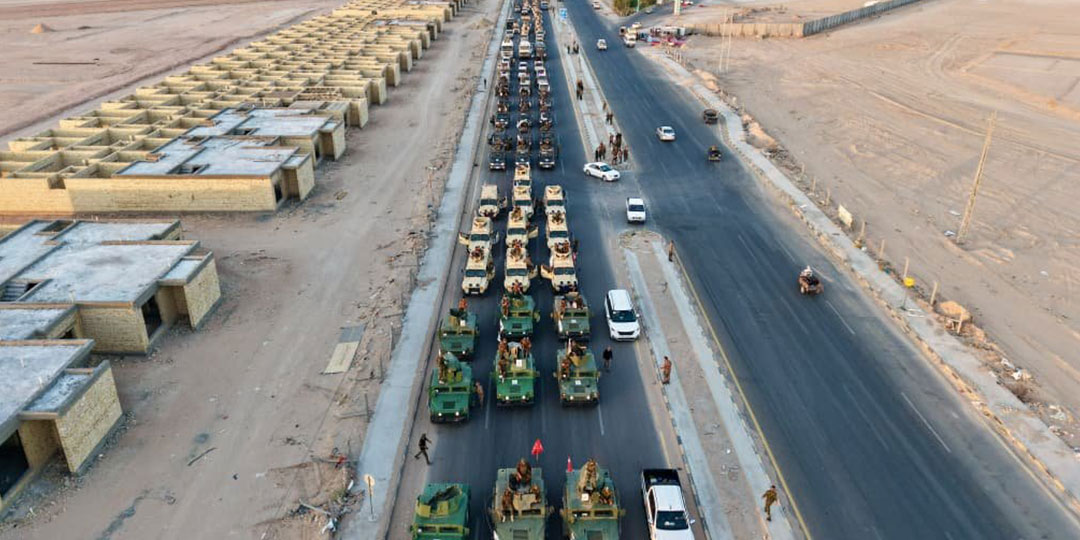
In a separate statement, the Popular Mobilization Forces said its units in Najaf had begun implementing the security deployment plan for Arbaeen.
According to Muhammad Al-Asadi, media director of the PMF in Najaf, the force launched its deployment early Thursday morning as part of a joint effort to protect pilgrims and ensure the smooth movement of processions and visitors.
Units involved in the deployment
The plan includes the following units:
2nd Brigade
42nd Brigade
21st Brigade
11th Brigade
Special Tasks Regiment
A regiment affiliated with the PMF General Staff
A unit linked to the PMF secretariat
Security coverage from Diyala border to Karbala road
Al-Asadi said the deployment extends from the administrative boundary with al-Diwaniyah, through the old city of Najaf, and onward to the border with Karbala at kilometer marker 667.
The plan also includes securing the eastern trench line extending for 155 kilometers and protecting pilgrim transport areas within the designated responsibility zones.
Conclusion:
The Najaf Arbaeen security plan reflects the province’s central role in managing one of Iraq’s largest annual religious gatherings. With multiple agencies involved, authorities say the focus remains on intelligence coordination, orderly movement, and protecting pilgrims throughout the Arbaeen period.