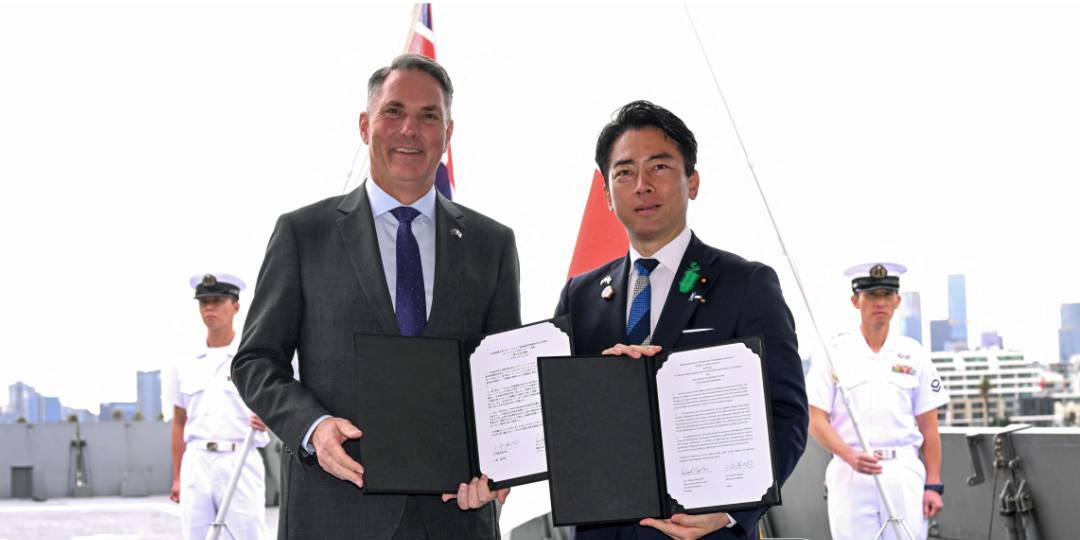

Japan and Australia signed contracts Friday valued at 10 billion Australian dollars, approximately 7 billion US dollars, for supply of advanced warships to the Royal Australian Navy. The agreement represents Japan’s largest military export transaction since Tokyo lifted its weapons export ban in 2014, reflecting significant strategic pivot in Japanese defense policy and deepening bilateral military cooperation. The signing occurred following discussions between Australian Defense Minister Richard Marles and Japanese counterpart Shinjiro Koizumi, affirming government commitment to successful program implementation.
The landmark defense agreement underscores accelerating strategic developments across Asia-Pacific and reflects mounting concerns regarding shifting geopolitical balances in the region. Both governments emphasized their commitment to defense relationship enhancement and demonstrated resolve to strengthen security partnerships amid evolving regional security environment. The transaction signals Japan’s expanded military-industrial role and Australia’s determination to enhance naval capabilities facing emerging strategic challenges.
Contract Signing and Government Commitment Affirmation
Australian Defense Minister Richard Marles and Japanese counterpart Shinjiro Koizumi signed the formal contracts Friday, with Marles stating in official statement: “I signed the contracts with my Japanese counterpart, affirming both governments’ commitment to successful implementation of the warship delivery program.”
The ministerial-level signing reflects political importance attached to the transaction and demonstrates seriousness of commitment from both governments. Contract signatures represent completion of extensive negotiations and precise coordination to ensure optimal terms and conditions benefiting both parties. The formal nature of the signing ceremony underscores the strategic significance beyond routine military procurement.
Deal Value and Economic Significance
The contract value totals 10 billion Australian dollars, equivalent to approximately 7 billion US dollars. This substantial investment reflects strategic importance to both nations:
- Japanese Economy: Significant revenue from defense industry and naval construction
- Australian Economy: Job creation and development of domestic shipbuilding capacity
- Regional Security: Enhancement of maritime military capabilities and regional stability
Deal Details and Planned Warships
Under the signed agreement, Japanese company Mitsubishi Heavy Industries will supply the Royal Australian Navy with three advanced multirole frigates. The first three vessels will be constructed in Japan beginning 2029, with eight additional frigates to be constructed in Australia subsequently.
This division between Japanese and Australian production reflects carefully balanced approach combining Japanese technological expertise with Australian industrial capacity. The phased construction timeline allows for technology transfer and workforce development across both nations’ shipbuilding sectors.
Frigate Specifications and Combat Capabilities
The planned frigates feature advanced technical specifications:
- Multirole Capability: Capable of performing diverse military and civilian missions
- Technological Advancement: Equipped with cutting-edge electronic and military systems
- Defensive Capability: Armed with advanced defense systems against air and naval threats
- Range and Endurance: Capable of extended-range maritime operations
Japanese Defense Ministry Position and Official Affirmations
Japan’s Defense Ministry confirmed via platform X (formerly Twitter) that Koizumi and Marles “welcomed conclusion of multirole frigate contracts and affirmed strengthening bilateral defense relations between the countries.”
The official announcement confirmed that the transaction represents more than routine military commerce, reflecting genuine government commitment to deepening military and defense cooperation. This high-level affirmation signals serious intent regarding long-term defense partnership development between the nations.
Geopolitical Implications of the Agreement
The transaction conveys several important geopolitical messages:
- Strategic Alliance: Deepening alliance between Japan and Australia
- Threat Response: Preparation to confront potential regional threats
- Allied Cooperation: Strengthening military cooperation with reliable allies
- Regional Stability: Contributing to Asia-Pacific security and stability
Broader Context of Australian Defense Spending Increases
This transaction arrives within context of Australia’s recent announcement regarding intention to increase defense spending to 3 percent of gross domestic product by 2033, compared to approximately 2 percent currently. This spending increase reflects growing Australian concerns regarding:
- Regional Developments: Rapid changes in Asia-Pacific power balance
- Potential Threats: Concerns about military expansion by major regional powers
- Maritime Security: Importance of controlling vital commercial shipping routes
Rationale for Australian Defense Spending Increase
Australia increases defense spending due to several strategic reasons:
- Geographic Position: Australia located distant from Western allies
- Economic Resources: Possesses substantial economic resources requiring protection
- Maritime Dependence: Majority of trade dependent on maritime transportation
- Defense Autonomy: Desire to reduce reliance on allied security assistance
Parallel US-German Military Contracts Worth 11.9 Billion Dollars
In parallel development, the United States approved potential sale of military equipment to Germany valued at 11.9 billion dollars. The US State Department announced approval, stating: “This proposed sale will support US foreign policy and national security objectives by improving security of a NATO alliance member state.”
The State Department characterized Germany as “a force for political stability and economic progress in Europe,” justifying substantial military technology transfer to strengthen German defense capabilities.
Contents of US-German Military Agreement
The US-German transaction includes several advanced military elements:
- Integrated Combat Systems: Eight advanced combat systems
- Radar Systems: Modern threat detection systems
- Missile Launch Systems: Guided missile launch capabilities
- Communication Technology: Advanced communication systems compatible with NATO forces
Broader Picture of Global Military Activity Acceleration
The Japanese-Australian and US-German agreements reflect broader global patterns of accelerating military activity:
- Alliance Strengthening: Reinforcing relationships between allied nations
- Increased Military Spending: General rise in global defense expenditures
- Technology Development: Development and deployment of advanced military technologies
- Conflict Preparation: Preparation for potential confrontations in various regions
Driving Factors for Global Military Activity Increase
Multiple factors propel global increases in military spending and activity:
- Ongoing Conflicts: Wars and disputes occurring in numerous locations
- Geopolitical Tensions: Competition among major powers for regional influence
- Technological Developments: Necessity to maintain pace with military technological evolution
- Security Concerns: Rising security anxieties across diverse regions
Strategic Importance of Naval Industry in Modern Military Strategy
Both transactions underscore critical strategic importance of naval power in contemporary military doctrine:
- Seapower Control: Importance of controlling vital maritime passages
- Trade Protection: Protecting commercial vessels from emerging threats
- Strategic Deterrence: Naval forces provide robust deterrent capabilities
- Operational Flexibility: Warships offer flexibility in responding to multiple commitments
Evolution of Warship Technology and Advanced Capabilities
Modern frigates represent substantial advancement in naval capabilities:
- Automation: Advanced automated systems reducing crew requirements
- Sensing: Sophisticated sensing systems enabling early threat detection
- Communications: Advanced communication networks coordinating operations
- Weaponry: Precision-guided weapons with enhanced combat capabilities
Potential Effects on Regional and Global Balance
The agreements may significantly influence regional and global power balances:
- Power Balance Adjustment: Enhancement of Western military capabilities
- Deterrence: Increased deterrent capabilities against regional expansion
- Relative Stability: Possible contribution to regional stability
- Armed Competition: Potential stimulus for arms race in affected regions
Risks Associated with Military Escalation
Despite anticipated benefits, military increases entail potential risks:
- Arms Race: Stimulation of arms competition in affected regions
- Tension Escalation: Possible escalation rather than tension reduction
- Accidents: Potential for unintended military incidents
- Lethal Weapons: Expansion of advanced and destructive weapons capabilities
Japanese Defense Policy Transformation
The Japanese-Australian contract marks watershed moment in Japanese defense policy, reflecting transition from postwar peace orientation toward more active military roles. Japan’s participation in substantial arms exports represents departure from historical reluctance regarding military industry development and weapons proliferation.
This strategic shift reflects:
- Regional Security Concerns: Growing concerns about regional security environment
- Alliance Strengthening: Desire to strengthen partnerships with allied nations
- Economic Benefits: Recognition of defense industry economic contributions
- Strategic Autonomy: Enhanced capacity for independent defense initiatives
Historical Context of Japanese Defense Policy
Japan’s weapons export ban, imposed following World War II, reflected commitments to pacifism and non-militarization. Lifting this ban in 2014 represented significant policy evolution, permitting Japanese defense contractors to export military equipment to allied nations. Current transaction demonstrates acceleration of this liberalization trend.
NATO Expansion and European Defense Enhancement
The US-German military agreement reflects broader NATO strengthening and European defense enhancement efforts. Germany, as central European NATO member, receives substantial military technology transfer aimed at enhancing European deterrent capabilities against potential threats.
The transaction supports:
- NATO Strengthening: Enhanced military capabilities for alliance
- European Defense: Development of autonomous European defense capacity
- Transatlantic Cooperation: Deepened US-European military cooperation
- Integrated Defense: Enhanced interoperability among allied forces
Commercial and Industrial Dimensions of Defense Contracting
Beyond military implications, defense contracts carry significant commercial dimensions:
- Industrial Capacity: Contracts stimulate defense industry development and growth
- Employment: Creation of sustained employment in defense-related sectors
- Technology Transfer: Advanced technology flowing to domestic industries
- Economic Growth: Contribution to national economic development
Supply Chain and Industrial Development
Large-scale defense contracts drive industrial development through:
- Supplier Networks: Development of extensive supplier and subcontractor networks
- Workforce Development: Training and development of skilled technical workforce
- Research Investment: Substantial research and development investments
- Industrial Infrastructure: Development of modern manufacturing facilities
International Implications and Global Security Dynamics
The simultaneous execution of major defense contracts across Asia-Pacific and Europe conveys messages regarding global security dynamics:
- Great Power Competition: Reflects ongoing competition among major powers
- Alliance Strengthening: Demonstrates commitment to alliance relationships
- Regional Instability: Signals concerns regarding regional stability
- Technological Competition: Reflects competition in military technology development
Conclusion:
The Japanese-Australian and US-German defense transactions reflect accelerating global trend toward increased military spending and strengthening of defense alliances. The Japanese-Australian agreement marks watershed moment in Japanese defense policy, representing transition from postwar pacifism toward more active military-industrial role. The US-German transaction reflects American commitment to strengthening European allies against emerging threats.
However, these agreements potentially ignite new arms races and intensify regional tensions, necessitating parallel efforts promoting international dialogue and understanding to prevent comprehensive military confrontation. The sustainability of regional stability depends on successful balance between military capability enhancement and diplomatic engagement addressing underlying security concerns. International community must pursue conflict prevention and resolution mechanisms alongside defense capability development to prevent escalation spirals potentially destabilizing multiple regions. Success requires coordinated diplomatic initiatives alongside military preparations to ensure that defense acquisitions support rather than undermine long-term regional and global stability objectives.