
Israel renewed intensive strikes on Beirut on March 12, striking multiple targets across the Lebanese capital as the military threatened to expand operations and seize territory in Lebanon if Hezbollah did not cease attacks. Hezbollah responded by launching approximately 200 rockets and 20 drones in what the Israeli military characterized as the group’s “biggest barrage” since the war’s inception, in a coordinated operation timed with Iran’s simultaneous ballistic missile attacks on Israel. The escalating cycle of strikes and counterstrikes killed additional civilians in Beirut’s seafront areas and suburban districts while displacing tens of thousands more from their homes. Israeli Defence Minister Israel Katz announced he had ordered troops to “prepare for expanding” operations in Lebanon, warning that Israel would seize Lebanese territory and conduct military operations independently if the Lebanese government could not control Hezbollah. The intensifying conflict demonstrates the rapid escalation of the Lebanon dimension of the broader Middle East war and the growing humanitarian toll on civilian populations caught between military forces.
Israeli Military Renews Strikes on Central Beirut
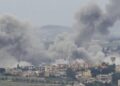
The Israeli military launched what it described as “a wave of strikes targeting Hezbollah terrorist infrastructure across Beirut” on March 12, striking multiple locations across the Lebanese capital. AFP video footage documented dark smoke rising above Bashoura, located in the heart of Beirut’s commercial district adjacent to the capital’s business center where major corporations and government institutions operate.
The strike on Bashoura marked the fourth Israeli attack on central Beirut since the latest round of fighting commenced on March 2. The targeting of Beirut’s commercial and administrative center represented a significant expansion of Israeli military operations beyond southern suburbs historically associated with Hezbollah strongholds.
The Israeli military announced it had issued evacuation warnings ahead of the Beirut attack and simultaneously expanded evacuation orders for residents in southern Lebanon to include areas below the Zahrani river, approximately 40 kilometers north of the Israeli border. The expanded evacuation zone reflected Israeli intentions to conduct military operations across expanded geographic areas of Lebanon.
Civilian Casualties in Beirut Seaside Attack
An Israeli strike in Ramlet al-Bayda, located on Beirut’s seaside, killed 12 people and wounded 28 according to Lebanon’s health ministry. The attack occurred in an area typically bustling with crowds, now sealed off by security forces following the strike. AFP correspondents at the scene documented damaged motorcycles and vehicles, blood stains on pavement, and a small crater in the ground.
The seaside attack marked the third major Israeli strike in the heart of Beirut since the Middle East war commenced. Displaced persons have been sheltering in tents and makeshift camps on Beirut’s streets, including in Ramlet al-Bayda where some shelters sustained shrapnel damage from the March 12 strike.
Aseel Habbaj, a displaced woman sheltering in a nearby tent after fleeing Israeli bombing in other Lebanese areas, described the attack: “We saw dead people on the ground. We were all asleep in my tent, when suddenly we heard a noise. We jumped up and went to see what was happening,” before a second strike wounded her husband.
Her 40-year-old neighbor Dalal al-Sayed, who had pitched her tent at the seaside after fleeing southern Lebanon attacks, stated: “Because the last thing we expected was Israel to hit Beirut.” Unable to afford apartment rentals, al-Sayed declared: “We won’t leave, we will stay here even if we die.”
Israeli Strikes on University and Residential Areas
An Israeli strike on a Lebanese University branch, the country’s only public institution of higher learning, killed the head of the faculty of sciences and another professor according to Lebanon’s state-run National News Agency. The targeting of the educational institution represented a significant strike against Lebanon’s civilian academic infrastructure.
Additional Israeli strikes on Aramoun, a residential area south of Beirut, killed five people and wounded a child according to the health ministry. The National News Agency reported multiple Israeli strikes on southern Lebanon, where Hezbollah has maintained long-standing presence and operational infrastructure.
Israel has repeatedly targeted the southern suburbs of Beirut, a traditional Hezbollah stronghold, with ongoing air raids and strikes across multiple districts. The combination of strikes on central Beirut, seaside areas, southern suburbs, and southern Lebanon demonstrates the geographic expansion of Israeli military operations across Lebanese territory.
Hezbollah Launches Coordinated 200-Rocket Barrage
Hezbollah launched what the Israeli military described as its “biggest barrage” since the war’s commencement on the night of March 11-12, firing approximately 200 rockets and 20 drones in a coordinated operation timed with simultaneous Iranian ballistic missile attacks. Israeli military spokesman Lieutenant Colonel Nadav Shoshani stated: “Last night, Hezbollah timed a simultaneous attack with Iran, firing rockets and drones at towns and communities across Israel. The numbers are approximately 200 rockets, approximately 20 UAVs, and combine those with ballistic missiles that were being fired from Iran at the same time.”
Shoshani acknowledged: “This was Hezbollah’s biggest barrage” since the start of the war.
However, the spokesman claimed Israeli air defenses performed effectively: “We had a good aerial defence and rapid response, resulting in minimal casualties, only two or three direct hits and a few civilians that were lightly injured.” The Israeli military assessment suggested that the majority of incoming rockets and drones were intercepted by Israeli air defense systems.
Hezbollah Targets Israeli Strategic Locations
Hezbollah announced attacks on multiple Israeli targets in coordinated statements released on March 12. The group declared it had targeted Israeli air defense systems near the town of Caesarea in central Israel, home to Prime Minister Benjamin Netanyahu’s private residence. Hezbollah also announced firing missiles at an Israeli military intelligence base in the suburbs of Tel Aviv and another base south of Haifa, among additional attacks on unspecified Israeli targets.
The coordinated timing of Hezbollah’s barrage with Iranian ballistic missile attacks suggested a deliberate strategy to overwhelm Israeli air defenses through simultaneous multi-domain attacks from multiple launch points. The coordinated approach reflected Iranian and Hezbollah efforts to maximize the probability of successful strikes against Israeli targets through distributed attack patterns.
Israeli Military Assessment and Strategic Response
Israeli military chief Lieutenant General Eyal Zamir announced that Israeli forces had killed the commander of the Iran-backed Imam Hussein Division and his deputy in strikes on Beirut’s southern districts. Zamir stated: “Let there be no confusion, we are fighting absolute evil,” in a military statement characterizing the conflict in stark moral terms.
Israeli military spokesman Shoshani reported that the army had conducted waves of strikes against Hezbollah on Wednesday night in southern Lebanon to limit the group’s rocket-firing capabilities and continued targeting Beirut’s southern suburbs. The military announced it had struck “dozens of launchers” as well as Hezbollah intelligence and command sites in south Beirut.
The Israeli military reported that overall Hezbollah had fired more than 1,000 drones, rockets, and missiles at Israel over the preceding 12 days, representing an escalating barrage of attacks that demonstrated sustained Iranian-backed group capabilities despite Israeli air strikes.
Israeli Minister Threatens Territory Seizure
Israeli Defence Minister Israel Katz announced that he had ordered troops to “prepare for expanding” operations in Lebanon following the latest Hezbollah barrage. Katz issued a direct warning to Lebanon’s government: “I warned the President of Lebanon that if the Lebanese government does not know how to control the territory and prevent Hezbollah from threatening northern communities and firing toward Israel, we will take the territory and do it ourselves.”
The statement represented an explicit threat that Israel would conduct military operations on Lebanese soil to eliminate Hezbollah capabilities if the Lebanese government did not independently restrict Hezbollah’s operational activities. The military later expanded its evacuation order for residents living in southern Lebanon, indicating preparations for expanded military operations in the region.
Escalating Casualty Toll and Humanitarian Crisis
The violence has killed more than 687 people according to Lebanese authorities, while more than 800,000 people have registered as displaced from their homes. The casualty figures underscore the humanitarian toll of the conflict now extending across multiple Lebanese regions beyond the initial southern border areas.
Khalil Khalil, owner of a house in an Arab village near Majd el-Kroum in northern Israel, described the impact of Hezbollah rockets: A projectile struck his house as his family of nine was sheltering, causing light injuries but fortunately no deaths. A local civil defense official suggested the damage appeared caused by a stray Israeli air defense missile rather than a direct Hezbollah rocket strike.
Conclusion:
The events of March 12, 2026, illustrate the rapid escalation of the Lebanon dimension of the broader Middle East conflict. Israeli strikes on central Beirut, the university, and residential areas coincided with Hezbollah’s coordinated 200-rocket barrage in cooperation with Iran, demonstrating the conflict’s expansion into sustained multi-domain warfare involving simultaneous attacks from multiple launch points. Israeli Defence Minister Katz’s explicit threat to seize Lebanese territory and conduct independent military operations signals potential further escalation of Israeli ground operations in Lebanon beyond air strikes. With over 687 deaths and 800,000 displaced persons, the humanitarian toll continues mounting while diplomatic mechanisms to de-escalate remain absent. The coordinated Iranian-Hezbollah attack strategy combined with Israeli threats of territorial seizure suggests the conflict will continue intensifying across multiple Lebanese regions absent diplomatic intervention.