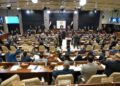


Iraq’s Federal Supreme Court on Sunday ratified the final results of the parliamentary elections held last month.
In a statement, the court said that after “review and deliberation, it was determined that the general voting process for the election of members of the Iraqi Council of Representatives had fulfilled all constitutional and legal requirements.”
It added that, “in the absence of any factors affecting their validity, the court decided to ratify the final results of the 2025 general elections for the winners of the Iraqi parliament.”
According to the constitution, the newly elected parliament, in its sixth electoral term, must convene its first session within two weeks of the ratification date. The session is to be chaired by the oldest member and will include the election of the Speaker of Parliament.
Following the first session, parliament is required to elect a president within 30 days by a two-thirds majority. The president must then, within no more than two weeks, nominate the candidate of the largest parliamentary bloc—traditionally from the Shiite community—to form the new government.
Iraq’s political forces often struggle to adhere to constitutional deadlines due to prolonged negotiations that may last for months over the selection of the country’s three top leadership positions.
Under the political norms and power-sharing system in place since 2003, the prime minister—who holds the strongest executive authority—is a Shiite politician, the Speaker of Parliament is Sunni, and the presidency, largely a ceremonial post, is held by a Kurdish politician.
Following the November 11 elections, the Coordination Framework—an alliance of influential Shiite parties—announced the formation of a single parliamentary bloc, which was joined by current Prime Minister Mohammed Shia’ Al-Sudani, whose list won the largest number of seats.
As a result, the Coordination Framework became the dominant parliamentary force and began negotiations to agree on the next prime minister. Al-Sudani hopes the alliance will nominate him for a second term, after first assuming office in 2022.
Meanwhile, leading Sunni parties are still negotiating to agree on a new Speaker of Parliament, while the two main Kurdish parties have yet to reach an agreement on a presidential candidate.