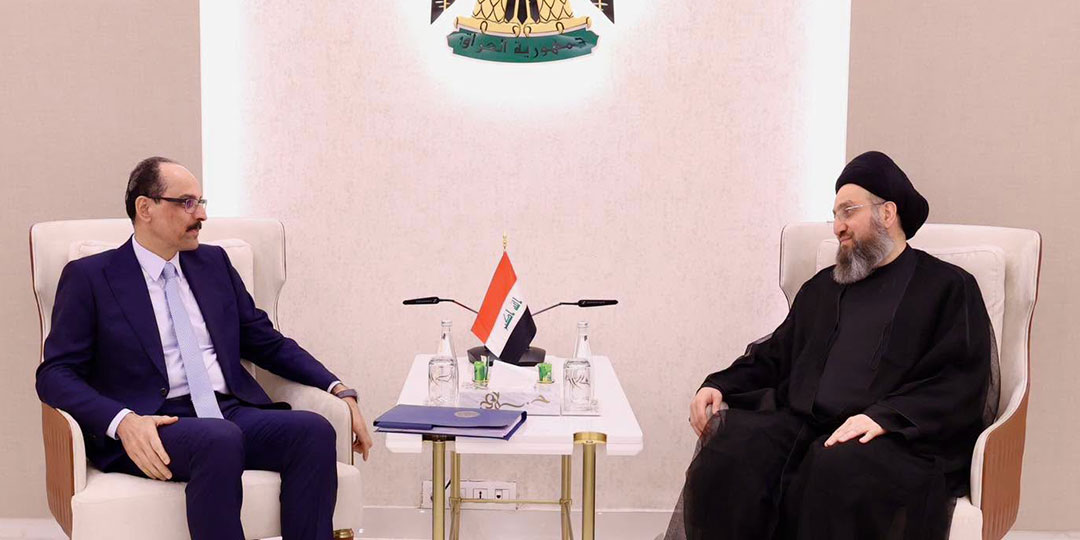

Iraq relations with neighboring countries remain a key priority, as Ammar Al-Hakim, head of the National State Forces Alliance, emphasized Baghdad’s commitment to building balanced ties and enhancing regional cooperation.
His remarks came during a meeting with Turkish intelligence chief Ibrahim Kalin and an accompanying delegation, where both sides discussed regional developments and bilateral relations.
Focus on Iraq–Turkey cooperation and shared interests
According to a statement cited by the Iraqi News Agency (INA), discussions covered ways to strengthen cooperation and expand mutual interests between Iraq and Turkey.
Al-Hakim highlighted the importance of activating joint economic projects, particularly the Development Road project, describing it as a strategic opportunity to position Iraq and Turkey as a key link between East and West.
Emphasis on sovereignty and constitutional principles
Al-Hakim stressed that Iraq seeks positive relations with neighboring countries in line with its constitution, which prohibits the use of Iraqi territory as a base for threatening other states.
He also underscored the importance of protecting national sovereignty and preventing all forms of external interference.
Cooperation in combating terrorism
Al-Hakim noted that Iraq has demonstrated its ability to defeat terrorism and restore control over its territory, calling for regional cooperation to benefit from Iraq’s experience.
He emphasized the need for joint efforts with Turkey to pursue remaining extremist elements and cut off their financial and ideological support networks.
Security coordination as a regional priority
The discussions highlighted the importance of coordinated security efforts to ensure stability across the region.
Optimism over regional de-escalation
Al-Hakim expressed optimism that a memorandum of understanding between Iran and the United States could lead to a comprehensive agreement that reduces tensions and restores regional stability.
He called on influential regional actors to support de-escalation efforts.
Economic challenges remain key domestic priority
On the domestic front, Al-Hakim stated that Iraq has overcome a period of political deadlock by forming a government and electing key leadership positions.
He pointed out that the current challenge lies in the economic sector, stressing the need to diversify income sources and expand oil export outlets to boost national revenues.
Key economic priorities
Diversifying sources of national income
Expanding oil export routes
Strengthening strategic infrastructure projects
Enhancing access to global markets
Iraq–GCC judicial cooperation discussed
In a related development, Iraq’s Supreme Judicial Council President Faiq Zaidan met with GCC Secretary-General Jasem Al-Budaiwi to discuss strengthening cooperation in judicial and legal fields.
The meeting, attended by Iraq’s ambassador to Saudi Arabia Safia Al-Suhail, focused on enhancing legal coordination between Iraq and Gulf Cooperation Council countries.
Expanding legal and institutional collaboration
The talks reflect Iraq’s broader efforts to deepen cooperation with Gulf states across institutional and legal frameworks.
Conclusion:
Iraq’s engagement with Turkey and Gulf states highlights a broader strategy to strengthen regional relations and promote stability. As Baghdad balances diplomatic outreach with internal economic priorities, cooperation across security, economic, and legal sectors remains central to its approach.