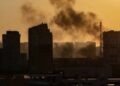
Iran missile strikes were announced Monday by both the Revolutionary Guards and the Iranian army as part of Tehran’s response to the killing of its supreme leader in US and Israeli strikes.
According to statements carried by Iranian state linked media, the attacks targeted the office of Israeli Prime Minister Benjamin Netanyahu and the US Ali Al Salem airbase in Kuwait.
The escalation marks one of the most direct confrontations involving Iran, Israel, and US military interests in the region.
Iran says Netanyahu office was targeted
The Revolutionary Guards said the operation involved Kheibar missiles aimed at what they described as key military and political sites inside Israel.
The statement, published by Fars news agency, said the Guards targeted two main locations:
• The office of Israeli Prime Minister Benjamin Netanyahu
• The headquarters of the Israeli air force commander
Tehran said the strikes were part of what it called a wider response to ongoing Israeli military actions and the assassination of Iran’s supreme leader days earlier.
Kheibar missiles and claimed impact
The Guards said Kheibar ballistic missiles were used. Iranian state media described them as long range missiles designed for high precision.
No immediate Israeli confirmation or casualty reports were available at the time of publication. Israel has previously used strict information controls during similar attacks.
Iran army says US base in Kuwait was hit
Earlier Monday, the Iranian army announced a separate missile strike on US military assets in Kuwait.
In its statement, the army said missile units from its ground and naval forces launched coordinated strikes from multiple locations.
Targets listed in the Iranian statement included:
• The US Ali Al Salem airbase in Kuwait
• US linked naval vessels stationed in the northern Indian Ocean
Cruise missiles used in Kuwait strike
The army said 15 cruise missiles were used in the operation.
No official confirmation from Kuwait or the US military was immediately available. The Pentagon typically conducts assessments before issuing statements on regional attacks.
Regional implications
The strikes come after a period of rapidly escalating tensions across the region following the killing of Iran’s supreme leader in a joint US Israeli operation according to Iranian claims.
The attacks signal Tehran’s intent to demonstrate direct retaliation against both Israeli and US targets.
For Iraq, the escalation raises regional security concerns due to proximity to both Iran and Kuwait as well as the presence of US forces inside Iraq.
Reactions expected
Analysts expect responses from Washington and Tel Aviv once damage assessments are complete.
Regional governments including Iraq, Kuwait, and Gulf states are also expected to issue security updates in the coming hours.
Conclusion:
Iran’s announcement of coordinated strikes on Israeli and US targets marks a sharp increase in regional hostilities. More information will emerge as involved countries release official statements.