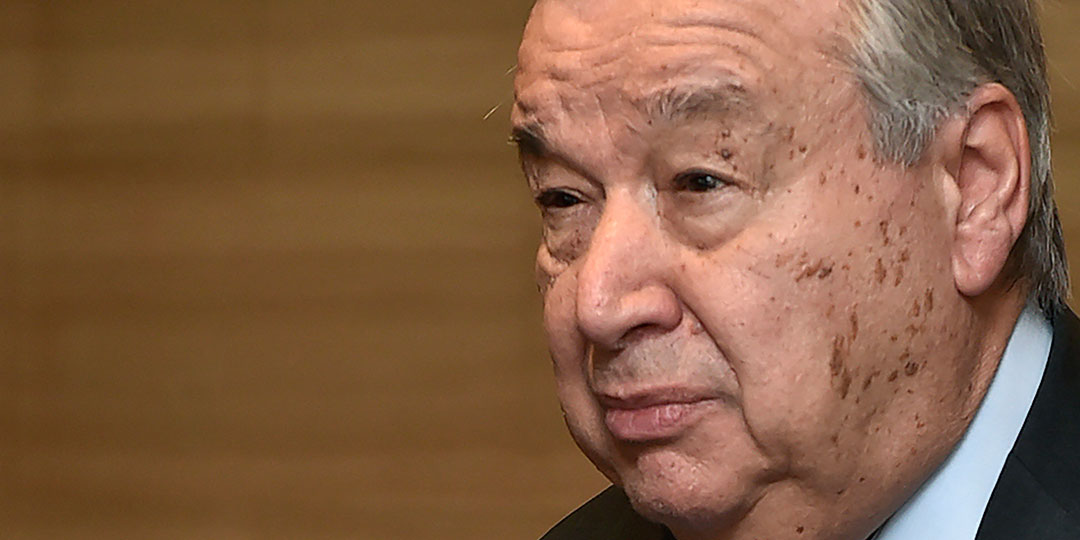

UN Secretary-General António Guterres declared Saturday from Beirut that “there is no military solution, only diplomacy and dialogue” to end the war between Hezbollah and Israel in Lebanon, while affirming that “diplomatic channels remain available.” Speaking at a press conference during his visit to the Lebanese capital, Guterres called on the international community to intensify support for the Lebanese state confronting the humanitarian catastrophe from two weeks of intensive bombardment.
Guterres’s remarks came as the death toll from airstrikes exceeded 800 people and displacement surpassed 800,000 persons since Hezbollah launched its March 2 offensive responding to the assassination of Iranian Supreme Leader Ali Khamenei. The UN chief launched an emergency $325 million funding appeal to support Lebanon’s humanitarian response while urging diplomatic engagement to halt escalating violence.
Reaffirmation of Diplomatic Possibilities Despite Active Warfare
Guterres forcefully asserted that “there is no military solution, but the solution only lies in diplomacy and dialogue” to resolve the Hezbollah-Israel dispute. He confirmed that “diplomatic channels remain available, including through my special coordinator for Lebanon and also through major member states.”
The UN chief acknowledged ongoing diplomatic outreach: “My special coordinator Janine Hennis-Plasschaert is working around the clock communicating with all parties to bring them to the dialogue table,” while “UNIFIL peacekeeping forces remain in their positions” to facilitate potential negotiations. Guterres’s emphasis on diplomatic possibilities reflected international consensus among major powers regarding the necessity of negotiated settlement despite continued military operations.
International Community Mobilization Appeal
Guterres issued a direct appeal to the international community: “My message to the international community is simple: double your efforts, empower the Lebanese state and provide it support.” The appeal reflected recognition that Lebanese state institutions require external support to manage the humanitarian emergency and provide basic services to displaced populations.
The UN chief acknowledged ongoing international efforts while calling for increased commitment: “We are doing what we can currently to achieve immediate de-escalation and cessation of hostilities,” emphasizing that sustained diplomatic pressure through multiple channels remained essential for achieving ceasefire agreements.
Launch of $325 Million Emergency Humanitarian Appeal
Guterres announced an emergency funding appeal totaling $325 million from Beirut Friday to support Lebanon’s humanitarian response to the displacement crisis. The funding targets assistance for over 800,000 registered displaced persons, with additional hundreds of thousands sheltering in temporary reception centers or with host families.
The magnitude of the appeal reflects the scale of humanitarian need: shelter, food assistance, healthcare, water and sanitation services, and psychological support for traumatized populations. The appeal acknowledges that Lebanon’s already-strained public services cannot absorb the humanitarian burden without substantial international assistance.
Humanitarian Crisis Dimensions
The humanitarian emergency encompasses multiple dimensions: displacement of approximately one in three Lebanese citizens from their homes, destruction of residential neighborhoods and infrastructure, disruption of essential services including healthcare and water supply, and psychological trauma affecting entire communities. Children comprise a significant portion of displaced persons, with particular vulnerability to malnutrition, disease, and developmental disruption.
Condemnation of Attacks on UN Peacekeeping Forces
Guterres condemned attacks on UNIFIL positions and personnel, characterizing such incidents as “absolutely unacceptable” and constituting potential violations of international law that “could constitute war crimes.” His statement followed wounding of three Ghanaian peacekeepers from UNIFIL by gunfire during the previous week in southern Lebanon.
The UN chief emphasized that attacks on peacekeeping forces constitute breaches of international humanitarian law protecting UN personnel, stating: “This must stop and constitutes a breach of international law and may be considered war crimes.” The condemnation appeared directed implicitly at Israeli military operations in proximity to UNIFIL positions rather than Hezbollah, though Guterres avoided explicit attribution.
UNIFIL Operational Status and Future Role
Guterres emphasized that UNIFIL forces “remain in their positions” despite security threats and active warfare surrounding their locations. The maintenance of UN peacekeeping presence in southern Lebanon provides potential framework for future de-escalation mechanisms and monitoring of potential ceasefire arrangements.
The UN chief’s affirmation of continued UNIFIL deployment reflected international commitment to maintaining UN institutional presence in Lebanon despite battlefield volatility and threats to peacekeeping operations.
Criticism of Israeli Evacuation Orders
Guterres criticized evacuation orders issued by the Israeli military to civilian populations in areas “containing large numbers of the most vulnerable population groups,” characterizing the orders as failing “to provide adequate civilian protection.” He asserted that any policies failing “to provide adequate civilian protection” constitute “inevitable violations of international humanitarian law.”
The UN chief’s criticism targeted the scope and implementation of evacuation orders covering 14% of Lebanon’s territory according to Norwegian Refugee Council data, creating displacement without adequate reception capacity or humanitarian support. Guterres’s implicit legal judgment suggested that evacuation orders implemented without adequate protection mechanisms may themselves constitute violations of international law protecting civilian populations.
Displacement Scale and Vulnerable Population Impact
Israeli evacuation orders have affected southern Lebanon and entire neighborhoods in southern Beirut suburbs, displacing families with limited opportunity to relocate safely or access humanitarian assistance. Vulnerable populations including elderly persons, disabled individuals, and persons with chronic medical conditions face particular hardship during forced displacement.
The scale of displacement (800,000+ registered persons) exceeds Lebanon’s internal capacity to provide shelter and services, requiring international humanitarian assistance at unprecedented scale.
Affirmation of Lebanese State Sovereignty and Weapons Monopoly
Guterres praised the Lebanese government for adopting what he characterized as a “historic decision” in August 2025 “to establish state monopoly over weapons throughout the country,” adding that the UN would continue “supporting efforts to strengthen the capabilities of the Lebanese Army and other state security apparatuses.”
The UN chief’s affirmation of Lebanese government authority and state monopoly over armed forces represented implicit endorsement of the government’s efforts to disarm Hezbollah and assert state control over security institutions. This positioning aligned Guterres with Lebanese President Joseph Aoun’s stated objective of eliminating non-state armed actors.
Constraints on Lebanese Government Implementation
While Guterres affirmed Lebanese government sovereignty and stated objectives, practical implementation of state monopoly on weapons remains constrained by Hezbollah’s military capacity and organizational independence. The government’s ability to enforce disarmament without external military support or negotiated settlement appears limited, creating tension between international affirmations of state authority and actual security dynamics.
International Legal Accountability Framework
Guterres’s repeated references to international humanitarian law violations and potential war crimes reflected emerging international legal accountability frameworks surrounding the Lebanon conflict. The UN chief’s statements created a record of official international concern regarding compliance with international legal obligations, potentially supporting future accountability mechanisms or International Criminal Court investigations.
The emphasis on international humanitarian law compliance applies theoretically to all belligerents including Hezbollah, though Guterres’s specific criticisms targeted Israeli military operations and evacuation policies.
Turkish Regional Concerns and Genocide Allegations
Turkish Foreign Minister Hakan Fidan expressed “serious concern” Saturday regarding continued Israeli airstrikes on Lebanon, stating fears that Israel may commit “new genocide” under the pretext of fighting Hezbollah. Fidan called on the international community to “take immediate action.”
Turkey’s characterization of potential Israeli operations as genocide represented escalating regional concern regarding civilian protection standards and the humanitarian toll of intensive bombardment campaigns. The genocide allegation, while inflammatory, reflected regional assessments that civilian casualty levels and displacement scales may constitute violations of genocide conventions prohibiting intent to destroy populations.
Regional Diplomatic Positioning
Turkish concerns regarding potential genocide and calls for international action position Ankara as regional voice advocating for stronger international intervention mechanisms. Turkey’s statements may reflect both genuine humanitarian concern and strategic positioning regarding regional power dynamics and potential post-conflict political arrangements in Lebanon.
Diplomatic Pressure Context Amid Continuing Intensive Warfare
Guterres’s emphasis on diplomatic channels and ceasefire possibilities occurs amid continuing intensive Israeli airstrikes, Hezbollah rocket attacks, and displacement of civilian populations. The timing of diplomatic appeals during active warfare reflects international recognition that early diplomatic intervention may prevent further escalation while military stalemate develops.
The diplomatic efforts represent attempts to prevent Lebanon conflict from expanding into broader regional war involving additional states or expanded scale of operations.
Lebanese Government Position and Diplomatic Constraints
The Lebanese government has proposed direct negotiations with Israel, but these proposals have received no Israeli response. The government remains constrained in its ability to compel Hezbollah compliance with disarmament or ceasefire arrangements without external military or diplomatic support. Guterres’s calls for international support reflect recognition that Lebanese state capacity requires external reinforcement.
Broader Regional Context of Conflict
The Lebanon war represents extension of broader Middle Eastern conflict following US-Israeli air campaign against Iran. Regional states confronting direct Iranian retaliation face pressure to balance humanitarian concerns with geopolitical alignment. Diplomatic efforts to contain the Lebanon conflict to bilateral Israeli-Hezbollah dimensions reflect international concern regarding potential regional expansion.
Timeframe and Urgency of Diplomatic Engagement
Guterres’s repeated emphasis on diplomatic urgency and open channels reflects international assessment that continued warfare creates window for diplomatic intervention before military stalemate hardens and mutual destruction increases. Early diplomatic initiatives may prevent later escalation scenarios involving ground operations or expanded targeting of civilian infrastructure.
Comparison to Venezuelan Precedent and International Mediation Models
Guterres’s diplomatic approach reflects UN precedents for managing regional conflicts through sustained engagement and multilateral mediation. The emphasis on maintaining UN peacekeeping presence while pursuing diplomacy follows established frameworks for conflict de-escalation and ceasefire negotiation.
Conclusion:
UN Secretary-General Guterres’s Beirut visit and diplomatic statements affirm that international consensus recognizes military solutions insufficient for resolving the Lebanon conflict, while diplomatic channels remain theoretically available for negotiated settlement. The $325 million emergency appeal acknowledges humanitarian catastrophe requiring international assistance regardless of conflict outcome. Turkish allegations regarding potential genocide and Guterres’s criticism of Israeli military policies regarding civilian protection establish international legal record regarding humanitarian law compliance. The diplomatic initiative proceeds amid continuing intensive warfare, suggesting international hope for early de-escalation before military conflict produces further civilian casualties and economic destruction.