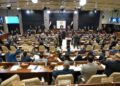
French Prime Minister Sebastien Lecornu on Friday forced the government’s 2026 budget through parliament without a vote, utilizing a special constitutional power amid ongoing political deadlock and signs of a slowing economy.
The move, which invokes Article 49.3 of the constitution, allows the government to bypass the National Assembly for the third and final time on the finance bill. The decision exposes Lecornu’s government to no-confidence motions from opposition parties, which are expected to be debated on Monday.
“France must have a budget. And so, before this chamber, I am committing the government’s responsibility for the entire Finance Bill for 2026,” Lecornu stated in the assembly.
The political maneuver comes as new data from the INSEE statistics office revealed that the French economy grew by only 0.9 percent in 2025, a decrease from the 1.1 percent growth recorded in 2024. The slowdown was particularly evident in the fourth quarter of last year, when GDP rose just 0.2 percent, coupled with a decline in household spending.
The 2026 budget aims to reduce the public deficit to five percent of GDP from 5.4 percent in 2025 and includes a significant €6.5 billion increase in defense spending. To navigate the hung parliament, Lecornu’s government made several concessions to gain the backing of the Socialists, including financial aid for students and low-income workers.
The political instability stems from the 2024 snap election called by President Emmanuel Macron, which resulted in his government losing its parliamentary majority. Prime Minister Lecornu has survived previous no-confidence votes in recent weeks related to earlier sections of the budget. If he survives the upcoming votes, the budget will be definitively adopted.